The false title page (1686)
French: vol. 1, title page, scan.
Philosophical Commentary on these words of Jesus Christ, Compel them to come in; in which it is proved by several demonstrative reasons that nothing is more abominable than to make conversions by constraint, and all the sophisms of the forcing converters are refuted, together with St Augustine’s apology for persecutions. Translated from the English of Mr John Fox of Bruggs by M. J. F. At Canterbury, printed for Thomas Litwel. 1686.
Original French
Commentaire philosophique sur ces paroles de Jésus-Chrit Contrain-les d’entrer ; où l’on prouve par plusieurs raisons démonstratives qu’il n’y a rien de plus abominable que de faire des conversions par la contrainte, et l’on réfute tous les sophismes des convertisseurs à contrainte, et l’Apologie que S. Augustin a faite des persécutions. Traduit de l’Anglois du Sieur Jean Fox de Bruggs par M. J. F. À Cantorbery, chez Thomas Litwel. 1686.
The title page spells “Jésus-Chrit” (sic) and “Contrain-les d’entrer”. Lecky’s “par M. J. F.” and “Jean Fox de Bruggs” agree with the print; “Fox de Bruggs” is Bayle’s joke on “Fox of Bruges”. The imprint is a fiction; Canterbury is not where the book was printed (I give this from memory, not from the scan).
Part I, chapter I: natural light as the rule of Scripture (pp. 11, 27)
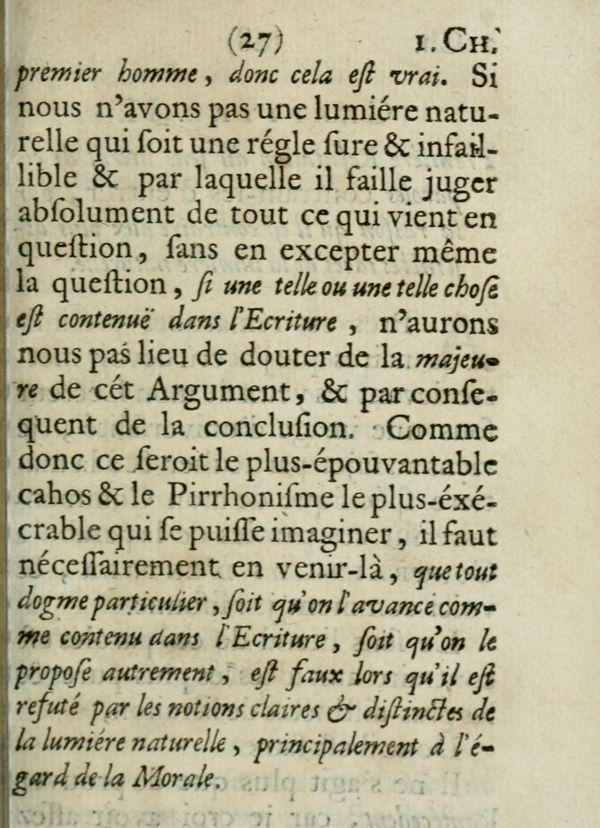
French: vol. 1, p. 11 (scan) and p. 27 (scan), Part I, chapter I (“Que la lumière naturelle, ou les principes généraux de nos connoissances, sont la règle matrice et originale de toute interprétation de l’Écriture en matière de mœurs principalement”). Spelling as printed, long s modernised. Highlighted: the words Lecky quotes in Chapter IV (continued), note 78.
[p. 11] I repeat it once more: God forbid that I should wish to extend this principle as far as the Socinians do; but if it may have certain limits with regard to speculative truths, I do not think it ought to have any with regard to the practical and general principles that relate to morals. I mean that without exception all moral laws must be submitted to that natural idea of equity which, like the metaphysical light, lighteth every man that cometh into the world.
[p. 27] … Since, then, that would be the most frightful chaos and the most execrable Pyrrhonism that can be imagined, we must necessarily come to this: that every particular dogma, whether it is put forward as contained in Scripture or proposed otherwise, is false when it is refuted by the clear and distinct notions of natural light, above all with regard to morals.
Original French
[p. 11] Je le répète encore une fois ; A Dieu ne plaise que je veüille étendre ce principe autant que font les Sociniens, mais s’il peut avoir certaines limitations à l’égard des véritez speculatives, je ne pense pas qu’il en doive avoir aucune à l’égard des principes practiques et généraux qui se raportent aux mœurs. Je veux dire que sans exception, il faut soumettre toutes les loix morales à cette idée naturelle d’équité, qui, aussi-bien que la lumière Métaphisique illumine tout homme venant au monde.
[p. 27] … Comme donc ce seroit le plus-épouvantable cahos et le Pirrhonisme le plus-exécrable qui se puisse imaginer, il faut nécessairement en venir-là, que tout dogme particulier, soit qu’on l’avance comme contenu dans l’Ecriture, soit qu’on le propose autrement, est faux lors qu’il est refuté par les notions claires et distinctes de la lumière naturelle, principalement à l’égard de la Morale.
Lecky’s quotations are accurate, in modernised spelling (“lois” for “loix”, “lorsqu’il” for “lors qu’il”; his “soummettre” is a misprint for “soumettre”). The italic “illumine tout homme venant au monde” is John 1:9, which Bayle applies to natural reason.
Part I, chapter V: a fleet from the Southern Land (pp. 76–77)
French: vol. 1, pp. 76–77, scan n177–n178, Part I, chapter V. Bayle has just imagined the Pope’s missionaries arriving in China; this is the principle he asks the reader to grant. Highlighted: Lecky’s quotation (note 79).
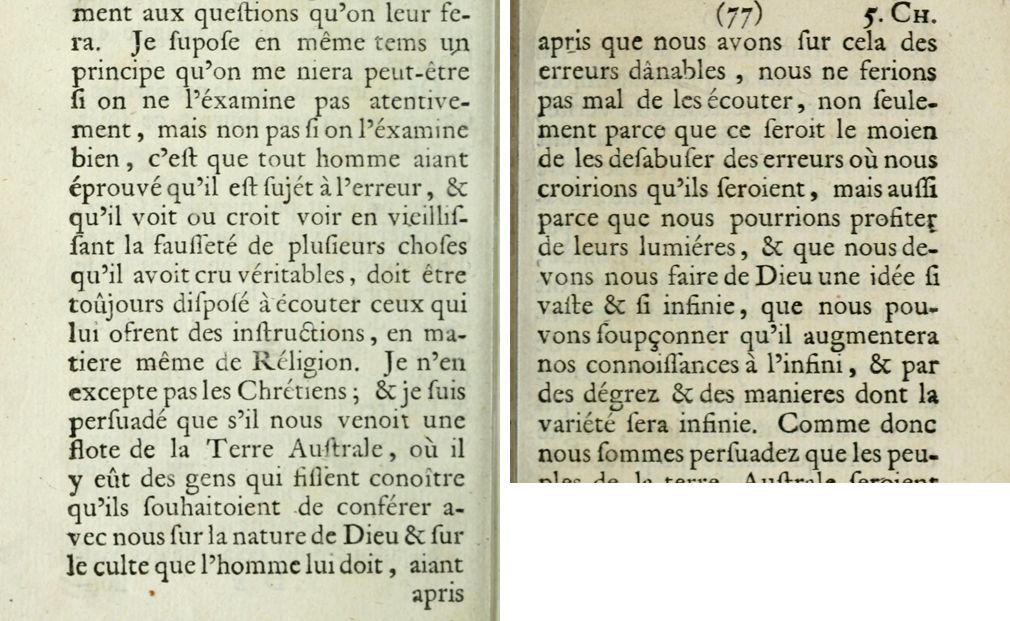
… At the same time I assume a principle which may be denied me if it is not examined attentively, but not if it is examined well: that every man, having found that he is liable to error, and seeing, or thinking he sees, as he grows older the falsity of many things he had believed true, ought always to be ready to listen to those who offer him instruction, even in matters of religion. I do not except Christians; and I am persuaded that if a fleet came to us from the Southern Land, with people who let it be known that they wished to confer with us about the nature of God and the worship man owes him, having heard that we hold damnable errors on the subject, we should do well to listen to them: not only because it would be the means of freeing them from the errors we should think them to be in, but also because we might profit by their light, and because we ought to form so vast and infinite an idea of God that we may suspect he will increase our knowledge infinitely, by degrees and in ways of infinite variety. Since, then, we are persuaded that the peoples of the Southern Land would be obliged to listen to our missionaries …, we must believe that we should be under the same obligation towards the fleet I speak of …
Translation: this edition’s draft (as in Lecky’s note).
Original French
… Je supose en même tems un principe qu’on me niera peut-être si on ne l’examine pas atentivement, mais non pas si on l’examine bien, c’est que tout homme aiant éprouvé qu’il est sujet à l’erreur, & qu’il voit ou croit voir en vieillissant la fausseté de plusieurs choses qu’il avoit cru véritables, doit être toûjours disposé à écouter ceux qui lui ofrent des instructions, en matiere même de Religion. Je n’en excepte pas les Chrétiens; & je suis persuadé que s’il nous venoit une flote de la Terre Australe, où il y eût des gens qui fissent conoître qu’ils souhaitoient de conférer avec nous sur la nature de Dieu & sur le culte que l’homme lui doit, aiant [p. 77] apris que nous avons sur cela des erreurs dânables, nous ne ferions pas mal de les écouter, non seulement parce que ce seroit le moien de les desabuser des erreurs où nous croirions qu’ils seroient, mais aussi parce que nous pourrions profiter de leurs lumiéres, & que nous devons nous faire de Dieu une idée si vaste & si infinie, que nous pouvons soupçonner qu’il augmentera nos connoissances à l’infini, & par des dégrez & des manieres dont la variété sera infinie. Comme donc nous sommes persuadez que les peuples de la terre Australe seroient dans l’obligation d’écouter nos Missionnaires …, nous devons croire que nous serions dans la même obligation à l’égard de la flote dont je parle …
Lecky’s quotation (vol. II, ch. IV, note 79, “Part i. c. 5”) is exact in substance, with modernised spelling (“toujours”, “offrent”, “flotte”, “connoître”, “damnables”) and one slip: he prints “de instructions” where Bayle has “des instructions” (checked on Lecky’s page, vol. II p. 69). The “Terre Australe” was the great southern continent that geographers still expected to find.
Part II, chapter IV: the objection from the Mosaic law (p. 295)
French: vol. 2, p. 295, scan. Heading and opening only.
Chapter IV. Fourth objection: one cannot condemn the literal sense of these words “Compel them to come in” without condemning at the same time the laws that God established among the Jews, and the conduct the Prophets have sometimes held. Difference, and particular reasons for the old law, which have no place under the Gospel.
Before putting this objection I think myself bound to say two words on a scruple that might arise in the minds of some persons. It will seem, they will say, that I wish to maintain that there are only two paths to take towards heretics, that of putting them to death, or that of abandoning them to their errors …
Original French
Chapitre IV. Quatriéme objection ; on ne peut condanner le sens literal de ces paroles Contrain-les d’entrer, sans condanner en même-tems les loix que Dieu a établies parmi les Juifs, et la conduite que les Prophetes ont quelquefois tenüe. Disparité et raisons particulieres pour l’ancienne loi qui n’ont point lieu sous l’Evangile.
Avant que de proposer cette objection je me crois obligé de dire deux mots sur un scrupule qui se pourroit élever dans l’ame de quelques personnes. Il semble dira-t-on, que je veuille soutenir qu’il n’y a que 2. chemins à prendre envers les Hérétiques, celui de les faire mourir, ou celui de les abandonner à leurs erreurs …
This is the chapter Lecky cites in note 7 for “the influence of this command [the Levitical penalty for idolatry] on Christian persecution”. The heading shows that Bayle treats the Mosaic laws as an objection to be answered, not as the cause of persecution; whether the chapter also says that Christians were led by them to persecute I have not read.
Editor’s notes on this page
Lecky’s note 76 gives the false imprint accurately in substance: “Traduit de l’Anglois du Sieur Jean Fox de Bruggs, par M. J. F.”, “À Cantorbery, chez Thomas Litwel”. On the title page of the first edition it reads “Traduit de l’Anglois du Sieur Jean Fox de Bruggs par M. J. F.” and “A Cantorbery. Chez Thomas Litwel. 1686”, with the full title “Commentaire philosophique sur ces paroles de Jésus-Christ Contrain-les d’entrer”. Lecky’s “k Cantorberry” has a misprinted “à” and an extra “r” in “Cantorbery”.
Note 7 refers to “pt. ii. ch. iv.”; in this edition, Part II chapter IV (p. 295) is headed “Quatrième objection; on ne peut condamner le sens littéral de ces paroles Contrain-les d’entrer, sans condamner en même temps les loix que Dieu a établies parmi les Juifs, et la conduite que les Prophètes ont quelquefois tenue. Disparité et raisons particulières pour l’ancienne loi qui n’ont point lieu sous l’Évangile”, which is Bayle’s answer to the argument from the law of Moses.
Further down the rabbit hole
Sources that Lecky cites in the notes next to the ones that cite this page.
- Simancas, De Catholicis InstitutionibusAn inquisitor’s handbook: no faith with heretics, and torture
- Taylor, A Discourse of the Liberty of ProphesyingLecky quotes Taylor accurately on water and Spirit
- Bossuet, Histoire des variations des Églises protestantesWhat Lecky leaves out of Bossuet on punishing heretics
- Hallam, Literature of Europe and Constitutional HistoryHow Lecky quotes Hallam on persecution
- Rousseau, Du contrat socialWhy civil and theological intolerance cannot be split
- Rogers, RecollectionsCharles James Fox at table: “The only foundation for toleration is a degree of scepticism”
Backlinks
Every place in Rationalism in Europe that links to this page (generated automatically when the site is built).