From the cabinet of curiosities
- The Devil as a mature student. Seventeenth-century Scottish divines taught that Satan’s cunning grew with age: “having been studying for more than five thousand years, he had now attained to unexampled dexterity”, as Buckle summed them up. Buckle →
- The stag that sucks snakes. Why was the stag a symbol of Christ? Because, Origen reported, it smells out where serpents hide and draws them from their holes with its breath; then it is so thirsty that if it goes three hours without water it dies. Maury →
- The sun is hell. An Anglican clergyman reasoned that the sun is large enough and hot enough to hold the damned of all ages, and concluded that it is “the Tartarus or Local Hell”. Swinden →
Newly added sources
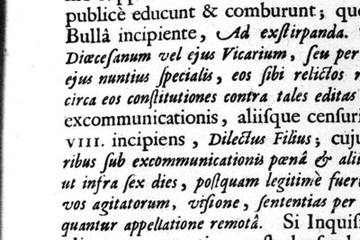
- Limborch, Historia InquisitionisSix days to burn the heretic, or be excommunicated
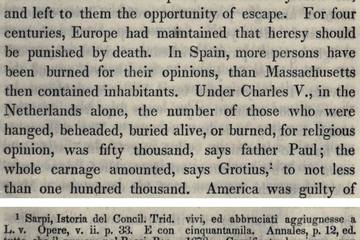
- Bancroft, History of the United States, vol. IHanging Quakers in Boston, and where Lecky’s 50,000 Dutch martyrs came from
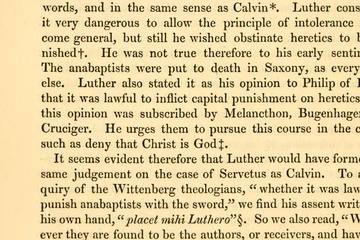
- Henry, The Life and Times of John Calvin, vol. II“Placet mihi Luthero”: Luther signs for the sword
- Lecky, The Leaders of Public Opinion in Ireland (1861)Lecky’s first book, which he cites without naming himself
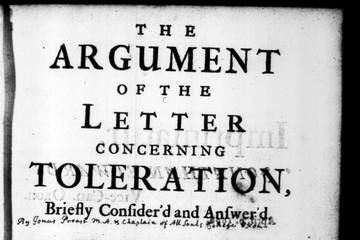
- Proast, The Argument of the Letter concerning TolerationLocke’s Oxford opponent, licensed by the Vice-Chancellor
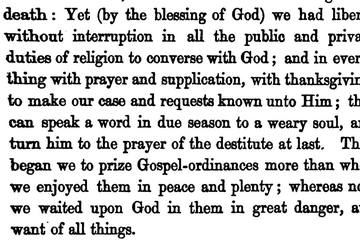
- Clogy, Memoir of Bishop BedellA Protestant bishop, held by Catholic rebels, keeps Gunpowder Day
William Edward Hartpole Lecky was born in Dublin in 1838 and died in 1903. He is best known for two large works of intellectual and moral history, The History of the Rise and Influence of the Spirit of Rationalism in Europe (1865) and A History of European Morals from Augustus to Charlemagne (1869), along with his later and more extensive A History of England in the Eighteenth Century. His historical method, tracing the slow retreat of superstition, persecution, and dogmatic certainty before the advance of a more sceptical, humane rationalism, makes his work unusually dense with citation: he draws constantly on primary sources, many of them obscure even in his own day.
That density of citation is the reason this site exists. Reading Lecky well means being able to follow him into his sources. Our aim is a site where that following-along is frictionless: hover a reference to see what it is, click through to read it, and keep going as deep as curiosity allows.
Available now
-
1865, two volumes. The whole text, with Lecky’s 850 footnotes; 565 of them now link to a source page. Lecky’s index is not transcribed. See About.
Planned
A History of European Morals from Augustus to Charlemagne · A History of England in the Eighteenth Century · Democracy and Liberty · The Map of Life, and Lecky’s shorter essays.