“Placet mihi Luthero” (vol. II, p. 236)
English: London 1849, vol. II, p. 236, scan n249. Henry’s footnotes give his sources: De Wette’s edition of Luther’s letters, t. iii. s. 347; the Altenburg edition of Luther’s works, t. v. s. 286, and the German exposition of Psalm 82; and, for the Wittenberg opinion, Heidelberg University Library, cod. 435, bl. 33. Highlighted: what Lecky’s note reports.
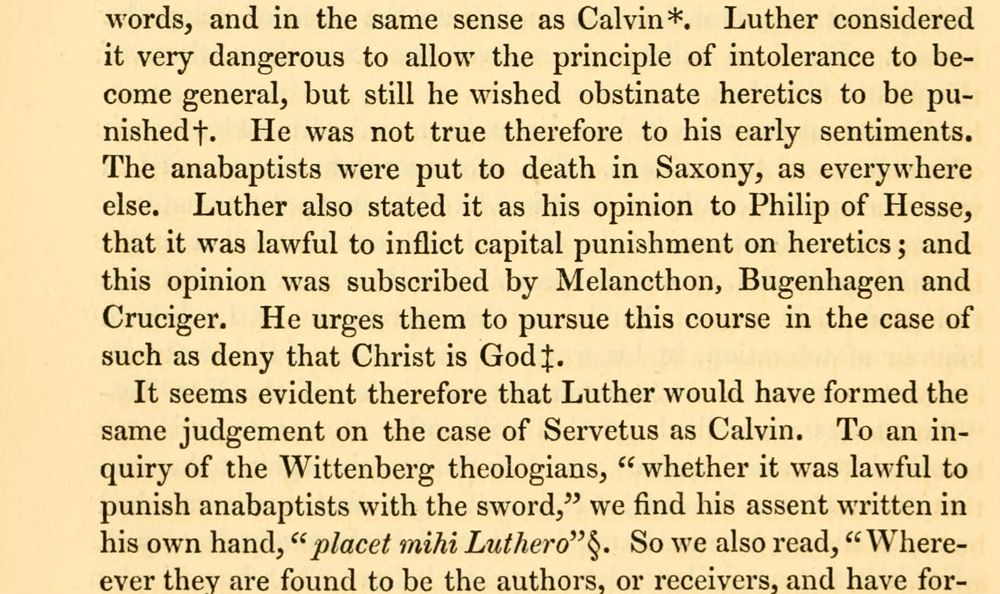
… Luther considered it very dangerous to allow the principle of intolerance to become general, but still he wished obstinate heretics to be punished. He was not true therefore to his early sentiments. The anabaptists were put to death in Saxony, as everywhere else. Luther also stated it as his opinion to Philip of Hesse, that it was lawful to inflict capital punishment on heretics; and this opinion was subscribed by Melancthon, Bugenhagen and Cruciger. He urges them to pursue this course in the case of such as deny that Christ is God.
It seems evident therefore that Luther would have formed the same judgement on the case of Servetus as Calvin. To an inquiry of the Wittenberg theologians, “whether it was lawful to punish anabaptists with the sword,” we find his assent written in his own hand, “placet mihi Luthero.” So we also read, “Wherever they are found to be the authors, or receivers, and have forbidden articles, they may be capitally punished, as those who have instituted conventicles, against the mandates which have been publicly issued.”
Lecky’s detail that Luther’s earlier tolerance came “when his translation of the New Testament was proscribed” is not on this page; Henry says only that he was untrue to “his early sentiments”.
Further down the rabbit hole
Sources that Lecky cites in the notes next to the ones that cite this page.
- Hallam, Literature of Europe and Constitutional HistoryHow Lecky quotes Hallam on persecution
- Beza, De haereticis a civili magistratu puniendisBeza’s “gates of hell” answer to Bellius
- Castellio, Traité des hérétiquesLecky quotes only the first third of the passage
- Knox, The AppellationWhy the English should have put Queen Mary to death
- Montaigne, EssaisLecky cuts Montaigne short and changes a word
- M’Crie, Life of John Knox“One mass is more fearful to me than ten thousand armed enemies”, and the biographer who excused it

Backlinks
Every place in Rationalism in Europe that links to this page (generated automatically when the site is built).