“America was guilty of the death of four individuals” (p. 455)
English: Boston 1846, vol. I, ch. X, p. 455, scan n484, with Bancroft’s footnote. Highlighted: the figures that reappear in Lecky’s note 38.
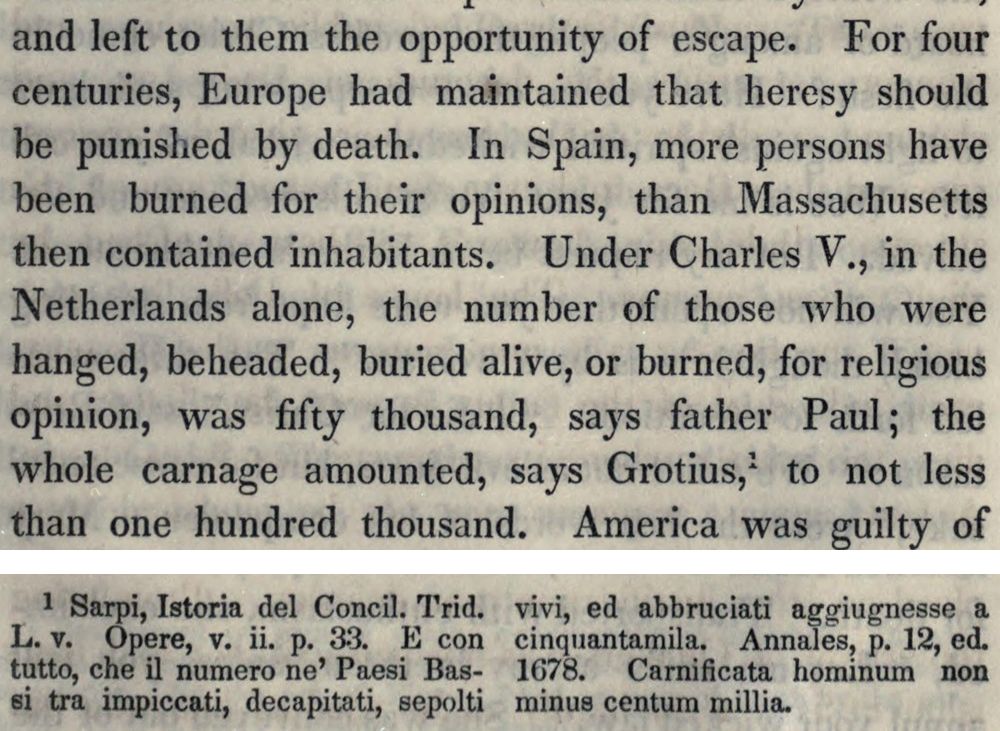
… The ship suspected of infection might sail for another port; and the Quaker, if he came once, was sent away; if he came again, was sentenced to death, and then might still quit the jurisdiction on a promise of returning no more. Servetus did but desire leave to continue his journey. The inquisition hearkened to secret whispers for grounds of accusation; the magistrates of Massachusetts left all in peace but the noisy brawlers, and left to them the opportunity of escape. For four centuries, Europe had maintained that heresy should be punished by death. In Spain, more persons have been burned for their opinions, than Massachusetts then contained inhabitants. Under Charles V., in the Netherlands alone, the number of those who were hanged, beheaded, buried alive, or burned, for religious opinion, was fifty thousand, says father Paul; the whole carnage amounted, says Grotius, to not less than one hundred thousand. America was guilty of the death of four individuals; and they fell victims [p. 456] rather to the contest of will, than to the opinion that Quakerism was a capital crime.
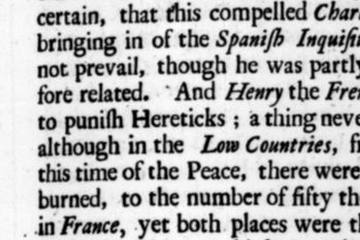
Bancroft’s footnote: “Sarpi, Istoria del Concil. Trid. L. v. Opere, v. ii. p. 33. E con tutto, che il numero ne’ Paesi Bassi tra impiccati, decapitati, sepolti vivi, ed abbruciati aggiugnesse a cinquantamila. Annales, p. 12, ed. 1678. Carnificata hominum non minus centum millia.” (Sarpi: “And although the number in the Low Countries of those hanged, beheaded, buried alive and burned reached fifty thousand”; Grotius: “a slaughter of men not less than a hundred thousand”. Translation: this edition’s draft. Grotius not checked.)
Lecky (vol. II, ch. IV, text at note 38): “The number of those who were put to death for their religion in the Netherlands alone, in the reign of Charles V. has been estimated by a very high authority at 50,000”; note 38: “Sarpi, Hist. of Council of Trent. Grotius says 100,000.” For Lecky the Quakers were persecuted “with atrocious severity”; for Bancroft, whose purpose on this page is to set the colony’s four deaths against Europe’s thousands, the law was atrocious but the executions few.
“Banished them on pain of death” (pp. 453–454, from the OCR)
English: Boston 1846, vol. I, p. 453, scan n482; transcribed from the OCR, not checked on the image.
… a Quaker, after the first conviction, was to lose one ear, after the second another, after the third to have the tongue bored with a red-hot iron. It was but for a very short time, that the menace of these enormities found place in the statute-book. The colony was so ashamed of the order for mutilation, that it was soon repealed, and was never printed. … The government of Massachusetts at length resolved to follow the advice of the commissioners for the united colonies; from which the younger Winthrop alone had dissented. Willing that the Quakers should live in peace in any other part of the wide world, yet desiring to deter them effectually from coming within its jurisdiction, the general court, after much resistance, and by a majority of but a single vote, banished them on pain of death.
Further down the rabbit hole
Sources that Lecky cites in the notes next to the ones that cite this page.
- Sarpi, History of the Council of Trent, Book VWhere Lecky’s figure of 50,000 Dutch martyrs comes from
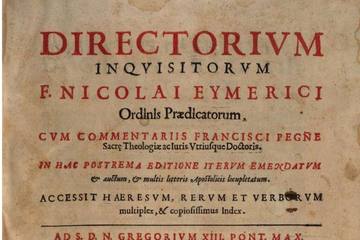
- Eymericus, Directorium inquisitorumLecky cuts the sequel to the Barcelona burning
- Buckle, History of Civilization in EnglandWeather and credulity, and the Scottish clergy’s Devil who had been studying for five thousand years
- Llorente, Histoire critique de l’Inquisition d’EspagneHow many did the Spanish Inquisition burn? Its former secretary counts
- Macaulay, History of England and EssaysMacaulay on Puritans, bear-baiting and the servile Church
- Motley, The Rise of the Dutch RepublicThree million people sentenced to death in three lines

Backlinks
Every place in Rationalism in Europe that links to this page (generated automatically when the site is built).