“Great Is the Power of Deceit” (Book I, ch. VIII)
English: Cowper’s translation, London 1866, pp. 19 and 24–25 (image index n46, n51–n52). Paragraph numbers are Cowper’s. Highlighted: the sentences that come closest to what Lecky describes. The first extract is Chrysostom’s statement of principle; the second comes after his examples (generals, the physician and the patient, pp. 19–24, not transcribed here).
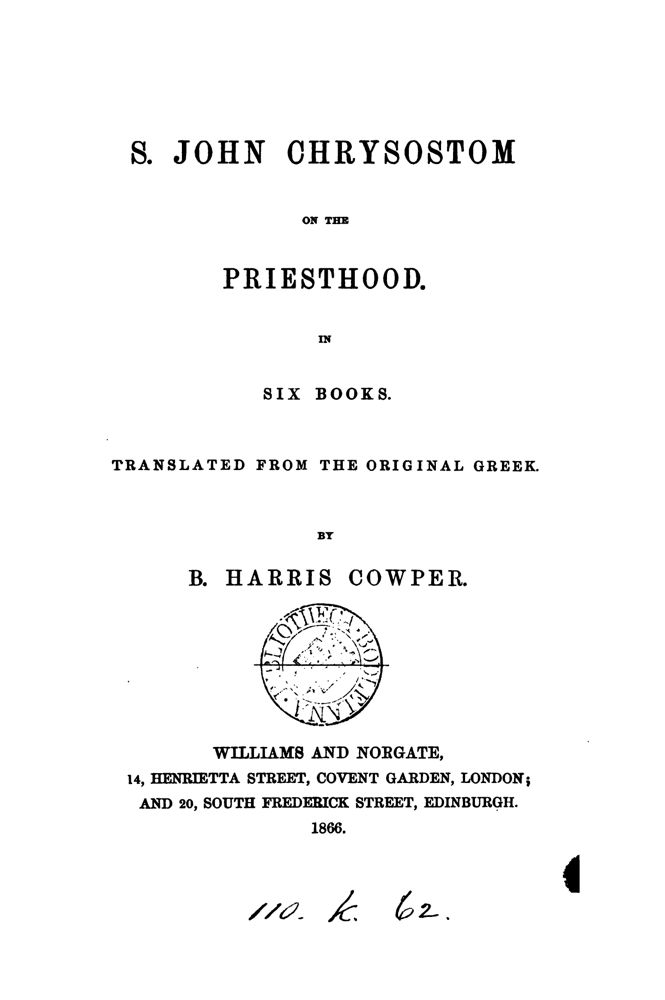
57. If indeed all guile be evil, and one is never to employ it when expedient, I am prepared to pay what penalty you will; or rather, since you will never bear to inflict punishment upon me, I shall pronounce on myself the same sentence as judges pronounce upon criminals when the plaintiffs carry conviction.
58. But if an act be not always wrong, but becomes bad or good according to the motive of the doer, cease to accuse me for deceiving, and show that I devised it for evil; …
[pp. 19–24: the argument from generals, from the physician who tricked a feverish patient into drinking water from a wine-scented cup, and so on.]
73. Do you see the benefit of deceit? and if one would enumerate all the frauds of physicians his discourse would run to an unlimited length.
74. We may say, that this remedy has been continually employed, not only by those who heal the body, but by those who have the care of spiritual diseases. In this way the blessed Paul attracted those many myriads of Jews; with this intention he circumcised Timothy, who yet admonished the Galatians that Christ will profit nothing such as are circumcised; and for this cause he became subject to the law, who accounted the righteousness which is by the law, a loss when one has faith in Christ.
[75]. Great is the power of deceit, provided it be not had recourse to with a crafty intention: or rather, such ought not to be called deceit, but a sort of good management, and wisdom, and skill which can invent many resources where resources fail, and can correct the errors of the mind.
The printed paragraph number of the last paragraph is “15”, an evident misprint for 75 (it follows 74 and precedes 76), which is why it is bracketed. The sentence breaks across pp. 24–25 at “or rather,”. Spelling and punctuation as printed.
Context, and what I have not checked
In this part of the dialogue Basil complains that Chrysostom had deceived him over their agreed decision about the priesthood; the passage above is Chrysostom’s defence. I have read only these extracts and the sentences around them on the page images, not the whole of Book I, so I do not claim to summarise the trick itself.
Chrysostom’s argument depends on the intention of the deceiver (“provided it be not had recourse to with a crafty intention”) and on his renaming good deception as “management” (the Greek is, I believe, oikonomia, but I have not checked the Greek). Later readers have long discussed whether this is a licence to lie; that is a separate question from what Lecky says.
Lecky’s Description Compared
| Lecky (ch. IV, note 37) | Chrysostom | Comment |
|---|---|---|
| “the curious panegyric on the habit of telling lies in St. Chrysostom On the Priesthood” | “Great is the power of deceit, provided it be not had recourse to with a crafty intention”; deceit is not wrong in itself but is “bad or good according to the motive of the doer”. | “Panegyric” is fair for the praise of deceit’s usefulness. “Habit of telling lies” is Lecky’s gloss: Chrysostom defends deception for a good end, in particular against a friend’s reproach, and says it should not be called deceit at all. Lecky gives no book or chapter. |
Editor’s notes on this page
In note 37 Lecky refers to “the curious panegyric on the habit of telling lies in St. Chrysostom On the Priesthood”. The only passage in that work I can find that fits is Book I, chapter VIII. There Chrysostom, accused by Basil of having deceived him, argues that deceit is not wrong in itself but becomes good or bad according to the intention of the deceiver, and then lists generals’ stratagems, a physician’s trick on a feverish patient, and St. Paul’s circumcision of Timothy as examples of its use.
The passage is a defence of deceit with a good purpose. It is not, as Lecky’s phrase suggests, a praise of lying as a habit. His wording is a hostile summary, though not an invention: Chrysostom does say “Great is the power of deceit”.
Further down the rabbit hole
Sources that Lecky cites in the notes next to the ones that cite this page.
- Augustine, Contra mendaciumAugustine rejects lying even to catch heretics
- Maury, Croyances et légendes de l’antiquitéPious frauds “fair play against heretics”, and the woman Simon Magus called the Thought of God
- Simancas, De Catholicis InstitutionibusAn inquisitor’s handbook: no faith with heretics, and torture
- Newman, Apologia pro Vita SuaWhen is an untruth not a lie? Newman’s answer, and the emphasis Lecky added
- Laing, Notes of a Traveller on the Social and Political State of France, Prussia, Switzerland, ItalyThe Swiss, moral in conduct yet irreligious
- Edwards, Freedom of the WillThe great Calvinist concedes that God is “the Author of Sin”, in a sense
Backlinks
Every place in Rationalism in Europe that links to this page (generated automatically when the site is built).
- Chapter IV, Part I: note 37