Lulli burns his opera (p. 28)
English: p. 28, scan.
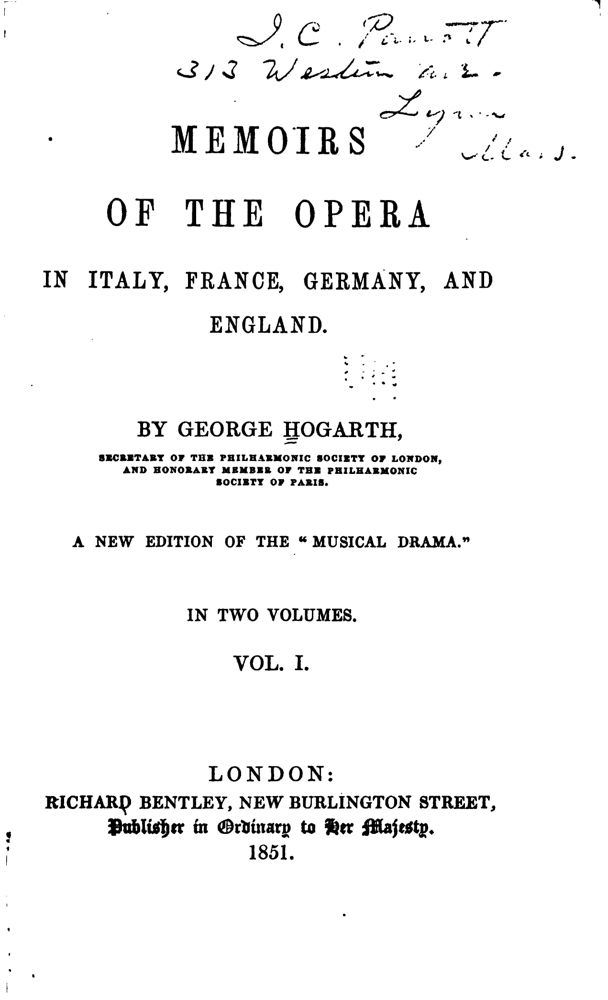
… But all their attempts were vain; and his case became evidently hopeless. His confessor refused to give him absolution, unless he burned his opera of Achille et Polixene, which he was then preparing for the stage. He consented, and the manuscript was committed to the flames. Some days afterwards, when he had seemed a little better, one of the young princes came to see him. “What, Baptiste,” cried the prince, “have you been such a fool as to burn your opera?”—“Hush, my lord,” whispered Lulli, “I have got a copy of it.” It is said, however, that in his last moments he showed sincere penitence and a strong sense of religion. He died on the 22nd March, 1687, in the 54th year of his age. …
Lecky: “Lulli, the first great musical composer of France, could only obtain absolution by burning an opera he had just composed.” Hogarth says “which he was then preparing for the stage”, not “had just composed”, and tells the story with its ending; Lecky’s “first great musical composer of France” is his own phrase.
The Orfeo of Politian (pp. 7–8)
English: p. 7, scan; p. 8, scan.
… Perhaps the Orfeo of the celebrated poet and scholar Politian, may be regarded as the lineal progenitor of the Italian opera. It is to be found in the Parnaso Italiano; and is a drama in five acts, founded on the ancient tale of Orpheus and Eurydice. … This drama, which is very short, seems intended to have been wholly sung, the poetry being of a lyrical kind and finely adapted to the purposes of music. It must have been written towards the end of the fifteenth century, as Politian, who is celebrated as one of the revivers of learning, died in 1494, at the age of forty.
Lecky’s “earliest instance of a secular musical drama” is a stronger statement than Hogarth’s “perhaps … may be regarded as the lineal progenitor”, and the Cardinal Gonzaga of Mantua is not mentioned on these pages.
Editor’s notes on this page
Note 148 is accurate: on p. 28 Hogarth says Lulli’s confessor refused absolution unless he burned the manuscript of Achille et Polixène; Lulli agreed, and Hogarth adds the sequel (“I have got a copy of it”), which Lecky omits.
Note 131 cites Hogarth for the Orfeo of Politian, “the earliest instance of a secular musical drama … acted in the presence of the Cardinal Gonzaga of Mantua”. Hogarth, p. 7, says only that the Orfeo “may be regarded as the lineal progenitor of the Italian opera”, that the piece is in five acts, very short, and “seems intended to have been wholly sung”. The cardinal and Mantua are not on pp. 7–8; presumably the detail is from Roscoe, whom the note also cites.
Further down the rabbit hole
Sources that Lecky cites in the notes next to the ones that cite this page.
- Concina, Adversus usuram and De spectaculisA Dominican against interest and against the stage: the pope’s own polemicist
- Desprez de Boissy, Lettres sur les spectaclesA lawyer’s book burnt by the executioner for defending actors, 1761
- Riccoboni, Histoire du théâtre italienAn Italian actor claims Tartuffe and Harlequin for Italy
- Lebrun, Discours sur la comédieWhy actors were buried at night, without priest or prayer
- Hallam, Literature of Europe and Constitutional HistoryHow Lecky quotes Hallam on persecution
- Vitet, Études sur l’histoire de l’artWhy the saints in Rome’s mosaics grew ugly: Lecky blames the monks, his source blames the barbarians
Backlinks
Every place in Rationalism in Europe that links to this page (generated automatically when the site is built).