“Augustin”, remark H: the synod of Amsterdam, 1690
French: tome 2, p. 557, scan. Highlighted: what Lecky reports.
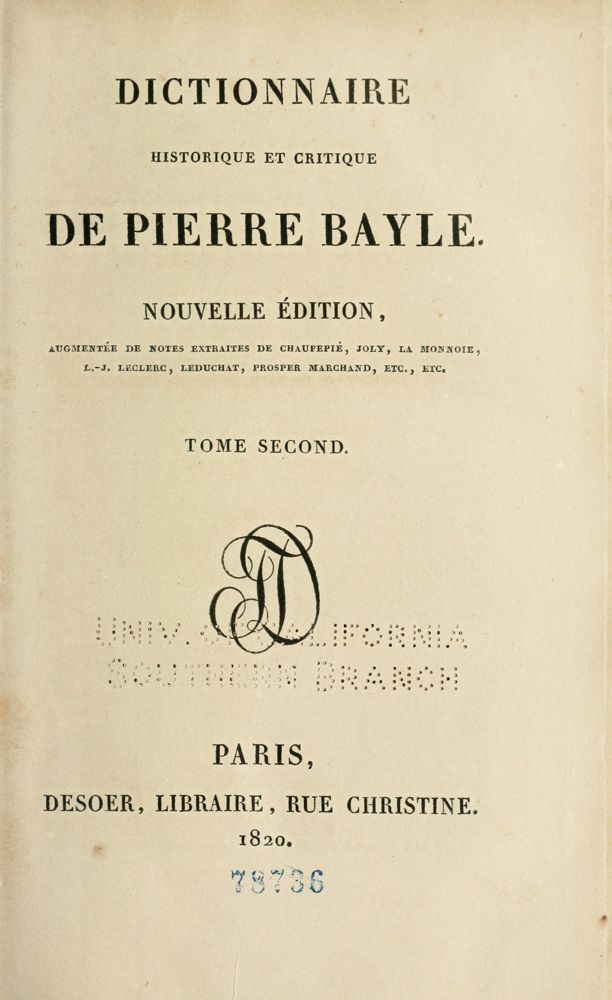
II. The acts of the synod of the Walloon churches of the United Provinces, held at Amsterdam in August 1690, establish invincibly the second thing I have to prove; for here is one of the propositions that this assembly condemned, the magistrate has no right to employ his authority to put down idolatry and to stop the progress of heresy. This proposition, I say, is one of those that the synod declares solemnly and unanimously false, scandalous, pernicious, equally destructive of morals and of the dogmas of religion. The synod proscribes, forbids and condemns them as such, forbidding under the severest censures all persons, ecclesiastical and secular, to utter them, whether in the pulpits or in private conversation … If M. Claude had been alive during the sitting of this synod, someone will tell me, the proposition I have reported would perhaps not have been condemned. I do not know; but however that may be, it cannot be denied that his opinion received the thunderbolt …
Original French
II. Les actes du synode des églises wallones des Provinces-Unies, tenu à Amsterdam au mois d’août 1690, établissent invinciblement la seconde chose que j’ai à prouver ; car c’est ici l’une des propositions que cette assemblée condamna, le magistrat n’est point en droit d’employer son autorité pour abattre l’idolâtrie et empêcher les progrès de l’hérésie. Cette proposition, dis-je, est l’une de celles que le synode déclare solennellement et unanimement fausses, scandaleuses, pernicieuses, destructives également de la morale et des dogmes de la religion. Le synode comme telles les proscrit, les interdit, et les condamne, défendant sous les dernières censures à toutes personnes ecclésiastiques et séculières de les débiter, ni dans les chaires, ni dans les conversations particulières … Si M. Claude eût été en vie pendant la tenue de ce synode, on n’aurait pas peut-être condamné la proposition que j’ai rapportée, me dira quelqu’un. Je n’en sais rien ; mais, quoi qu’il en soit, on ne peut nier que son sentiment n’ait reçu le coup de foudre …
Lecky (ch. IV Part II, text above note 55): “As late as 1690 a synod was held at Amsterdam, consisting partly of Dutch, and partly of French and English ministers who were driven to Holland by persecution, and in that synod the doctrine that the magistrate has no right to crush heresy and idolatry by the civil power, was unanimously pronounced to be ‘false, scandalous, and pernicious.’” Bayle’s footnote 28 on the same page says that the refugee ministers from France were far more numerous in the synod than the Walloon ministers and acted in concert with the refugee ministers in England; the page does not describe the synod as “partly Dutch”.
“Socin”, remark C: Socinus on armed resistance and the Dutch revolt
French and Latin: pp. 351–352, scan and scan.
(C) Who preached nothing less than sedition.] He condemns so strongly in it the taking of arms by subjects against their prince, and the Protestant theologians who have said that it was permitted to resist the oppressors of liberty of conscience, that perhaps the most extreme partisans of the arbitrary and despotic power of sovereigns have never spoken more plainly. … Hoornbeck, having quoted this whole long passage, adds a short refutation to it; and observes, among other things, that so malicious a criticism of the conduct of the Dutch against Philip II could have been alleged by the States General when they expelled the Socinian sect in the year 1598. I am astonished that Coccejus … was unaware that this heretic had condemned by name the wars of the Dutch against Spain. … Socinus against Palaeologus, p. 261, says: From this it can be understood how perversely those behave who take up arms against those who rule, in order (as they themselves say) to defend the worship of God and religion. So Socinus spoke in the year of Christ 1581.
Original French
(C) Qui ne prêchait rien moins que la sédition.] Il y condamne si fortement la prise d’armes des sujets contre leur prince, et les théologiens protestans qui ont dit qu’il était permis de s’opposer aux oppresseurs de la liberté de conscience, que jamais peut-être les partisans les plus outrés de la puissance arbitraire et despotique des souverains n’ont parlé plus nettement. … Hoornbeck ayant cité tout ce long passage y joint une courte réfutation ; et observe, entre autres choses, qu’une critique si maligne de la conduite des Hollandais contre Philippe II aurait pu être alléguée par les États-Généraux, lorsqu’ils chassèrent la secte socinienne l’an 1598. Je m’étonne que Coccéius … ait ignoré que cet hérétique a condamné nommément les guerres des Hollandais contre l’Espagne. … Socinus contra Palaeologum, p. 261, dicit : Ex quo intelligi potest quàm praeposterè ii se gerant qui arma adversùs eos qui dominantur, capiunt, ut (quemadmodùm aiunt ipsi) Dei cultum et religionem tueantur. Ita Socinus A. C. 1581, locutus est.
Lecky (ch. V text above note 133): “Thus Faustus Socinus had predicted that the seditious doctrines by which the Protestants supported their cause would lead to the dissolution of society, and in denouncing them he especially singled out for condemnation the noble struggle of the Dutch against Spain.” Bayle supports the condemnation of resistance in general and of the Dutch wars in particular (the work is Socinus’s book against Palaeologus, 1581). The “dissolution of society” prediction is not on these pages. The Latin above is only the fragment that Bayle’s page prints as Socinus’s words; I have not seen Socinus’s book. The Latin letter “quàm” and the accents are as read at this scan’s resolution.
Pensées diverses sur la comète, § 182: Mahomet Efendi
French: Pensées diverses, vol. 2 of the 1749 printing, pp. 378–379 (the section numbered CLXXXII, followed by CLXXXIII), scan. This is a different work of Bayle’s from the Dictionnaire; it is on this page for convenience. The image index here is the printed page minus 305 (p. 378 = n73).
To the example of Vanini one may add that of a certain Mahomet Efendi¹, who was executed at Constantinople not very long ago for having taught dogmatically against the existence of God. He could have saved his life by confessing his error and promising to renounce it in future; but he preferred to persist in his blasphemies, saying, that although he had no reward to expect, the love of truth obliged him to suffer martyrdom in order to maintain it. A man who speaks so necessarily has an idea of honesty; and if he pushes his obstinacy to dying for atheism, he must have so furious a desire to be its martyr that he would be capable of exposing himself to the same torments even if he were not an atheist.
¹ Ricaut, State of the Ottoman Empire [L’état de l’Empire ottoman], book 2, ch. 12.
Original French
On peut joindre à l’exemple de Vanini, celui d’un certain Mahomet Efendi¹, qui fut exécuté à Constantinople il n’y a pas fort long temps, pour avoir dogmatisé contre l’existence de Dieu. Il pouvoit sauver sa vie en confessant son erreur, et en promettant d’y renoncer à l’avenir : mais il aima mieux persister dans ses blasphêmes, disant, Qu’encore qu’il n’eût aucune recompense à attendre, l’amour de la verité l’obligeoit à souffrir le martyre, pour la soutenir. Un homme qui parle ainsi, a nécessairement une idée d’honnêteté ; et s’il pousse son obstination jusques à mourir pour l’Athéïsme, il faut qu’il ait une si furieuse envie d’en être le Martyr, qu’il seroit capable de s’exposer aux mêmes tourmens, quand même il ne seroit pas Athée.
¹ Etat de l’Emp. Ottom. de Mr. Ricaut, l. 2. ch. 12.
Lecky (ch. VI, text above note 187): “The conduct of that Turkish atheist, who, believing that death was an eternal sleep, refused at the stake to utter the recantation which would save his life, replying to every remonstrance, ‘Although there is no recompense to be looked for, yet the love of truth constraineth me to die in its defence,’ in the eye of reason is an inexplicable folly …”, with the note “Mahomet Effendi. See Bayle, Pensées Diverses, § 182.” The name, the offer of a pardon for recantation and the saying are in Bayle, and Lecky’s English is a translation of the saying (“die in its defence” for “souffrir le martyre pour la soutenir”). Two additions are Lecky’s: the belief that “death was an eternal sleep” and “at the stake”; Bayle says only that he was executed and mentions no manner of death, and Bayle’s own point (that such obstinacy shows a martyr’s temperament, not atheism as such) is not used by Lecky. Bayle’s own source is Rycaut, whom I have not read.
Editor’s notes on this page
Both citations check out. In remark (H) of “Augustin”, Bayle says that the acts of the synod of the Walloon churches of the United Provinces, held at Amsterdam in August 1690, declared the proposition “le magistrat n’est point en droit d’employer son autorité pour abattre l’idolâtrie et empêcher les progrès de l’hérésie” to be “solennellement et unanimement fausses, scandaleuses, pernicieuses”: Lecky’s “false, scandalous, and pernicious”. Two details differ. Bayle’s synod is of the Walloon (French-speaking) churches, with refugee ministers from France in it in great numbers, not a mixed gathering “of Dutch, and partly of French and English ministers”; and Bayle’s point is that this contradicted what the Reformed minister Claude had said against Augustine.
In remark (C) of “Socin”, Bayle says Socinus condemned the taking of arms against princes “si fortement” that the most extreme defenders of arbitrary power have hardly spoken more plainly, and that Socinus condemned “nommément les guerres des Hollandais contre l’Espagne”. This supports Lecky’s sentence that Faustus Socinus “especially singled out for condemnation the noble struggle of the Dutch against Spain”; Lecky’s statement that Socinus predicted that the seditious doctrines would “lead to the dissolution of society” is not in these two pages.
Further down the rabbit hole
Sources that Lecky cites in the notes next to the ones that cite this page.
- Hallam, Literature of Europe and Constitutional HistoryHow Lecky quotes Hallam on persecution
- Discours … par un ministre patrioteOn the eve of the Revolution, a clergyman warns Louis XVI against tolerating Protestants
- Gioja, Filosofia della statisticaThe queen who nearly banned Linnaeus for the sex lives of plants
- Temple, Observations upon the United ProvincesWhy Holland was tolerant: an English ambassador’s answer
- Voltaire, Lettres philosophiques, XIVDescartes, who spent his wits on new proofs of God, accused of atheism
- Buckle, History of Civilization in EnglandWeather and credulity, and the Scottish clergy’s Devil who had been studying for five thousand years
Backlinks
Every place in Rationalism in Europe that links to this page (generated automatically when the site is built).