“Least pretence of Power or Jurisdiction to the Clergy” (ch. V, pp. 174–176)
English: London 1673, ch. V “Of their Religion”, pp. 174–176, scan n207–n209. Long s modernised; Temple’s spelling kept. Highlighted: the point Lecky draws from Temple.
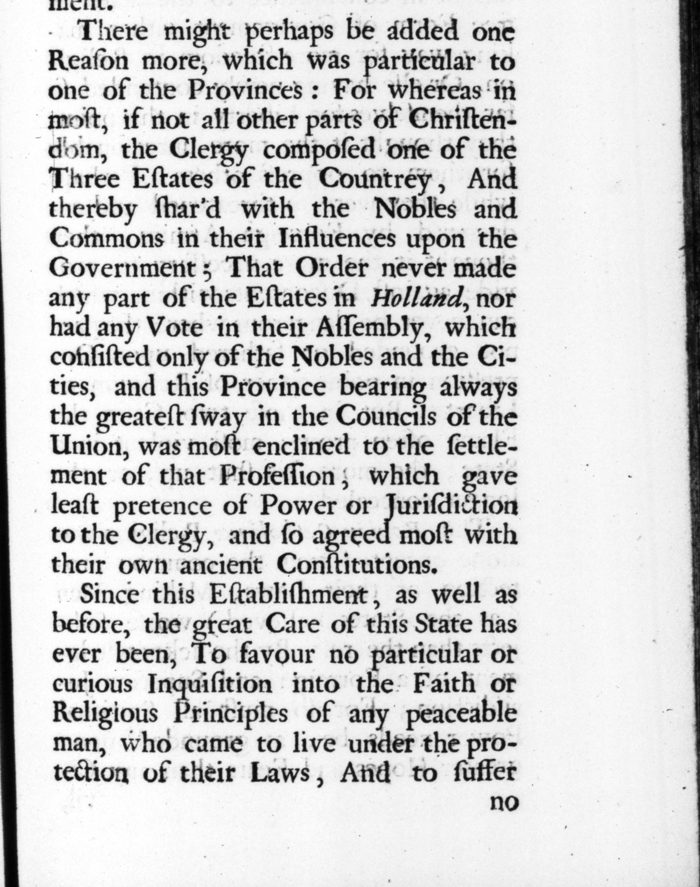
[p. 174] … And lastly, Because by this Profession, all Rights and Jurisdiction of the Clergy or Hierarchy being suppressed, There was no Ecclesiastical Authority left to rise up and trouble or fetter the Civil Power; And all the Goods and Possessions of Churches and Abbies, were seized wholly into the hands of the State, [p. 175] which made a great encrease of the publique Revenue, A thing the most necessary for the support of their Government.
There might perhaps be added one Reason more, which was particular to one of the Provinces: For whereas in most, if not all other parts of Christendom, the Clergy composed one of the Three Estates of the Countrey, And thereby shar’d with the Nobles and Commons in their Influences upon the Government; That Order never made any part of the Estates in Holland, nor had any Vote in their Assembly, which consisted only of the Nobles and the Cities, and this Province bearing always the greatest sway in the Councils of the Union, was most enclined to the settlement of that Profession, which gave least pretence of Power or Jurisdiction to the Clergy, and so agreed most with their own ancient Constitutions.
Since this Establishment, as well as before, the great Care of this State has ever been, To favour no particular or curious Inquisition into the Faith or Religious Principles of any peaceable man, who came to live under the protection of their Laws, And to suffer [p. 176] no Violence or Oppression upon any Mans Conscience; whose Opinions broke not out into Expressions or Actions of ill consequence to the State. A free Form of Government either making way for more freedom in Religion, Or else having newly contended so far themselves for Liberty in this point, they thought it the more unreasonable for them to oppress others. …
Lecky (vol. II, ch. IV, text at note 54) puts Temple’s two observations together, liberty “unusually great” and clerical power “unusually small”. Temple connects them less directly: he gives the weakness of the clergy as a reason for the choice of the Reformed religion, and the toleration as the policy of a free state recently at war for its own liberty.
Further down the rabbit hole
Sources that Lecky cites in the notes next to the ones that cite this page.
- Bancroft, History of the United States, vol. IHanging Quakers in Boston, and where Lecky’s 50,000 Dutch martyrs came from
- Bayle, Dictionnaire historique et critiqueWhat Bayle really said about Augustine and Socinus
- Hallam, Literature of Europe and Constitutional HistoryHow Lecky quotes Hallam on persecution
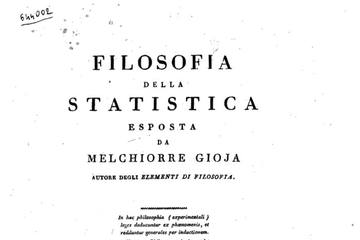
- Gioja, Filosofia della statisticaThe queen who nearly banned Linnaeus for the sex lives of plants
- Macaulay, History of England and EssaysMacaulay on Puritans, bear-baiting and the servile Church
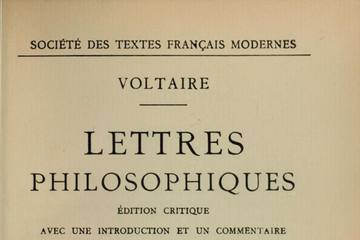
- Voltaire, Lettres philosophiques, XIVDescartes, who spent his wits on new proofs of God, accused of atheism
Backlinks
Every place in Rationalism in Europe that links to this page (generated automatically when the site is built).
- Chapter IV, Part II: note 54