“Une machine hydraulique” (p. 6)
French: p. 6, scan n21. Lemoine has just described Descartes’ mechanical physiology. Highlighted: what Lecky’s text reports.
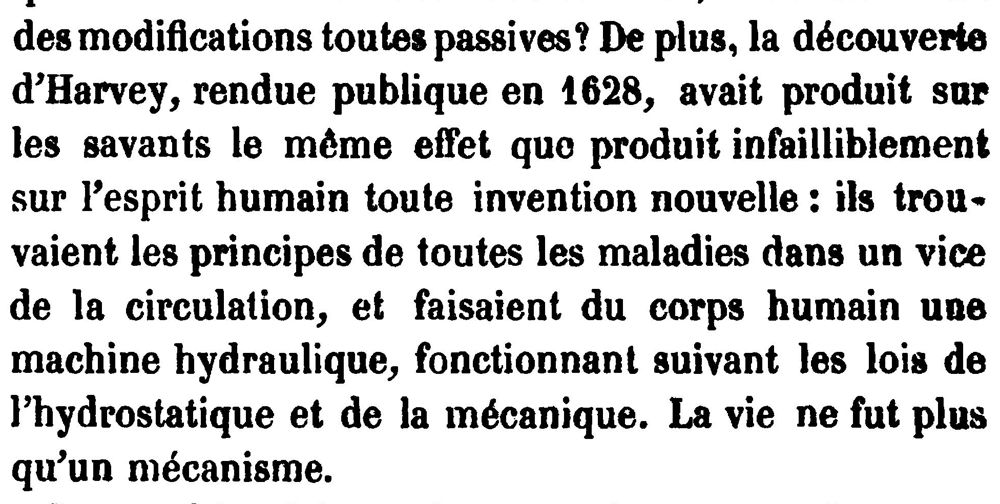
Moreover, Harvey’s discovery, made public in 1628, had had on the learned the same effect that every new invention infallibly has on the human mind: they found the principles of all diseases in a fault of the circulation, and made the human body a hydraulic machine, working according to the laws of hydrostatics and mechanics. Life was no longer anything but a mechanism.
Translation: this edition’s draft.
Original French
De plus, la découverte d’Harvey, rendue publique en 1628, avait produit sur les savants le même effet que produit infailliblement sur l’esprit humain toute invention nouvelle: ils trouvaient les principes de toutes les maladies dans un vice de la circulation, et faisaient du corps humain une machine hydraulique, fonctionnant suivant les lois de l’hydrostatique et de la mécanique. La vie ne fut plus qu’un mécanisme.
Further down the rabbit hole
Sources that Lecky cites in the notes next to the ones that cite this page.
- La Peyrère, Men before AdamWho did Abel guard his sheep against? A 1655 case for people before Adam
- Laplace, Exposition du système du monde“Deux cent mille milliards à parier contre un”
- Denis, Histoire des idées morales dans l’antiquitéA Pythagorean hell, and Plato’s punishment as medicine
- Agobard, Liber de imaginibusLecky’s five Agobard quotes checked against Baluze
- Aquinas, Summa theologiae, Supplement, q. 94Lecky’s quotation that is really a paraphrase
- Augustine, De Genesi contra ManichaeosGenesis as allegory: the six days as the ages of history and the stages of the soul
Backlinks
Every place in Rationalism in Europe that links to this page (generated automatically when the site is built).
- Chapter III: note 121