Thorns, poisonous herbs and barren trees (I.13, § 19)
Latin: Migne, PL 34, lib. I, cap. XIII, cols. 183–184, scan n92. The Manichees asked who had commanded the earth to bring forth thorny, poisonous and barren plants, if God commanded only grass and fruit trees. Highlighted: the passage behind Lecky’s note 104.
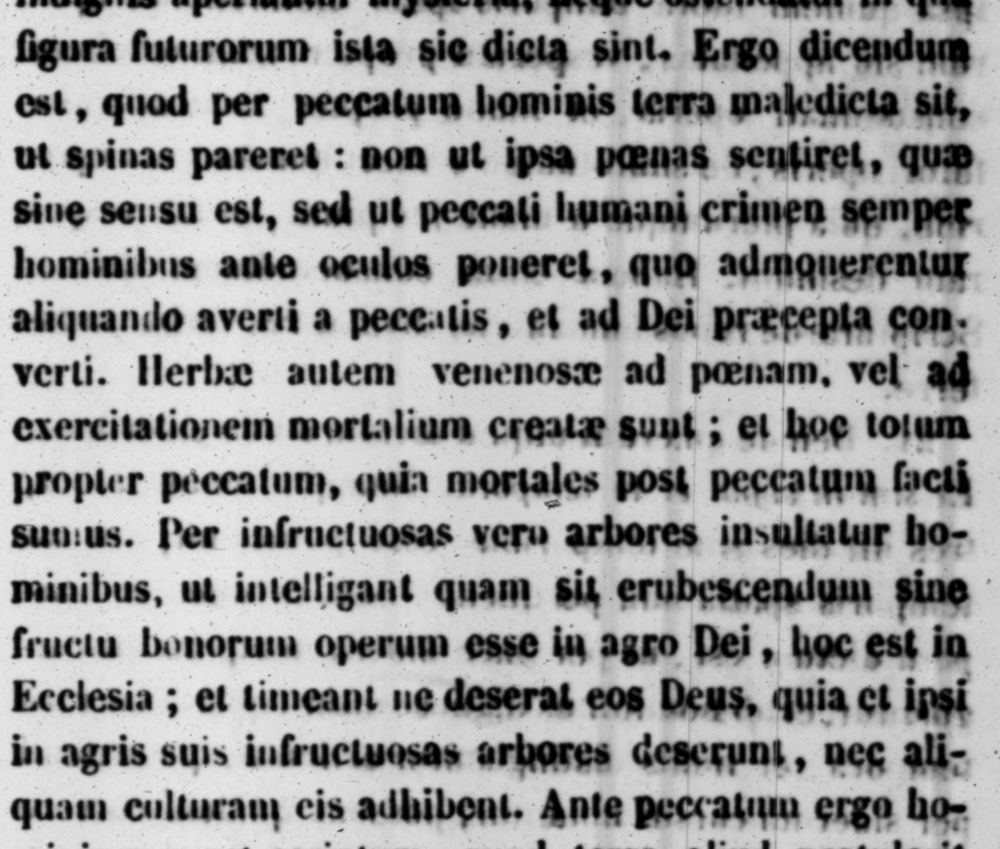
It must be said, then, that through man’s sin the earth was cursed so that it should bear thorns: not so that the earth itself should feel punishment, for it has no feeling, but so that it should keep the crime of human sin always before men’s eyes, and they might be warned at some time to turn from their sins and turn to God’s commandments. Poisonous herbs were created for the punishment, or for the exercise, of mortals; and all this on account of sin, because after sin we were made mortal. Barren trees are a reproach to men, so that they may understand how shameful it is to be without the fruit of good works in God’s field, that is, in the Church; and may fear that God will abandon them, since they too abandon the barren trees in their own fields and give them no tending.
Translation: this edition’s draft.
Original Latin
Ergo dicendum est, quod per peccatum hominis terra maledicta sit, ut spinas pareret: non ut ipsa pœnas sentiret, quæ sine sensu est, sed ut peccati humani crimen semper hominibus ante oculos poneret, quo admonerentur aliquando averti a peccatis, et ad Dei præcepta converti. Herbæ autem venenosæ ad pœnam, vel ad exercitationem mortalium creatæ sunt; et hoc totum propter peccatum, quia mortales post peccatum facti sumus. Per infructuosas vero arbores insultatur hominibus, ut intelligant quam sit erubescendum sine fructu bonorum operum esse in agro Dei, hoc est in Ecclesia; et timeant ne deserat eos Deus, quia et ipsi in agris suis infructuosas arbores deserunt, nec aliquam culturam eis adhibent.
The sixth age: Christ and the Church (I.23, § 40)
Latin: Migne, PL 34, lib. I, cap. XXIII, col. 192, scan n97. The italic is Migne’s, marking the Scripture quotation. Highlighted: the words behind Lecky’s text and note 89.
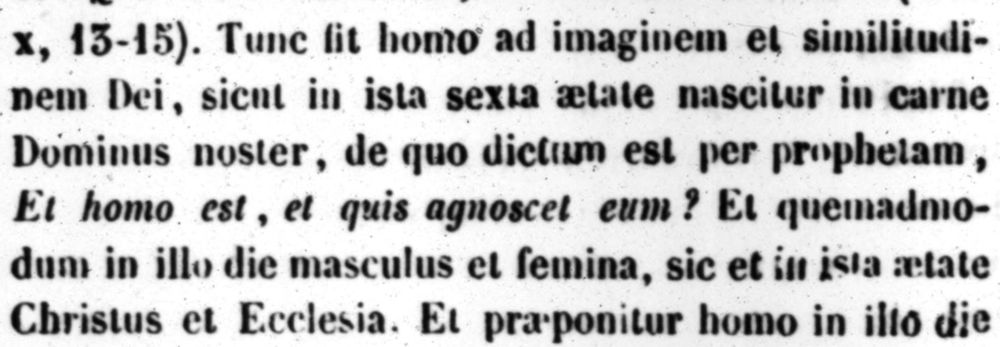
Then man is made in the image and likeness of God, as in this sixth age our Lord is born in the flesh, of whom it was said by the prophet, He is a man, and who shall know him? And as on that day there were male and female, so in this age there are Christ and the Church.
Translation: this edition’s draft.
Original Latin
Tunc fit homo ad imaginem et similitudinem Dei, sicut in ista sexta ætate nascitur in carne Dominus noster, de quo dictum est per prophetam, Et homo est, et quis agnoscet eum? Et quemadmodum in illo die masculus et femina, sic et in ista ætate Christus et Ecclesia.
Nothing in this chapter speaks of “bone of his bone” or of strength and purity; for that gloss see II.13 below.
The six days in each Christian life (I.25, § 43)
Latin: Migne, PL 34, lib. I, cap. XXV, cols. 193–194, scan n98; the facsimile shows col. 194. Lecky cites “Lib. v. cap. 25”, as printed (the work has two books). Migne’s note marks “visibilibus”: the Louvain edition read “invisibilibus”. Highlighted: what Lecky’s text paraphrases.
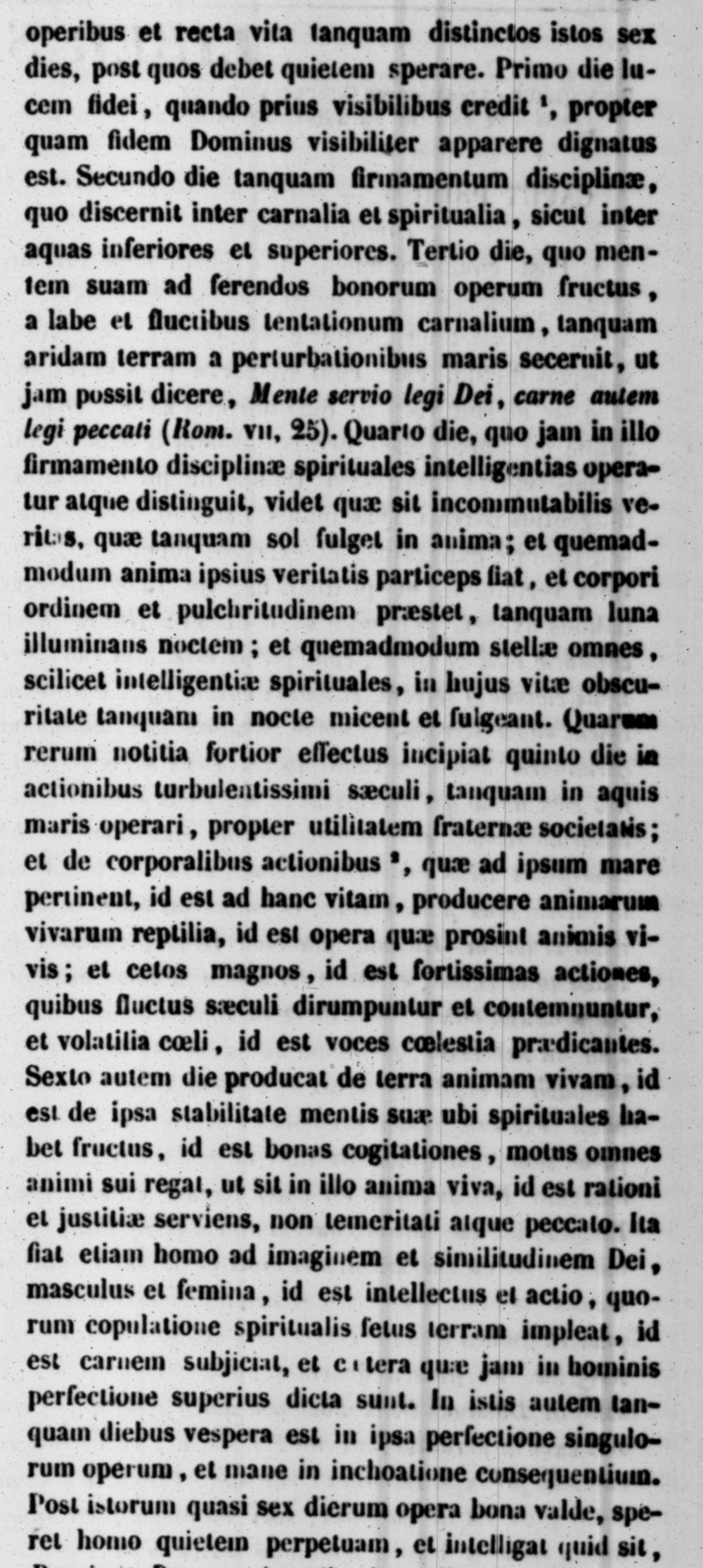
Each of us, too, has these six days, as it were distinct, in good works and an upright life, after which he ought to hope for rest. On the first day, the light of faith, when he first believes through visible things, for the sake of which faith the Lord deigned to appear visibly. On the second day, as it were the firmament of discipline, by which he distinguishes between carnal things and spiritual, as between the lower and the upper waters. On the third day he separates his mind, so that it may bear the fruits of good works, from the slippery ground and the waves of carnal temptations, as the dry land from the turmoil of the sea, so that he can now say, With the mind I serve the law of God, but with the flesh the law of sin (Rom. 7:25). On the fourth day, now within that firmament of discipline, he brings forth spiritual understandings and sets them in order: he sees what the unchangeable truth is, which shines in the soul like the sun; how the soul comes to share in that truth and gives order and beauty to the body, like the moon lighting the night; and how all the stars, that is, the spiritual understandings, glitter and shine in the darkness of this life as in the night. Made stronger by the knowledge of these things, let him begin on the fifth day to work in the actions of this most turbulent world, as in the waters of the sea, for the good of the brotherhood; and from bodily actions, which belong to that sea, that is, to this life, to bring forth the creeping things of living souls, that is, works that profit living souls; and great whales, that is, the strongest actions, by which the waves of the world are broken and despised; and the birds of heaven, that is, voices that preach heavenly things. On the sixth day let him bring forth from the earth the living soul, that is, from the very steadiness of his mind, where he has spiritual fruits, that is, good thoughts, let him rule all the motions of his mind, so that there may be in him a living soul, that is, one that serves reason and justice, not rashness and sin. So let man too be made in the image and likeness of God, male and female, that is, understanding and action, by whose union the spiritual offspring may fill the earth, that is, subdue the flesh, and the rest that has been said above of man’s perfection. In these days, as it were, evening is the completion of each work, and morning the beginning of the next. After the works of these six days, as it were, very good, let man hope for perpetual rest.
Translation: this edition’s draft.
Original Latin
Habet etiam unusquisque nostrum in bonis operibus et recta vita tanquam distinctos istos sex dies, post quos debet quietem sperare. Primo die lucem fidei, quando prius visibilibus credit, propter quam fidem Dominus visibiliter apparere dignatus est. Secundo die tanquam firmamentum disciplinæ, quo discernit inter carnalia et spiritualia, sicut inter aquas inferiores et superiores. Tertio die, quo mentem suam ad ferendos bonorum operum fructus, a labe et fluctibus tentationum carnalium, tanquam aridam terram a perturbationibus maris secernit, ut jam possit dicere, Mente servio legi Dei, carne autem legi peccati (Rom. VII, 25). Quarto die, quo jam in illo firmamento disciplinæ spirituales intelligentias operatur atque distinguit, videt quæ sit incommutabilis veritas, quæ tanquam sol fulget in anima; et quemadmodum anima ipsius veritatis particeps fiat, et corpori ordinem et pulchritudinem præstet, tanquam luna illuminans noctem; et quemadmodum stellæ omnes, scilicet intelligentiæ spirituales, in hujus vitæ obscuritate tanquam in nocte micent et fulgeant. Quarum rerum notitia fortior effectus incipiat quinto die in actionibus turbulentissimi sæculi, tanquam in aquis maris operari, propter utilitatem fraternæ societatis; et de corporalibus actionibus, quæ ad ipsum mare pertinent, id est ad hanc vitam, producere animarum vivarum reptilia, id est opera quæ prosint animis vivis; et cetos magnos, id est fortissimas actiones, quibus fluctus sæculi dirumpuntur et contemnuntur, et volatilia cœli, id est voces cœlestia prædicantes. Sexto autem die producat de terra animam vivam, id est de ipsa stabilitate mentis suæ ubi spirituales habet fructus, id est bonas cogitationes, motus omnes animi sui regat, ut sit in illo anima viva, id est rationi et justitiæ serviens, non temeritati atque peccato. Ita fiat etiam homo ad imaginem et similitudinem Dei, masculus et femina, id est intellectus et actio, quorum copulatione spiritualis fetus terram impleat, id est carnem subjiciat, et cætera quæ jam in hominis perfectione superius dicta sunt. In istis autem tanquam diebus vespera est in ipsa perfectione singulorum operum, et mane in inchoatione consequentium. Post istorum quasi sex dierum opera bona valde, speret homo quietem perpetuam.
Lecky’s paraphrase adds colour of his own (the mind “still immersed in the waves of sin” on the first day; good works springing “from the waves of trial as the fish from the sea”), but the sequence is Augustine’s, and “sanctified thought being wedded to sanctified action, as Eve to Adam” is a fair rendering of “masculus et femina, id est intellectus et actio”.
Where the letter fails, read a riddle (II.2, § 3)
Latin: Migne, PL 34, lib. II, cap. II, col. 197, scan n100. Highlighted: the rule Lecky states in his text before note 92.
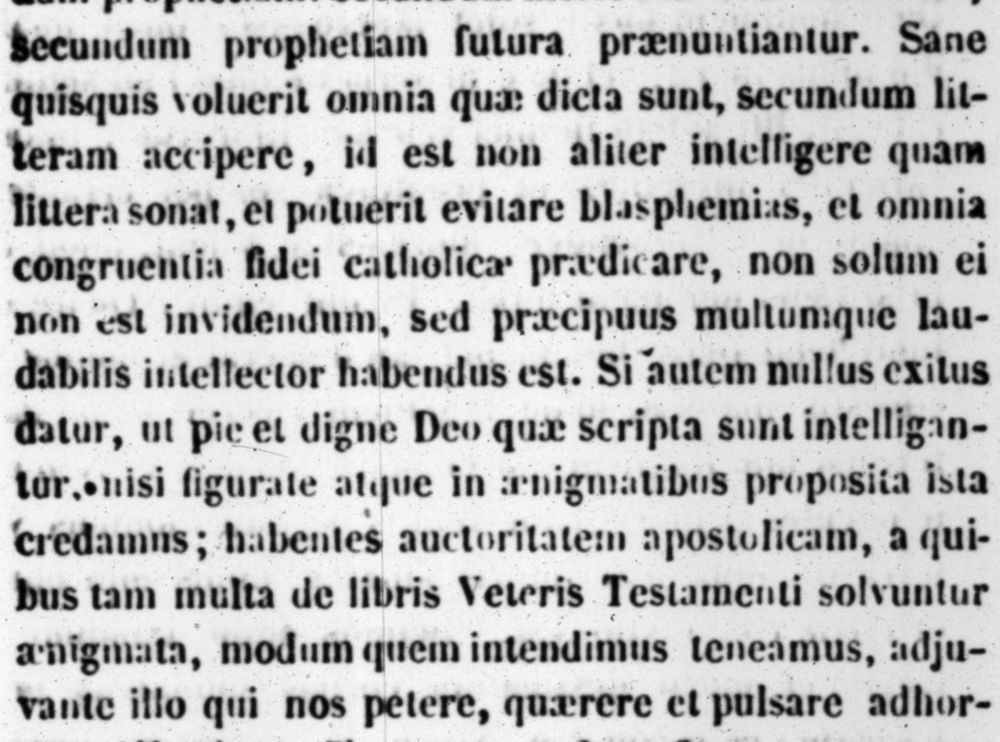
Certainly, whoever wishes to take everything that is said according to the letter, that is, to understand it no otherwise than as the letter sounds, and can avoid blasphemies and set forth everything in agreement with the Catholic faith, is not only not to be grudged but to be held an outstanding and most praiseworthy interpreter. But if there is no way of understanding what is written piously and worthily of God, unless we believe it to be set forth figuratively and in riddles, then, having the authority of the apostles, by whom so many riddles in the books of the Old Testament are solved, let us keep to the method we have in view, with the help of him who urges us to ask, to seek and to knock (Matt. 7:7).
Translation: this edition’s draft.
Original Latin
Sane quisquis voluerit omnia quæ dicta sunt, secundum litteram accipere, id est non aliter intelligere quam littera sonat, et potuerit evitare blasphemias, et omnia congruentia fidei catholicæ prædicare, non solum ei non est invidendum, sed præcipuus multumque laudabilis intellector habendus est. Si autem nullus exitus datur, ut pie et digne Deo quæ scripta sunt intelligantur, nisi figurate atque in ænigmatibus proposita ista credamus; habentes auctoritatem apostolicam, a quibus tam multa de libris Veteris Testamenti solvuntur ænigmata, modum quem intendimus teneamus, adjuvante illo qui nos petere, quærere et pulsare adhortatur (Matth. VII, 7).
“Bone of my bones”: fortitude and temperance (II.13, § 18)
Latin: Migne, PL 34, lib. II, cap. XIII (“Spirituale conjugium in homine”, the spiritual marriage within man), col. 206, scan n104. The italic is Migne’s. Not cited by Lecky here; given because it is the gloss his note 89 attaches to I.23.
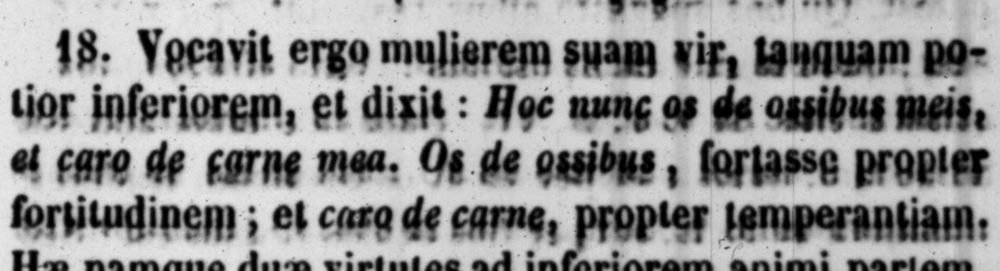
So the man named his woman, as the stronger names the weaker, and said: This is now bone of my bones, and flesh of my flesh. Bone of my bones, perhaps because of fortitude; and flesh of my flesh, because of temperance.
Translation: this edition’s draft.
Original Latin
Vocavit ergo mulierem suam vir, tanquam potior inferiorem, et dixit: Hoc nunc os de ossibus meis, et caro de carne mea. Os de ossibus, fortasse propter fortitudinem; et caro de carne, propter temperantiam.
The next sentence (read in the OCR, not checked on the image) explains that these two virtues belong to the lower part of the soul, which rational prudence rules. The “man” and “woman” here are the governing and the obeying parts of one soul. Lecky’s note 89 transfers the gloss to Christ and the Church and renders temperance as “purity”.
Further down the rabbit hole
Sources that Lecky cites in the notes next to the ones that cite this page.
- Macaulay, History of England and EssaysMacaulay on Puritans, bear-baiting and the servile Church
- Bacon, Novum OrganumTruth for its own sake: “more worthy than all the fruit of inventions”
- Durand, La vie et les sentimens de Lucilio VaniniWere the pagan oracles the Devil’s work? “If Father Baltus wants to believe in them, he is welcome”
- Matthew of Westminster, Flores HistoriarumErigena’s joke at the king’s table, and the magician pope
- Agobard, Liber de imaginibusLecky’s five Agobard quotes checked against Baluze
- Aquinas, Summa theologiae, Supplement, q. 94Lecky’s quotation that is really a paraphrase
Backlinks
Every place in Rationalism in Europe that links to this page (generated automatically when the site is built).