“How far is a Scotus removed from a Sotus?” (A.D. 883, pp. 434–435)
English: Yonge’s translation, vol. I, pp. 434–435, scan n447–n448. Highlighted: the jest that makes the notice “amusing”.
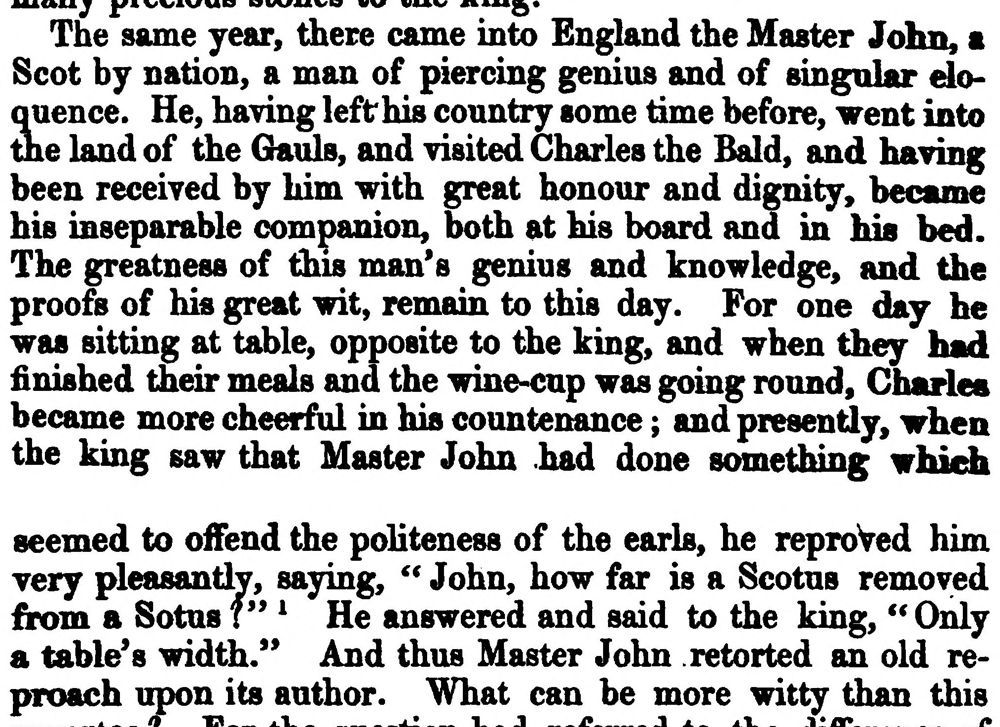
The same year, there came into England the Master John, a Scot by nation, a man of piercing genius and of singular eloquence. He, having left his country some time before, went into the land of the Gauls, and visited Charles the Bald, and having been received by him with great honour and dignity, became his inseparable companion, both at his board and in his bed. The greatness of this man’s genius and knowledge, and the proofs of his great wit, remain to this day. For one day he was sitting at table, opposite to the king, and when they had finished their meals and the wine-cup was going round, Charles became more cheerful in his countenance; and presently, when the king saw that Master John had done something which seemed to offend the politeness of the earls, he reproved him very pleasantly, saying, “John, how far is a Scotus removed from a Sotus?” He answered and said to the king, “Only a table’s width.” And thus Master John retorted an old reproach upon its author.
Yonge’s footnote (read in the OCR): “Scotus, means a Scot. Sotus, a trunk, a log, i.e. a blockhead; the origin probably of the French ‘sot,’ and of the English ‘sot.’” Matthew goes on (pp. 435–436, OCR only) with a second jest about two large fishes and a small one, Erigena’s translation of Dionysius the Areopagite and his Division of Nature, and a papal letter complaining of it.
Gerbert’s talking head and sweating tomb (A.D. 998, pp. 496–497)
English: Yonge’s translation, vol. I, pp. 496–497, scan n509–n510; the story begins on p. 495 with Gerbert’s flight to Spain (OCR only). Highlighted: the parts of the legend Lecky retells in note 102.
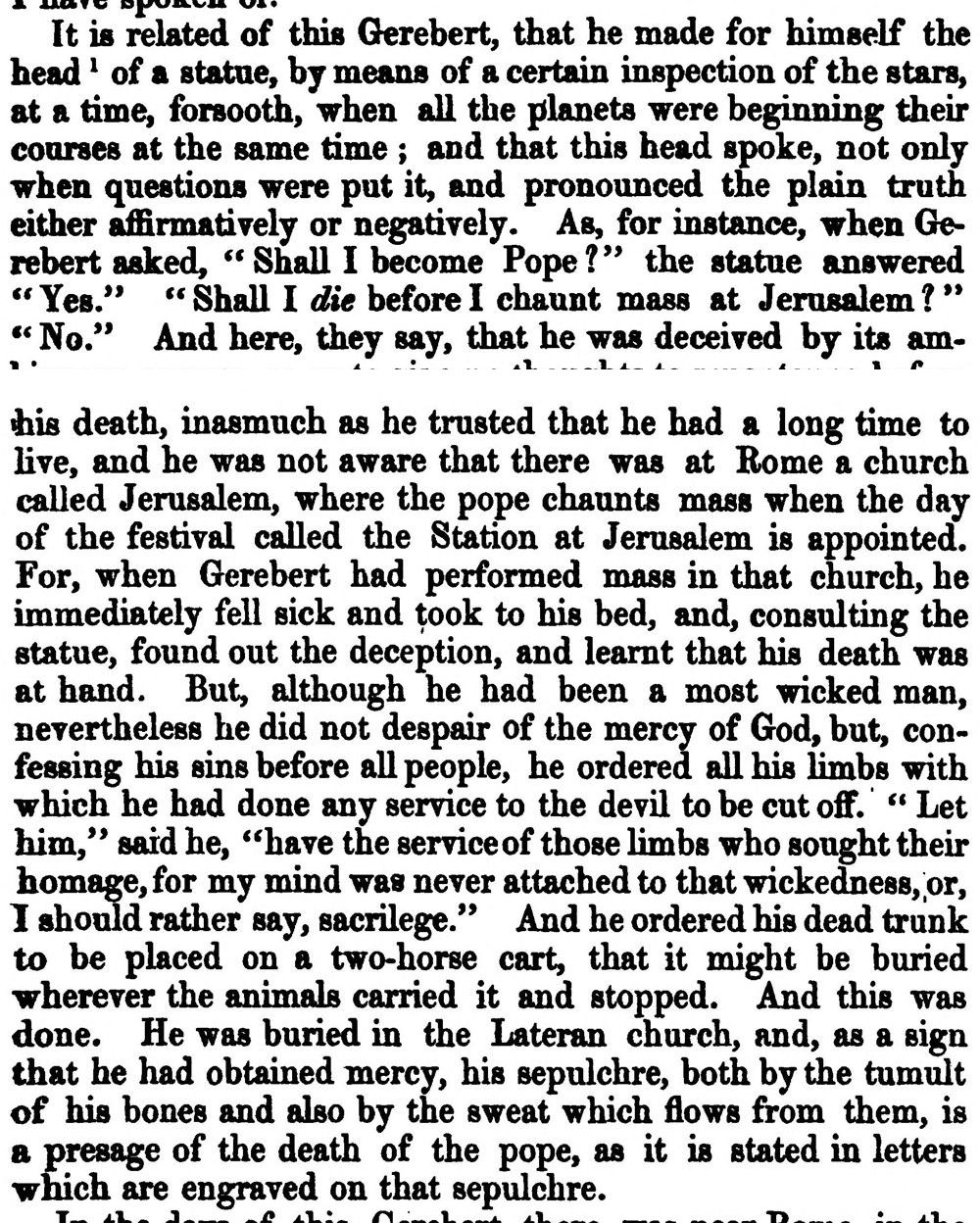
It is related of this Gerebert, that he made for himself the head of a statue, by means of a certain inspection of the stars, at a time, forsooth, when all the planets were beginning their courses at the same time; and that this head spoke, not only when questions were put it, and pronounced the plain truth either affirmatively or negatively. As, for instance, when Gerebert asked, “Shall I become Pope?” the statue answered “Yes.” “Shall I die before I chaunt mass at Jerusalem?” “No.” And here, they say, that he was deceived by its ambiguous answer, so as to give no thoughts to repentance before his death, inasmuch as he trusted that he had a long time to live, and he was not aware that there was at Rome a church called Jerusalem, where the pope chaunts mass when the day of the festival called the Station at Jerusalem is appointed. For, when Gerebert had performed mass in that church, he immediately fell sick and took to his bed, and, consulting the statue, found out the deception, and learnt that his death was at hand. But, although he had been a most wicked man, nevertheless he did not despair of the mercy of God, but, confessing his sins before all people, he ordered all his limbs with which he had done any service to the devil to be cut off. “Let him,” said he, “have the service of those limbs who sought their homage, for my mind was never attached to that wickedness, or, I should rather say, sacrilege.” And he ordered his dead trunk to be placed on a two-horse cart, that it might be buried wherever the animals carried it and stopped. And this was done. He was buried in the Lateran church, and, as a sign that he had obtained mercy, his sepulchre, both by the tumult of his bones and also by the sweat which flows from them, is a presage of the death of the pope, as it is stated in letters which are engraved on that sepulchre.
| Matthew (Yonge’s translation) | Lecky, note 102 |
|---|---|
| a church called Jerusalem, where the pope chaunts mass … the Station at Jerusalem | the Chapel of Jerusalem, in the Basilica of St. Croce |
| all his limbs with which he had done any service to the devil to be cut off | his body to be cut in pieces |
| a two-horse cart … wherever the animals carried it and stopped | a car driven by oxen … wherever they stopped of themselves |
| He was buried in the Lateran church, and, as a sign that he had obtained mercy … | to show that pardon may be extended even to the most guilty, the oxen stopped at the door of the Lateran |
| by the tumult of his bones and also by the sweat which flows from them | the tomb of Sylvester grows moist, and the bones of the old magician clatter below |
Lecky’s other details (the sees of Rheims and Ravenna, the parallel with Henry IV of England) are not in this passage; he may have them from Gronovius, whom he cites in the same note and who has not been checked.
Further down the rabbit hole
Sources that Lecky cites in the notes next to the ones that cite this page.
- Saint-René Taillandier, Scot Érigène et la philosophie scholastiqueErigena’s hell: not a place, but a bad conscience
- Bacon, Novum OrganumTruth for its own sake: “more worthy than all the fruit of inventions”
- Daillé, De poenis et satisfactionibus humanisWould even the Virgin Mary pass through the fire? A Protestant reads the Fathers on purgatory
- Augustine, De Genesi contra ManichaeosGenesis as allegory: the six days as the ages of history and the stages of the soul
- Durand, La vie et les sentimens de Lucilio VaniniWere the pagan oracles the Devil’s work? “If Father Baltus wants to believe in them, he is welcome”
- Magnin, Les origines du théâtre moderneHell as a stage show in the Greek mysteries
Backlinks
Every place in Rationalism in Europe that links to this page (generated automatically when the site is built).