Hell is the conscience (pp. 179–180)
French: p. 179, scan n190, and p. 180, n191. Taillandier is paraphrasing De divisione naturae V, 31–36, which his footnotes cite. Note numbers omitted. Highlighted: the doctrine Lecky reports.
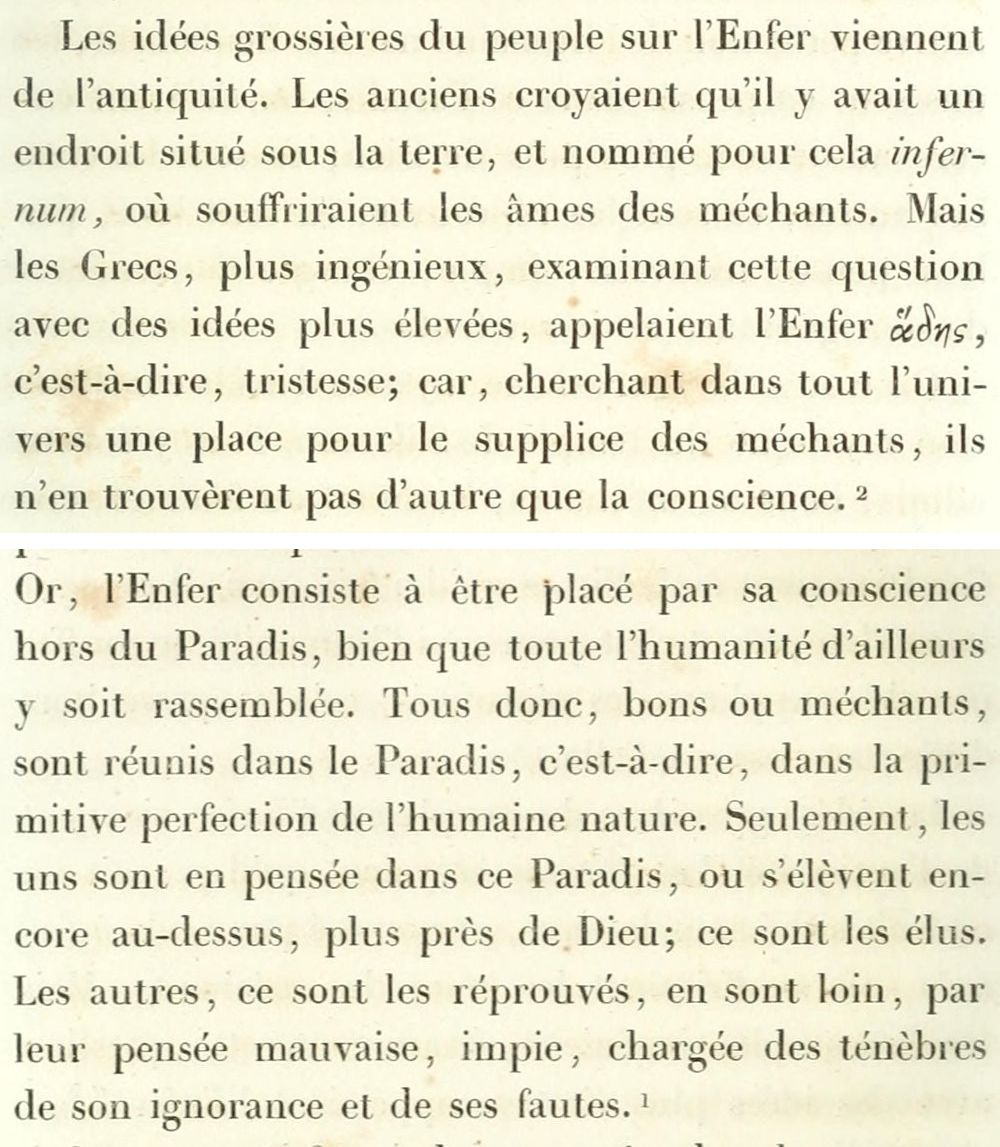
The people’s crude ideas of hell come from antiquity. The ancients believed that there was a place under the earth, called for that reason infernum, where the souls of the wicked would suffer. But the Greeks, more ingenious, examining the question with loftier ideas, called hell Hades, that is, sadness; for, looking through the whole universe for a place to punish the wicked, they found none but the conscience.
Now hell consists in being placed by one’s conscience outside Paradise, although all mankind is gathered there. All, then, good or wicked, are united in Paradise, that is, in the original perfection of human nature. Only, some are in that Paradise in thought, or rise still higher, closer to God: these are the elect. The others, the reprobate, are far from it through their evil, impious thought, laden with the darkness of its ignorance and its sins.
Translation: this edition’s draft.
Original French
Les idées grossières du peuple sur l’Enfer viennent de l’antiquité. Les anciens croyaient qu’il y avait un endroit situé sous la terre, et nommé pour cela infernum, où souffriraient les âmes des méchants. Mais les Grecs, plus ingénieux, examinant cette question avec des idées plus élevées, appelaient l’Enfer ᾅδης, c’est-à-dire, tristesse; car, cherchant dans tout l’univers une place pour le supplice des méchants, ils n’en trouvèrent pas d’autre que la conscience.
Or, l’Enfer consiste à être placé par sa conscience hors du Paradis, bien que toute l’humanité d’ailleurs y soit rassemblée. Tous donc, bons ou méchants, sont réunis dans le Paradis, c’est-à-dire, dans la primitive perfection de l’humaine nature. Seulement, les uns sont en pensée dans ce Paradis, ou s’élèvent encore au-dessus, plus près de Dieu; ce sont les élus. Les autres, ce sont les réprouvés, en sont loin, par leur pensée mauvaise, impie, chargée des ténèbres de son ignorance et de ses fautes.
On p. 181 (OCR) Taillandier concludes that “Paradise and Hell will be nothing other than the place, more or less near to God, that each will occupy there in thought”, and illustrates it with Judas and Peter sitting side by side at the Last Supper.
Further down the rabbit hole
Sources that Lecky cites in the notes next to the ones that cite this page.
- Swinden, An Enquiry into the Nature and Place of HellAn Anglican clergyman proves that hell is in the sun
- Matthew of Westminster, Flores HistoriarumErigena’s joke at the king’s table, and the magician pope
- Aquinas, Summa theologiae, Supplement, q. 94Lecky’s quotation that is really a paraphrase
- Daillé, De poenis et satisfactionibus humanisWould even the Virgin Mary pass through the fire? A Protestant reads the Fathers on purgatory
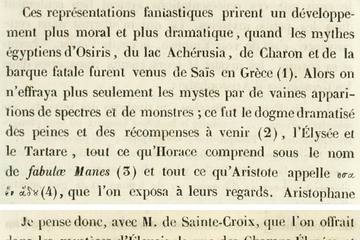
- Magnin, Les origines du théâtre moderneHell as a stage show in the Greek mysteries
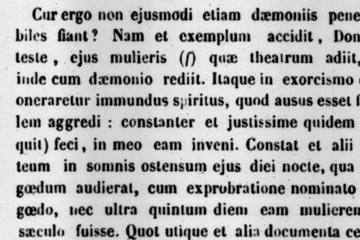
- Tertullian, De spectaculisLecky’s Latin quotation is accurate but not exact
Backlinks
Every place in Rationalism in Europe that links to this page (generated automatically when the site is built).