Chapter 30: “What a Breadth of Spectacle”
Latin: Migne, PL 1, cols. 660–662. Spelling regularised (æ as ae, j as i); editors’ footnote numbers and marginal letters omitted. The running head of cols. 661–662 reads “Liber de idololatria” in this printing, though the chapter is part of De spectaculis. Highlighted: the words Lecky quotes (from “Quae tunc spectaculi latitudo”).
What a spectacle is that, so near, of the Lord’s advent, now beyond doubt, now exalted, now triumphant! What exultation of the angels, what glory of the saints rising again! what a kingdom of the just thereafter! what a new city of Jerusalem! But there remain other spectacles: that last and everlasting day of judgement, that day unlooked for by the nations, that day derided, when so great an age of the world, and all its births, shall be consumed in one fire.
What a breadth of spectacle there will then be! What shall I admire? What shall I laugh at? Where shall I rejoice, where exult, as I look on so many and such great kings, who were announced as received into heaven, groaning together with Jove himself and with those who bore witness for them, in the lowest darkness? Likewise the governors, persecutors of the Lord’s name, melting in flames fiercer than those with which they raged against the Christians, as they mocked? And further those wise philosophers, blushing before their disciples as they burn together with them, to whom they argued that nothing concerned God, to whom they asserted that souls were either nothing or would not return into their former bodies? And poets too, trembling before the tribunal not of Rhadamanthus or Minos but of the unexpected Christ? Then tragic actors will be better worth hearing, being more vocal in their own calamity; then actors will be recognised, much looser through the fire; then the charioteer will be worth watching, all red in his wheel of flame; then the athletes will be worth contemplating, not in the gymnasia but hurled in the fire; except that not even then would I wish to see them, preferring to turn my insatiable gaze rather on those who raged against the Lord. “This is he”, I shall say, “the son of the carpenter or of the prostitute, the destroyer of the sabbath, the Samaritan, who has a demon. This is he whom you bought from Judas, this is he who was beaten with reed and fists, dishonoured with spittle, given gall and vinegar to drink. This is he whom his disciples secretly stole away, so that it might be said he had risen, or the gardener removed, lest his lettuces be damaged by the crowd of visitors.” That you may see such things, that you may exult in such things, what praetor or consul or quaestor or priest will provide for you out of his liberality? And yet these things we already in a way have, represented to us by faith, through the imagining spirit. But as for those things which neither eye has seen nor ear heard nor have entered into the heart of man: I believe they are more pleasing than the circus, and both theatres, and every stadium.
Original Latin
Quale autem spectaculum in proximo est adventus Domini iam indubitati, iam superbi, iam triumphantis! Quae illa exsultatio angelorum, quae gloria resurgentium sanctorum! quale regnum exinde iustorum! qualis civitas nova Hierusalem! At enim supersunt alia spectacula, ille ultimus et perpetuus iudicii dies, ille nationibus insperatus, ille derisus, cum tanta saeculi vetustas, et tot eius nativitates uno igni haurientur.
Quae tunc spectaculi latitudo! quid admirer? quid rideam? ubi gaudeam, ubi exsultem, spectans tot ac tantos reges, qui in coelum recepti nuntiabantur, cum ipso Iove et ipsis suis testibus in imis tenebris congemiscentes? item praesides, persecutores dominici nominis, saevioribus, quam ipsi contra christianos saevierunt, flammis insultantibus, liquescentes? praeterea sapientes illos philosophos coram discipulis suis una conflagrantibus erubescentes, quibus nihil ad Deum pertinere suadebant, quibus animas aut nullas, aut non in pristina corpora redituras affirmabant, etiam poetas non ad Rhadamanti, nec ad Minois, sed ad inopinati Christi tribunal palpitantes? Tunc magis tragoedi audiendi, magis scilicet vocales in sua propria calamitate. Tunc histriones cognoscendi solutiores multo per ignem: tunc spectandus auriga in flammea rota totus rubens: tunc xystici contemplandi non in gymnasiis, sed in igne iaculati, nisi quod nec tunc quidem illos velim visos, ut qui malim ad eos potius conspectum insatiabilem conferre, qui in Dominum desaevierunt. Hic est ille (dicam) fabri aut quaestuariae filius, sabbati destructor, Samarites et daemonium habens. Hic est quem a Iuda redemistis, hic est ille arundine et colaphis diverberatus, sputamentis dedecoratus, felle et aceto potatus. Hic est quem clam discentes subripuerunt, ut resurrexisse dicatur, vel hortulanus detraxit, ne lactucae suae frequentia commeantium laederentur. Ut talia spectes, ut talibus exsultes, quis tibi praetor aut consul, aut quaestor, aut sacerdos de sua liberalitate praestabit? et tamen haec iam quodammodo habemus per fidem spiritu imaginante repraesentata. Caeterum qualia illa sunt quae nec oculus vidit, nec auris audivit, nec in cor hominis ascenderunt? Credo, circo et utraque cavea et omni stadio gratiora.
Notes on the translation
Fabri aut quaestuariae filius is “son of the carpenter or of the quaestuaria”, which means a woman who earns her living (that is, a prostitute); the edition’s note and a variant (“quaestuarii”) are not followed here. “Xystici” are athletes who trained in the covered portico (xystus). Utraque cavea I take to mean the seating of both theatre and amphitheatre. “Imagining spirit” is spiritu imaginante. The edition’s apparatus records a few variant readings (“tot spectans reges”, “ruber” for “rubens”, “quaestuarii”, “adlaederentur”); none is used.
Chapter 26: the woman who came home from the theatre with a demon (cols. 657–658)
Latin: Migne PL 1, ch. 26, cols. 657–658, scan n346. Highlighted: what Lecky retells.
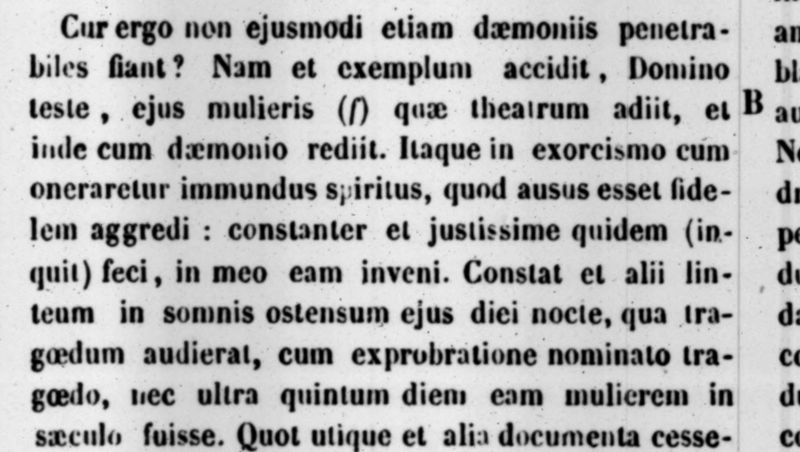
Why then should such people not become open to demons as well? For there is the example, the Lord is witness, of the woman who went to the theatre and came back from it with a demon. So, in the exorcism, when the unclean spirit was rebuked for having dared to attack a believer, it answered boldly: “And quite rightly too, I did it; I found her in my own domain.” It is well known, too, that another woman was shown a linen cloth in her sleep, on the night of the day she had heard a tragic actor, with reproaches in which the actor was named, and that this woman did not live beyond the fifth day.
Original Latin
Cur ergo non ejusmodi etiam dæmoniis penetrabiles fiant? Nam et exemplum accidit, Domino teste, ejus mulieris quæ theatrum adiit, et inde cum dæmonio rediit. Itaque in exorcismo cum oneraretur immundus spiritus, quod ausus esset fidelem aggredi: constanter et justissime quidem (inquit) feci, in meo eam inveni. Constat et alii linteum in somnis ostensum ejus diei nocte, qua tragœdum audierat, cum exprobratione nominato tragœdo, nec ultra quintum diem eam mulierem in sæculo fuisse.
Lecky (ch. I, text and note 23) retells both stories: the devil “replied apologetically, that it had found the woman in its house”, and the second woman “dreamed all the following night of a winding sheet, and heard the actor’s name ringing, with frightful reproaches, in her ears”. Tertullian’s devil is not apologetic but defiant (“constanter et justissime quidem feci”), and Lecky leaves out the end of the second story: she was dead within five days.
Lecky’s Quotation Collated
Lecky quotes the passage in note 152 from “Quae tunc spectaculi latitudo?” to “repræsentata”, with the reference “De Spectac. cap. xxx.” Set against Migne, the words are the same except at the points below. Spelling variants (æ/ae, j/i) are not listed.
| Lecky, 1865 | Migne | |
|---|---|---|
| Opening | Quæ tunc spectaculi latitudo? Quid admirer? Quid rideam? | Quae tunc spectaculi latitudo! quid admirer? quid rideam? |
| Kings | spectans tot et tantos reges | spectans tot ac tantos reges |
| Kings (end) | congemescentes! | congemiscentes? |
| Governors | Item præsides persecutores dominici nominis sævioribus quam ipsi flammis sævierunt insultantibus contra Christianos liquescentes! | item praesides, persecutores dominici nominis, saevioribus, quam ipsi contra christianos saevierunt, flammis insultantibus, liquescentes? |
| Philosophers | quos præterea sapientes illos philosophos coram discipulis suis una conflagrationibus erubescentes | praeterea sapientes illos philosophos coram discipulis suis una conflagrantibus erubescentes |
| Poets | … affirmabant! Etiam poetas non ad Rhadamanti nec ad Minois …palpitantes. | … affirmabant, etiam poetas non ad Rhadamanti, nec ad Minois … palpitantes? |
| The athletes | nisi quod ne tunc quidem illos velim visos | nisi quod nec tunc quidem illos velim visos |
| “Dicam” | Hic est ille dicam fabri aut quæstuariæ filius | Hic est ille (dicam) fabri aut quaestuariae filius |
| Ending | Ut talia spectes, ut talibus exultes quis tibi prætor, aut consul, aut quæstor, aut sacerdos de suâ liberalitate præstabit. Et tamen hæc jam quodammodo habemus per fidem spiritu imaginante repræsentata. | Ut talia spectes, ut talibus exsultes, quis tibi praetor aut consul, aut quaestor, aut sacerdos de sua liberalitate praestabit? et tamen haec iam quodammodo habemus per fidem spiritu imaginante repraesentata. |
| What follows | Lecky stops here. | Caeterum qualia illa sunt quae nec oculus vidit, nec auris audivit, nec in cor hominis ascenderunt? Credo, circo et utraque cavea et omni stadio gratiora. |
| Scan | (note 152, ch. III) | cols. 659–660, 661–662 |
The substantive differences are in the governors’ clause, where Lecky’s words are in another order, and “quos” and “conflagrationibus”. The order in his text is not a reading I could find in the apparatus of Migne’s page, so it may come from another edition (or from his copy); I have not been able to say which. The change of “tot ac tantos” to “tot et tantos” is likewise unexplained. None changes the sense. His statement of what the passage shows, that the early Church found pleasure in the sight of the damned, rests on the highlighted text, which supports it; but Tertullian’s own final sentence, which Lecky leaves out, adds that the joys “which neither eye has seen nor ear heard” are, he believes, more pleasing still than the circus and the theatres.
Editor’s notes on this page
In Chapter III Lecky argues that the early Church found a positive pleasure in the thought of the damned. His note 152 gives, in Latin, Tertullian’s picture in De spectaculis 30 of the Christian watching his persecutors, philosophers, poets and actors “in the fire”, and the Christ they mocked, instead of the games of the circus.
The quotation is substantially accurate and runs from “Quae tunc spectaculi latitudo” to the end of the paragraph on the pleasures “already represented by faith”. But it is not word for word: Lecky has one clause in a different order, an extra word, a few changed words, and different punctuation. All are listed in the table below. He also omits the last sentence of the chapter, which sets these pleasures against the circus.
Further down the rabbit hole
Sources that Lecky cites in the notes next to the ones that cite this page.
- Gregory the Great, Dialogues“I was sitting there upon the lettice, and she came and did eat me”
- Maury, La magie et l’astrologieRoman laws against diviners, the first medieval doubters, and the praying heretics
- Sprenger, Malleus MaleficarumThe witch-hunters’ handbook of the fifteenth century
- Swinden, An Enquiry into the Nature and Place of HellAn Anglican clergyman proves that hell is in the sun
- Codex Theodosianus, IX.16Lecky’s Latin matches the 1738 text word for word
- Aquinas, Summa theologiae, Supplement, q. 94Lecky’s quotation that is really a paraphrase

Backlinks
Every place in Rationalism in Europe that links to this page (generated automatically when the site is built).