The laws of Constantius against divination (pp. 117–118)
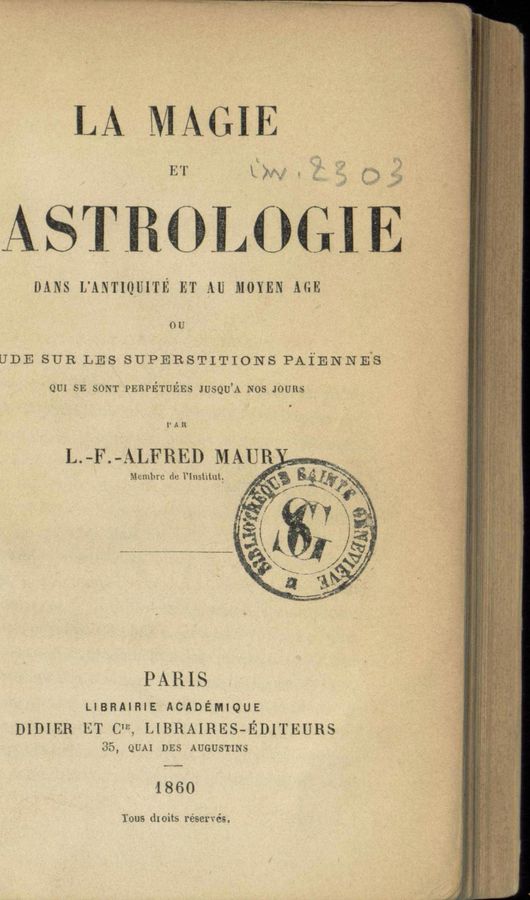
French: pp. 117–118, scan and scan. Highlighted: what Lecky quotes (note 29).
Constantine by his law of the year 321 permitted divination in its legal forms; he had condemned only the bad use that might be made of it; such had long been the rule. But Constantius went further and forbade the use of divination absolutely: Let the curiosity of divining be silent for ever … These general terms leave no doubt. And for fear that some interpreter of things to come should try to evade the law, care was taken to name every class of diviners. Let no one consult a haruspex, or a mathematicus; let the wicked confession of augur and seer be silent; Chaldaeans and magi, and the rest whom the common people call malefici for the greatness of their crimes.
In this way the ministers of polytheism most in credit were struck, and the practices that inspired superstition with the most confidence. Was it not to diviners that Maximin, Maxentius and Licinius had shown all their regard? Did they not consult them before taking the field? Many people no longer troubled to render to the gods the legal and consecrated worship, but the oracles, the augurs, the omens, almost all the pagans resorted to with confidence, and to take away the possibility of it was to strip them of what made their consolation and their joy.
Original French
Constantin permettait par sa loi de l’an 321 la divination sous les formes légales ; il n’avait condamné que le mauvais usage qu’on en pouvait faire ; telle était depuis longtemps la règle. Mais Constance alla plus loin et interdit absolument l’emploi de la divination : Sileat omnibus perpetuo divinandi curiositas … Ces termes généraux ne laissent aucun doute. Et de crainte que quelque interprète des choses futures ne tentât de se soustraire à la loi, on prit soin de désigner nominativement toutes les classes de devins. Nemo haruspicem consulat, aut mathematicum nemo, hariolum, augurem et valem, prava confessio conticescat ; Chaldaei, et magi, et caeteri quos maleficos ob facinorum magnitudinem vulgus appellat.
De la sorte, se trouvaient atteints les ministres du polythéisme les plus en crédit, les pratiques qui inspiraient à la superstition le plus de confiance. N’était-ce pas en effet aux devins que Maximin, Maxence, Licinius, avaient témoigné toute leur considération ? ne les consultaient-ils pas avant d’entrer en campagne ? Bien des gens ne se souciaient plus de rendre aux dieux le culte légal et consacré, mais les oracles, les augures, les présages, presque tous les païens y recouraient avec confiance, et leur en enlever la possibilité, c’était les dépouiller de ce qui faisait leur consolation et leur joie.
Maury’s notes: ¹ Cod. Theodos., lib. IX, tit. xvi, l. 3. ² Ibid., lib. IX, tit. xvi, l. 4, p. 128, t. III, éd. Ritter. ³ Ibid., éd. cit.
Lecky’s note 29: “On these laws, M. Maury well says, ‘De la sorte se trouvaient atteints les ministres du polythéisme les plus en crédit, les pratiques qui inspiraient à la superstition le plus de confiance \* \* \* Bien des gens ne se souciaient plus de rendre aux dieux le culte légal et consacré; mais les oracles, les augures, les présages, presque tous les païens y recouraient avec confiance, et leur en enlever la possibilité c’était leur dépouiller de ce qui faisait leur consolation et leur joie’ (pp. 117, 118).” Collation: Maury has “De la sorte, se trouvaient” (comma); Lecky joins the two sentences with asterisks and omits the sentences on Maximin, Maxentius and Licinius; “consacré, mais” becomes “consacré; mais”; “possibilité, c’était” loses its comma; and Lecky’s “leur dépouiller” is the book’s “les dépouiller”. Lecky’s note is left as printed. For the Latin laws Maury quotes, see Codex Theodosianus IX.16, law 4.
The emperors keep the future to themselves (ch. IV, pp. 79–81)
French: ch. IV, “La magie à Rome et dans l’empire romain”, pp. 79 and 81, scans n90 and n92.
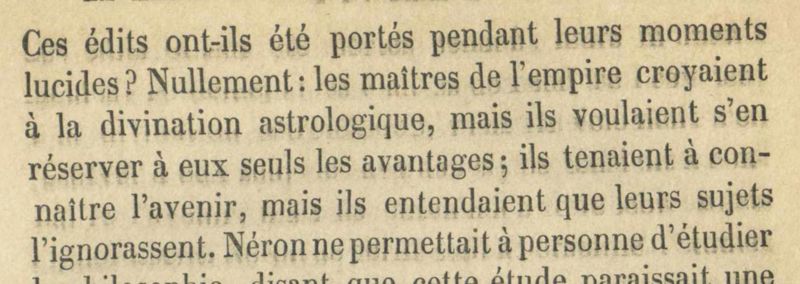
[p. 78] … Did superstition seize the emperors only in fits? [p. 79] Were these edicts issued in their lucid moments? Not at all: the masters of the empire believed in astrological divination, but they wanted to keep its advantages to themselves alone; they were set on knowing the future, but they meant their subjects to remain ignorant of it. … It would indeed have been dangerous for citizens to be able to read in the stars the fate in store for their prince. … And then curiosity might go so far as to want to find out when and how the emperor would die, indiscreet questions to which the answers were conspiracies and assassinations. That is what the heads of the State feared above all.
[p. 81] Divination that had the emperor for its object came in the end to be a crime of high treason. The severities against the indiscreet curiosity of ambition took on more terrible proportions under the first Christian emperors. We shall see under Constantius many people who had consulted oracles punished with the cruellest tortures.
Original French
[p. 78] … Est-ce que la superstition ne prenait les empereurs que par accès? [p. 79] Ces édits ont-ils été portés pendant leurs moments lucides? Nullement: les maîtres de l’empire croyaient à la divination astrologique, mais ils voulaient s’en réserver à eux seuls les avantages; ils tenaient à connaître l’avenir, mais ils entendaient que leurs sujets l’ignorassent. … Il eût été dangereux, en effet, que les citoyens pussent lire dans les astres le sort réservé à leur prince. … Et puis, on pouvait pousser la curiosité jusqu’à vouloir découvrir quand et comment mourrait l’empereur, indiscrètes questions, auxquelles les réponses étaient des conspirations et des attentats. C’est ce que redoutaient surtout les chefs de l’État.
[p. 81] La divination qui avait l’empereur pour objet finit par constituer un crime de lèse-majesté. Les rigueurs contre la curiosité indiscrète de l’ambition prirent des proportions plus terribles sous les premiers empereurs chrétiens. Nous verrons sous Constance quantité de personnes qui s’étaient adressées aux oracles punies des plus cruels supplices.
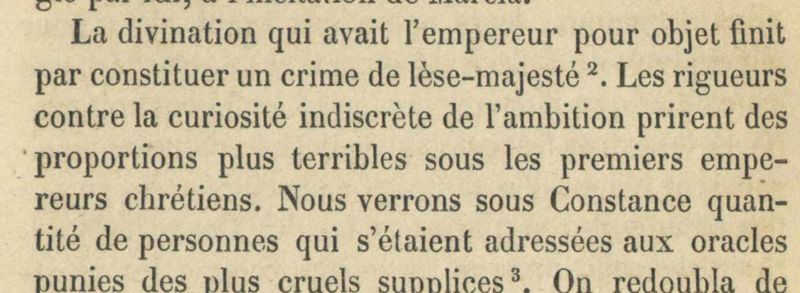
Lecky’s ch. I paragraph before notes 15 and 16 follows these pages closely: the diviner “by casting the horoscope of the reigning emperor” encouraged conspiracies (Maury: the answers to such questions “were conspiracies and assassinations”), “a law, which made divination concerning the future of the emperor, high treason” (Maury p. 81, citing Paul’s Sententiae V.21.3 and Tertullian, Apologeticum 35), and “the emperors desired to monopolise the knowledge of the future” (p. 79). Lecky’s note 15 gives “pp. 78–85” and note 16 “ch. iv.”: pp. 78–85 lie inside that chapter, on magic at Rome and in the Roman empire, and they fit. Pp. 78, 80 and 82–85 (Tiberius’s horoscopes, Septimius Severus, the expulsions of astrologers) are from the OCR only.
The Dusii and the “Deuce” (p. 189)
French: p. 189, with Maury’s note 2, scan n200.
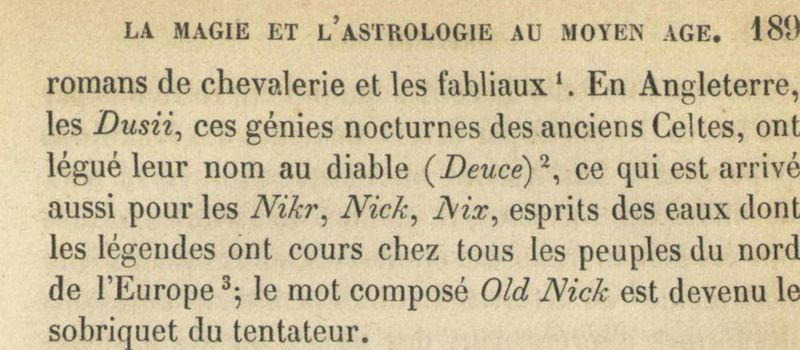
… In England, the Dusii, those night spirits of the ancient Celts, have bequeathed their name to the Devil (Deuce), as has happened too with the Nikr, Nick, Nix, water spirits whose legends are current among all the peoples of northern Europe; the compound Old Nick has become the nickname of the tempter.
[note 2] St Augustine, City of God, XV, c. 23. Compare A. Maury, Les fées du moyen âge, p. 89.
Original French
… En Angleterre, les Dusii, ces génies nocturnes des anciens Celtes, ont légué leur nom au diable (Deuce), ce qui est arrivé aussi pour les Nikr, Nick, Nix, esprits des eaux dont les légendes ont cours chez tous les peuples du nord de l’Europe; le mot composé Old Nick est devenu le sobriquet du tentateur.
[note 2] S. Augustin., De Civit. Dei, XV, c. xxiii. Cf. A. Maury, les Fées du moyen âge, p. 89.
Lecky’s ch. I note 21 (“The Dusii, whose exploits St. Augustine mentions, were Celtic spirits, and are the origin of our ‘Deuce’ (Maury, p. 189)”) matches the page and Maury’s footnote, which sends the reader to the same chapter of the City of God that Lecky quotes at the head of the note (see the Augustine page). The etymology is Maury’s, not Lecky’s.
The first free-thinkers and the lawyers (p. 221)
French: p. 221, scan (chapter “La magie de la Renaissance à nos jours”). Highlighted: Lecky’s quotation in note 93.
… It was the free-spirits (esprits forts) of the beginning of the seventeenth century who first strove to combat the prevailing prejudice, and to defend unfortunate madmen or indiscreet inquirers against the tribunals. This required courage, for one risked, in trying to save the accused’s head, being taken oneself for a confederate of the devil, or, what was no better, for an unbeliever. The free-thinkers, the libertins as they were then called, had little credit; generally frivolous in their denials, they put at the service of their cause only a vulgar good sense which frightened people like atheism, and which deeply shocked the faithful, accustomed to counting good sense for nothing where orthodoxy was concerned.
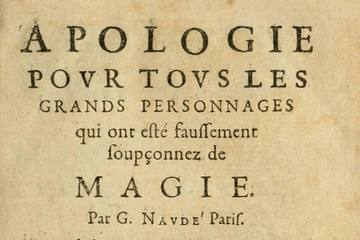
Gabriel Naudé went further in boldness and displayed his opinion in a book published in 1625 under the title Apologie pour les grands hommes accusés de magie. It is true that those he defended had long been dead and had only their memory to fear for; his book, though prudently dedicated to a president of the parlement of Paris, gave some offence to the law and could be reprinted only abroad. …
Original French
… Ce furent les esprits forts du commencement du dix-septième siècle qui s’efforcèrent les premiers de combattre le préjugé régnant, de défendre de malheureux fous ou d’indiscrets chercheurs contre les tribunaux. Il fallait pour cela du courage, car on risquait, en cherchant à sauver la tête du prévenu, de passer soi-même pour un affidé du diable, ou, ce qui ne valait pas mieux, pour un incrédule. Les libres penseurs, les libertins, comme on les appelait alors, n’avaient que peu de crédit ; généralement frivoles dans leurs négations, ils ne mettaient au service de leur cause qu’un bon sens vulgaire qui effarouchait comme de l’athéisme, et qui choquait profondément les fidèles habitués à ne compter le bon sens pour rien, quand il s’agissait d’orthodoxie.
Gabriel Naudé poussa plus loin la hardiesse et afficha son opinion dans un livre publié en 1625, sous le titre d’Apologie pour les grands hommes accusés de magie. Il est vrai que ceux dont il prenait la défense étaient morts depuis longtemps et n’avaient à craindre que pour leur mémoire ; son livre, quoique prudemment dédié à un président du parlement de Paris, porta quelque ombrage à la justice et ne put se réimprimer qu’à l’étranger. …
Lecky’s note 93 is accurate; it stops at “n’avaient que peu de crédit.” where Maury’s sentence continues after a semicolon, and “ou ce que ne valait pas mieux” lacks the commas and the “qui” (“ce qui ne valait pas mieux”) of the book. Note 92 (“Maury, pp. 221, 222. The principal of those writers was Naudé, whose Apologie pour les Grands Hommes Soupçonnez de Magie …”) refers to the next paragraph, which is on this page. Note that Lecky’s title is that of Naudé’s book (“Soupçonnez”), while Maury’s gives “accusés”.
The Messalians (p. 317)
French: p. 317, scan (chapter “Possession démoniaque”).
… The Lives of the Fathers of the Desert swarm with these aberrations of the religious mind. In the fourth century there appeared the sect of the Messalians, which had Sabas for its chief, believing itself constantly besieged by demons; and these unfortunates blew their noses, spat incessantly, made horrible contortions in order to drive them off, and even shot arrows at times at these invisible beings.
Original French
… Les Vies des Pères du désert fourmillent de ces aberrations de l’esprit religieux. Au quatrième siècle, on vit la secte des messaliens, qui eut Sabas pour chef, se croire sans cesse assiégée par les démons ; et ces malheureux se mouchaient, crachaient sans cesse, faisaient d’horribles contorsions, pour les repousser, et tiraient même quelquefois des flèches sur ces êtres invisibles.
Lecky’s note 20: “One sect of heretics of the fourth century — the Messalians — went so far as to make spitting a religious exercise, in hopes of thus casting out the devils they inhaled. (Maury, p. 317.)” Maury’s sentence supports the spitting, the demons and the fourth century. “Religious exercise” and “devils they inhaled” are not in this sentence or its footnotes; “inhaled” may come from Maury’s other sources, which I have not checked.
Valentinian’s persecution (pp. 118–119)
French: pp. 118–119, scan and scan.
However, under the following reign these rigours were relaxed. Jovian seems to have shown himself fairly tolerant towards the pagans. … Valentinian I directed against magicians and the abettors of magical practices a relentless persecution of which Ammianus Marcellinus has given us the circumstances. … Several eminent persons, and notably Marinus, a famous advocate, were involved in the prosecution and put to death. Everywhere, says Zosimus, one saw tears flowing, everywhere one heard groans; the prisons were full of people whom their merit had not been able to save from captivity. Thus the Christian emperors had become as persecuting as the pagan emperors, and expiring paganism had its martyrs as nascent Christianity had had its own.
Original French
Toutefois, sous le règne suivant, on se relâcha de ces rigueurs. Jovien paraît s’être montré assez tolérant à l’égard des païens. … Valentinien Ier dirigea contre les magiciens et les fauteurs des pratiques magiques une persécution acharnée dont Ammien-Marcellin nous a rapporté les circonstances. … Plusieurs personnages éminents, et notamment Marinus, avocat célèbre, furent impliqués dans la poursuite et mis à mort. Partout, dit Zosime, on voyait couler des larmes, partout on entendait pousser des gémissements ; les prisons étaient remplies de personnes que leur mérite n’avait pu sauver de la captivité. Ainsi les empereurs chrétiens étaient devenus aussi persécuteurs que les empereurs païens, et le paganisme expirant avait ses martyrs comme le christianisme naissant avait eu les siens.
Lecky (note 33, after the text “Valentinian … consented to its remaining inoperative [in Greece] … but, in other portions of the Empire, fearful scenes of suffering and persecution were everywhere witnessed”): “Maury, pp. 118, 119.” The suffering and persecution are on these pages (with Maury’s citation of Zosimus, iv. 14, and Ammianus, xxvi. 3). The law “against impious prayers and midnight sacrifices” and its suspension for Greece are not on these two pages; I did not look elsewhere in Maury for them.
La Bruyère on magic (p. 219, footnote 4)
French: p. 219, scan; the quotation continues on p. 220, which I did not read.
⁴ “What are we to think, writes La Bruyère, of magic and sorcery? The theory of it is obscured, the principles vague, uncertain, and bordering on the visionary; but there are embarrassing facts, affirmed by grave men who have seen them; to admit them all or to deny them all seems an equal inconvenience, and I venture to say that in this, as in all extraordinary things that depart from the common rules, there is a middle course to be found between …
Original French
⁴ « Que penser, écrit La Bruyère, de la magie et du sortilège ? La théorie en est obscurcie, les principes vagues, incertains, et qui approchent du visionnaire ; mais il y a des faits embarrassants, affirmés par des hommes graves qui les ont vus ; les admettre tous ou les nier tous paraît un égal inconvénient, et j’ose dire qu’en cela comme en toutes les choses extraordinaires et qui sortent des communes règles, il y a un parti à trouver entre …
Lecky’s sentence in the text (“La Bruyère said that the principles on which magic rests seem vague, uncertain, and visionary; but that many embarrassing facts have been attested by credible eye-witnesses; that it appeared equally to admit or to deny them, and that it was better to take a central position between the credulous who admitted all, and the freethinkers who rejected all”) is a faithful summary of this passage; the “credulous” and “freethinkers” must be on the next page. Note 94 says only “See the passage in Maury, p. 219.” I did not check La Bruyère’s own text (Les Caractères, “Des esprits forts”).
Pacts with the devil and the Sabbath (p. 185)
French: p. 185, scan (chapter “La magie et l’astrologie au moyen âge”).
The idea that magic is a diabolical work was so general that the sorcerers had ended by seeing demons themselves in the gods evoked by their enchantments; but they were none the less confident in their protection for that; they bound themselves to them by pacts², and imagined they went in their company to the Sabbath. In this too they did not depart entirely from the ancient datum, for the Romans also believed that the use of talismans and charms devoted those against whom they were used to the infernal powers. …
² Belief in pacts with the devil spread chiefly in the fifteenth and sixteenth centuries, but it was already credited in the twelfth and thirteenth. See Soldan, Geschichte der Hexenprocesse, p. 142. The sorcerer sold his soul to the evil spirit for money … Satan marked his children, as God marked his own by baptism. See J. G. Dalyell, The Darker Superstitions of Scotland, p. 576. Soldan, p. 201.
Original French
L’idée que la magie est une œuvre diabolique fut si générale que les sorciers avaient fini par voir eux-mêmes les démons dans les dieux évoqués par leurs enchantements ; mais ils n’en demeuraient pas pour cela moins confiants en leur protection ; ils s’engageaient à eux par des pactes², et s’imaginaient aller en leur compagnie au sabbat. En cela encore, ils ne s’écartaient pas tout à fait de la donnée antique, car les Romains croyaient aussi que l’emploi des talismans, des charmes, vouait ceux contre lesquels ils étaient employés aux puissances infernales. …
² La croyance aux pactes avec le diable se répandit surtout au quinzième et au seizième siècle, mais elle était déjà accréditée au douzième et au treizième. Voy. Soldan, Geschichte der Hexenprocesse, p. 142. Le sorcier vendait au malin esprit son âme pour de l’argent … Satan marquait ses enfants, comme Dieu marquait les siens par le baptême. Voy. J. G. Dalyell, The Darker Superst. of Scotland, p. 576. Soldan, p. 201.
Lecky’s sentence, to which note 49 is attached, says that in the twelfth century “the conception of a witch, as we now conceive it — that is to say, of a woman who had entered into a deliberate compact with Satan, who was endowed with the power of working miracles whenever she pleased, and who was continually transported through the air to the Sabbath … first appeared”. Maury’s footnote dates belief in the pact to the twelfth and thirteenth centuries, in agreement; but he adds on this page that the idea of a diabolical magic is older and that the pact and the Sabbath do not depart “entirely from the ancient datum”, so that “first appeared” is Lecky’s wording rather than Maury’s. Maury’s footnote also cites Dalyell, p. 576, which is on this site.
Editor’s notes on this page
Both French quotations are accurate. Note 29 (pp. 117–118) has one slip, “leur dépouiller” for the book’s “les dépouiller”, and a comma turned into a semicolon; the Latin laws of Constantius that Maury quotes on p. 117 are those of the Codex Theodosianus IX.16 law 4, from Ritter’s edition, which is also on this site. Note 93 (p. 221) stops where Maury’s sentence continues. Note 20 (p. 317) is looser: Maury says the Messalians “se mouchaient, crachaient sans cesse”, made contortions and shot arrows at the demons; he does not say there that they made spitting a “religious exercise”, nor that they “inhaled” devils (the page does not contain either claim, though Lecky may have another page in mind).
Further down the rabbit hole
Sources that Lecky cites in the notes next to the ones that cite this page.
- Bodin, Démonomanie des SorciersThe great lawyer who wrote the witch-hunters’ handbook
- Codex Theodosianus, IX.16Lecky’s Latin matches the 1738 text word for word
- Sprenger, Malleus MaleficarumThe witch-hunters’ handbook of the fifteenth century
- Garinet, Histoire de la Magie en FranceA history of magic in France, from the Frankish kings to the author’s own day
- Augustine, De civitate DeiSeventy reports, not miracles, and a town, not a province
- Naudé, Apologie pour tous les grands personnages qui ont esté faussement soupçonnez de magieA librarian clears the great men of magic: Pope Sylvester, Pietro d’Abano, Agrippa
Backlinks
Every place in Rationalism in Europe that links to this page (generated automatically when the site is built).