The Box in the Church (p. 623) and the Aberdeen Inquisition (p. 624)
English: Dalyell, 1834, pp. 623–624 (p. 623, p. 624). As printed (the scan’s long text has been read from the image). Highlighted: the sentences behind Lecky’s notes 146–148.
[p. 623] … Clandestine information, it is said, was sought, “by placing an empty box in church, to receive a billet with the sorcerer’s name, and the date and description of his deeds.”‖ Too many readily assented, and a secret enquiry on the truth or probability of the accusation, before some of the ecclesiastical judicatories, such as the kirk session, followed.
‖ Bodinus, lib. iv. c. 1. p. 321. illustrates the custom of Milan from Scotish practice.
[p. 624] But besides the operation of private calumnies, a general discovery of offenders was occasionally contemplated by the zealous, and conducted on a scale of unexampled magnitude, like huntsmen beating up extensive coverts for dislodging beasts of prey. A whole presbytery was up in arms. Thus, “at the College of auld Abirdene, the sext of Januar 1603,” it was ordained that every minister should make “ane subtill and privie inquisitioun, heirin: videlicet, the minister with tua of his elderis, that feris God and ar maist zealous for his glorie, at ilk particular kirk respectivè, tak the aithis of the inhabitants within thair charge, quhat thay knaw of wiches and consultaris with thame: and wreitt thair depositiounis, and returne the same to the presbyterie, with the names of sic as ar metest to be assysouris to thame, that the same may be sent to the Marques with all hastie expeditioun, conforme to the desyre of his Lordschip’s letter.” Meantime the conduct of individuals underwent a secret scrutiny …
What the box note says
Dalyell’s footnote to the “box” sentence cites Bodin’s Démonomanie (book IV, ch. 1, p. 321), and says Bodin “illustrates the custom of Milan from Scotish practice”. That is hard to read: on the ordinary sense, Bodin uses the Scottish practice to illustrate Milan. Reginald Scot’s Discovery of Witchcraft (1665, Book II ch. 2) reports that Bodin “commendeth much the Scottish custome”, a hollow chest in the church with three locks (see the Scot page); so the Scottish box is Bodin’s report, not independent evidence. I have not looked at Bodin’s p. 321 itself. What matters here is that Dalyell himself reports the Scottish box as something “it is said”, not as established.
“Watching” (pp. 644–645)
English: Dalyell, 1834, pp. 644–645 (p. 644, p. 645), under the heading “Watching”. As printed. Highlighted: the sentences behind Lecky’s notes 150–153.
[p. 644] Watching.—Though privation of sleep be described as “the choicest means they use in Scotland for discovery of witches,” it was not restricted to them only; for, after other expedients for detecting a conspiracy, had failed to obtain confession, the commander of the forces was enjoined to employ the most trusty officers or soldiers to watch “Master William Spence be turnes, and not to suffer him to sleep by night or by day, and, for that end, to use all effectual meanes for keeping him still awake.” Another was “withhaldin from sleep to the great perturbation of his brayne.” By means of tortures, pricking, watching,
[p. 645] and keeping several women from sleep, James Gillespie, minister of Rind, and some coadjutors, were charged with having obtained false confessions, whereon the innocent had suffered death. Several also, under a guard of drunken fellows at Pittenweem, were kept days and nights awake, which “cruel usage made some of them to be so wise as to acknowledge every question that was asked of them, whereby they found the minister and baillies well pleased, and themselves better treated.” One was kept five days and nights awake by continual pricking, to the great effusion of her blood: and this kind of torture is alleged to have been protracted even to nine nights.
Suspected sorcerers were treated thus in England. Conjoined with other torture it was common on the continent, and esteemed singly as the most effectual inducement to confess. Keeping the suspected awake for the same purpose, is still practised in the Turkish dominions: and it may be traced to ancient date, in Proto Sebastus having been kept awake three days and nights, by his guards pricking him.
Not transcribed here
The page 644 text above the “Watching” heading (on the French royal commission that examined fourteen persons condemned on the “insensible mark”) and the footnotes, which cite the Privy Council records (1662, 1684), Webster’s Tracts, Shields’s A Hind Let Loose (p. 198) and other sources. Lecky’s notes 150 and 152 (the witches’ bridle, the saying that a witch would not confess while she could drink) are on pages I have not read.
Lecky’s Statements Compared
| Lecky (ch. I) | Dalyell | Comment |
|---|---|---|
| “Assembled in solemn synod, the College of Aberdeen, in 1603, enjoined every minister to take two of the elders of his parish to make ‘a subtle and privy inquisition,’ and to question all the parishioners upon oath as to their knowledge of witches.” Note 146: “p. 624.” | p. 624: the “College of auld Abirdene, the sext of Januar 1603” ordained every minister to make “ane subtill and privie inquisitioun” with two elders, taking “the aithis of the inhabitants … quhat thay knaw of wiches and consultaris with thame”. | Accurate, and the page agrees. It was a presbytery meeting (“a whole presbytery was up in arms”), “College” being the place; “solemn synod” is Lecky’s phrase. Lecky leaves out that the returns were to go to the Marquis (of Huntly) at his letter’s desire. |
| “Boxes were placed in the churches for the express purpose of receiving the accusations.” Note 147: “Ibid. p. 623.” | p. 623: “it is said, was sought, ‘by placing an empty box in church, to receive a billet …’”, with a note citing Bodin on Milan. | Lecky drops Dalyell’s “it is said” and states the practice as a fact. Dalyell does not give a Scottish source for it on this page. |
| “When a woman had fallen under suspicion, the minister from the pulpit denounced her by name, exhorted his parishioners to give evidence against her, and prohibited anyone from sheltering her.” Note 148: “Ibid. p. 624, &c.” | p. 624: public accusation “was invited, as by the kirk session directing their officer to intimate, that those who had anything to say against ‘Jonet …’” (the page breaks off). | The next page (not read) presumably continues; the “&c.” covers it. On p. 624 the invitation is by the kirk session’s officer, not the minister from the pulpit, and I did not see the sheltering prohibition on this page. |
| “Some prisoners have been waked for five nights; one, it is said, even for nine.” Note 153: “Dalyell, p. 645.” | p. 645: “One was kept five days and nights awake by continual pricking … and this kind of torture is alleged to have been protracted even to nine nights.” | Accurate: Lecky keeps Dalyell’s hedge (“it is said”). Dalyell’s “five” is one woman at Pittenweem, kept awake by pricking, which Lecky generalises to “some prisoners”. |
| Note 151: “Dalyell, p. 645. The ‘prickers’ formed a regular profession in Scotland.” | pp. 644–645: “pricking” is mentioned as part of the tortures; the probe of “the pricker” is discussed on p. 644. | “Regular profession” is not on p. 645. In the OCR of earlier pages (pp. 641–643, not read on the image) a fee paid to “the celebrated pricker” John Kincaid is recorded, which would support Lecky’s statement; the page reference may simply be a few pages out. Unverified. |
| (Text, ch. I) “the most effectual … method of obtaining confession was by what was termed ‘waking her.’” | p. 644: sleep-deprivation described as “the choicest means they use in Scotland for discovery of witches” (quoting Remesey, 1684); p. 645: “common on the continent, and esteemed singly as the most effectual inducement to confess”. | Dalyell’s “most effectual” refers to the practice on the continent. For Scotland he quotes a contemporary calling it “the choicest means”. Dalyell also stresses that it was used in England, on the continent and in Turkey, so it was not peculiarly Scottish, which Lecky’s account does not say. |
Fire-matches (p. 657)
English: Edinburgh 1834, p. 657, scan n673.

… Few instruments of punishment can be traced to their origin. The boot is said to have been applied to the slaves destined for the British colonies. In 1722, a reputed witch was burnt in the soles of the feet, and executed. Fire matches were frequently used to extort confession. Kindling straw under the feet of suspected sorcerers was practised …
Lecky’s ch. I note 155 (p. 657) supports “Fire-matches were sometimes applied to the body of the victim”: Dalyell says “frequently”, Lecky “sometimes”, for once milder than his source. The next page (OCR only) adds matches used on servants and wives to make them inform on masters and husbands.
More dead in Scotland in 1662 than in England in two centuries? (p. 669)
English: Edinburgh 1834, p. 669, scan n685.
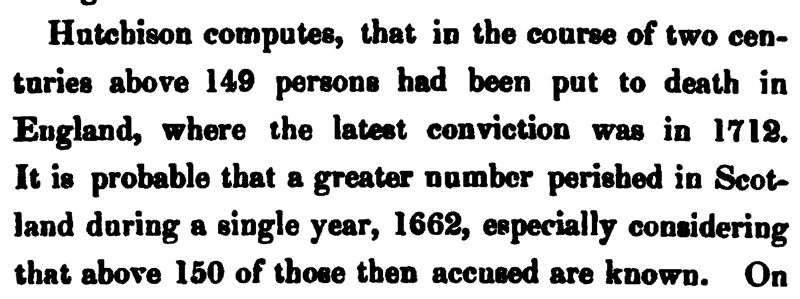
Hutchison computes, that in the course of two centuries above 149 persons had been put to death in England, where the latest conviction was in 1712. It is probable that a greater number perished in Scotland during a single year, 1662, especially considering that above 150 of those then accused are known.
Lecky’s ch. I note 157 (p. 669): “We know that in 1662, more than 150 persons were accused of witchcraft.” Exact. Lecky stops short of Dalyell’s guess that Scotland put more witches to death in that one year than England did in two centuries (Hutchinson’s count is on the Hutchinson page); he says only that the number of victims “it is now impossible to say”.
Scotland, 1662–1678: numbers accused and burnt (pp. 669–670)
English: Edinburgh, 1834, pp. 669–670, scan p. 669, scan p. 670. The asterisked note on p. 670 is not transcribed.
P. 669. Hutchison computes, that in the course of two centuries above 149 persons had been put to death in England, where the latest conviction was in 1712. It is probable that a greater number perished in Scotland during a single year, 1662, especially considering that above 150 of those then accused are known. On the 13th of September 1678, ten women were brought to the bar of the Court of Justiciary, nine of whom were condemned to be strangled and burnt: and on the very day that this bloody tribunal sanctioned their slaughter, other nine were outlawed. But immediately afterwards, as if the sense of the nation had been awakened to such an outrage on reason and mercy, persecution seems to have slumbered for a season.
P. 670. Besides the numerous trials and punishments for sorcery occupying the records of judicatories, and historical compositions, general allusions are found to “the last burning of witches,” regarding which no other memorials are preserved. “I remember,” says a stranger visiting Scotland, that “in 1644, I saw nine burnt at one time in Leith Links.”* Only a single capital conviction, in the course of that year, appears in the records of the supreme court. Therefore the numbers perishing must have been very great.
Lecky uses these pages for three statements (ch. I, pp. 142–143). “We know that in 1662, more than 150 persons were accused of witchcraft” (note 157, “Dalyell, p. 669”): accurate. “In 1678, nine others were condemned in a single day” (note 159, “Dalyell, pp. 669, 670”): accurate. But “one traveller casually notices having seen nine women burning together at Leith in 1664” departs from Dalyell twice: Dalyell’s traveller saw nine burnt in 1644, and does not say they were women. The 1865 print (vol. I, p. 143, scan) does read “1664”; it is left as printed.
Editor’s notes on this page
Lecky’s picture of the Scottish ministers hunting witches rests on a handful of pages of Dalyell. They bear him out on the Aberdeen inquisition of 1603 and on “waking” (keeping a prisoner from sleep, up to nine nights), but in three places Lecky states as fact what Dalyell reports with a qualification: that boxes “were placed in the churches” to receive accusations (Dalyell says “it is said”, and cites Bodin on Milan), that a minister from the pulpit “denounced her by name” (I did not find that on the page cited), and that pricking was a “regular profession” (not on p. 645, but earlier in the chapter).
Dalyell also says that waking was not peculiar to Scotland: it was used in England, “common on the continent”, and in the Turkish dominions. See the comparison.
Further down the rabbit hole
Sources that Lecky cites in the notes next to the ones that cite this page.
- Pitcairn, Ancient Criminal Trials in ScotlandIsobel Gowdie’s confessions, and who took them
- Burt, Letters from a Gentleman in the North of ScotlandBurt’s 1727 pitch-barrel burning at Dornoch
- Buckle, History of Civilization in EnglandWeather and credulity, and the Scottish clergy’s Devil who had been studying for five thousand years
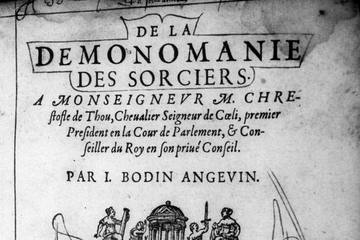
- Bodin, Démonomanie des SorciersThe great lawyer who wrote the witch-hunters’ handbook
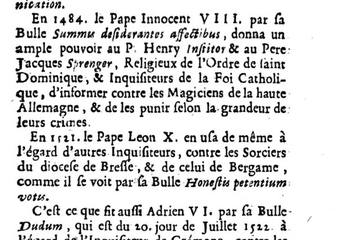
- Thiers, Traité des SuperstitionsThree papal bulls but no rebellion
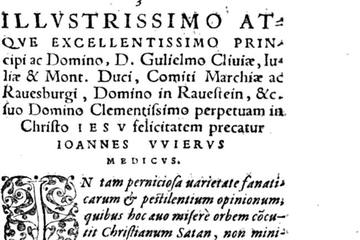
- Wier, De praestigiis daemonumThe physician who doubted the witches, and the council that banned dancing bears

Backlinks
Every place in Rationalism in Europe that links to this page (generated automatically when the site is built).