Letter XII, p. 281: The Burning at Dornoch
English: Burt, 1754, vol. I, p. 281 (scan). Long s printed as s. Highlighted: the sentences Lecky relies on.
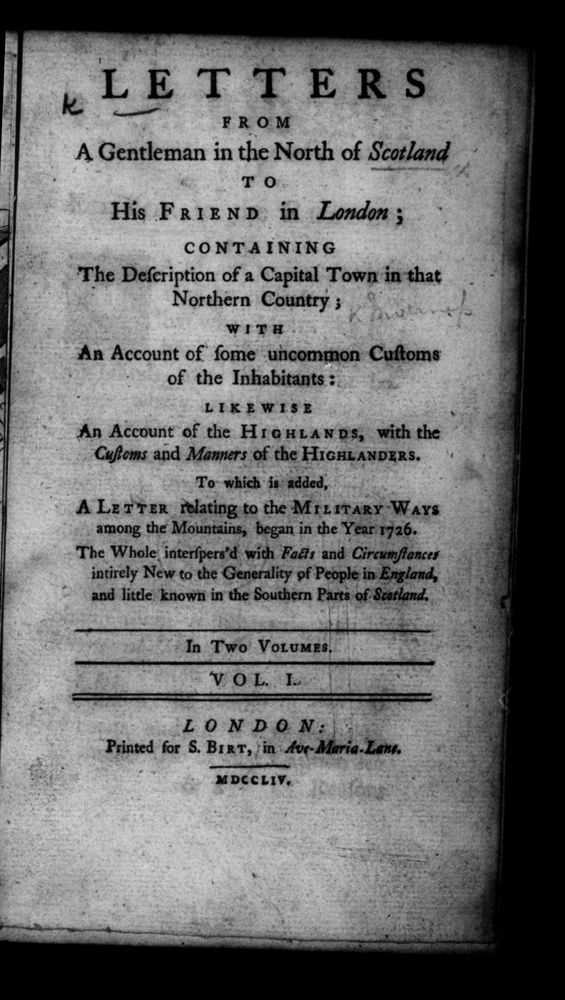
But I shall now give you an Instance (in this Country) wherein the Judge was not so clear-sighted.
In the Beginning of the Year 1727, two poor Highland Women (Mother and Daughter) in the Shire of Sutherland, were accused of Witchcraft, tried and condemned to be burnt. This Proceeding was in a Court held by the Deputy Sheriff. The young one made her Escape out of Prison, but the old Woman suffered that cruel Death, in a Pitch-Barrel, in June following, at Dornoch, the Head Borough of that County.
In the Introduction to the Chapter under the Title of Witchcraft in Nelson’s Justice, which I have by me, there are these Words: “It seems plain that there are Witches, because Laws have been made to punish such Offenders, though few have been convicted of Witchcraft.” …
Lecky’s Note Compared
| Lecky | Burt | Comment |
|---|---|---|
| “Captain Burt, who visited the country in 1730, speaks of a woman who was burnt as late as 1727.” | p. 281: condemned early in 1727; the old woman burnt in June following at Dornoch. | Burt says 1727 explicitly. The date of Burt’s visit (“1730”) is not on this page. Burt does not say he was present: he gives the case as an “Instance” of a judge who “was not so clear-sighted”, and he is arguing against the belief. |
| Note 166: “I suspect Burt has misdated the execution that took place in 1722, placing it in 1727.” | (1727 stated twice: “Beginning of the Year 1727”, and “June following”.) | The suspicion is Lecky’s. Burt’s account is internally consistent about the year; whether he or the “generally said” date of 1722 is right is not settled by this page. |
Editor’s notes on this page
Lecky says the last Scottish execution for witchcraft is “generally said” to be of 1722, but that Captain Burt, “who visited the country in 1730, speaks of a woman who was burnt as late as 1727”, adding that he suspects Burt has misdated the 1722 case. Burt’s text bears out the first part: he says that in the beginning of 1727 a mother and daughter in Sutherland were condemned, and that the old woman was burnt in a pitch-barrel at Dornoch in the following June.
Burt gives the year plainly, and gives details (the daughter’s escape, the deputy sheriff’s court). Lecky’s suspicion that Burt confused 1722 with 1727 is Lecky’s own and cannot be checked here. The case is the one now usually called the last Scottish execution for witchcraft, but I did not check that claim against a modern source.
Further down the rabbit hole
Sources that Lecky cites in the notes next to the ones that cite this page.
- Dalyell, The Darker Superstitions of ScotlandThe tortures of the Scottish witch-trials
- Pitcairn, Ancient Criminal Trials in ScotlandIsobel Gowdie’s confessions, and who took them
- Macaulay, History of England and EssaysMacaulay on Puritans, bear-baiting and the servile Church
- Scott, Letters on Demonology and WitchcraftKing James, the kirk, and witch-burning as a “royal syllogism”
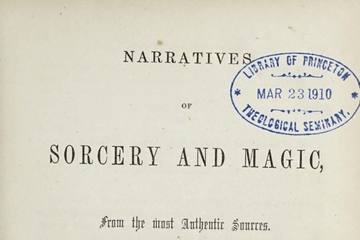
- Wright, Narratives of Sorcery and MagicWright’s six hundred at Bamberg is on p. 326
- Augustine, De civitate DeiSeventy reports, not miracles, and a town, not a province
Backlinks
Every place in Rationalism in Europe that links to this page (generated automatically when the site is built).