The Table of Facts, 1634–1646 (p. 37)
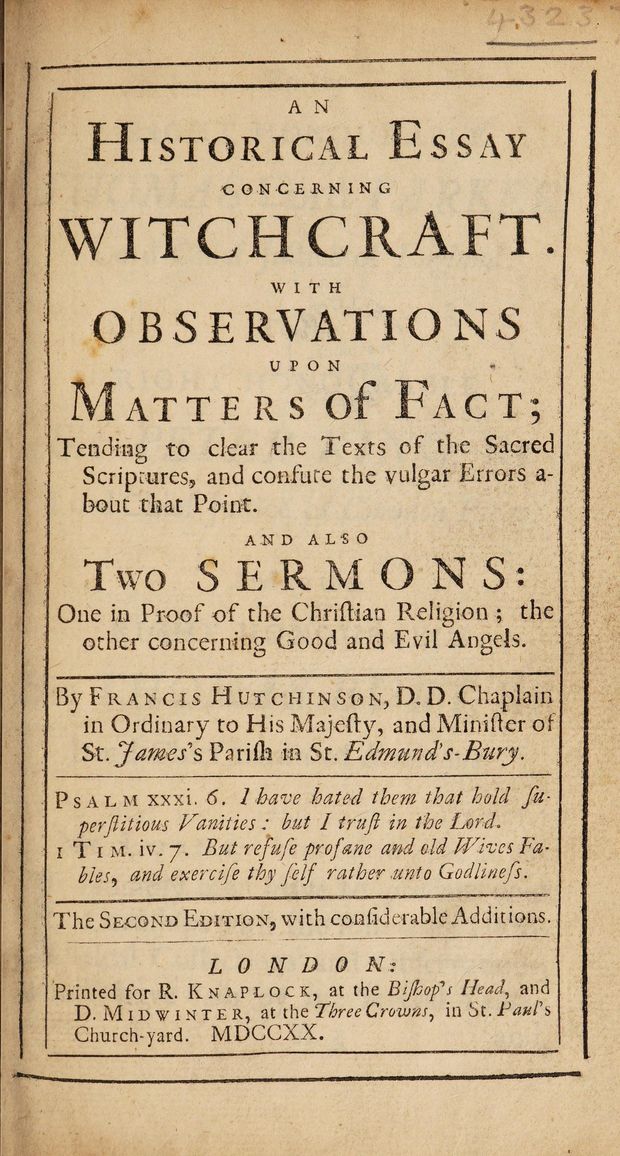
English: Hutchinson, 1718, p. 37 (scan). Long s printed as s; the year column is given in brackets. Highlighted: the entries for the 1640s.
… stripp’d naked, search’d for insensible Marks, and put to cruel Pains, while they try’d with an artificial Knife, which Parts of him were sensible, and which not. … After that he was tortur’d till he swooned upon the Rack; and maintaining his Innocence, he was at last inhumanly burnt, without being suffered either to unbosom his Mind to his Confessor, or speak to the People. See the Ways of their Wickedness fully proved in Histoire de Diables de Loudun.
About that Time, Seventeen Pendle-Forest Witches were condemned in Lancashire, by the Contrivance of a Boy and his Father. [1634] See their Vindication in the latter Part of this Book, Ch. 15. Imposture 5.
Dr. Lamb was killed by the Mob, being thought a Conjurer. [1640]
Mother Jackson condemned in London. [1642]
Sixteen executed at Yarmouth, discovered by Hopkins the famous Witch-finder of that Time. [1644]
Fifteen condemn’d at Chelmsford in Essex, and hang’d, some at Chelmsford, and some at Manningtree. Another died in Goal. Another died as going to Execution. They were condemned at a Sessions by the Earl of Warwick, and some Justices of the Peace. [1645]
One hang’d at Cambridge. She kept a tame Frog, and it was sworn to be her Imp. [1645]
Many hang’d at Bury St. Edmunds in Suffolk; I have been told near Forty at the several Times of Executions, and as many more in the County as made up Threescore. [1645–46] See the Notes upon Hudibras, 2d Part, 3d Canto. Mr. Ady, in his Book of Witchcraft, speaks of more.
Notes
The first paragraph is the end of an entry on a Continental case (the French Loudun reference shows it is the burning of Urbain Grandier, 1634); I did not read the rest of it. The “Pendle-Forest” witches of 1634 were in fact the later, discredited Lancashire accusations (Hutchinson refers to them as a contrivance). The year column is Hutchinson’s, and the “[1645–46]” for Bury is my reading of the two year-marks beside that entry.
Lecky’s Notes Compared
| Lecky (ch. I) | Hutchinson | Comment |
|---|---|---|
| Note 101: Hutchinson “restricted himself for the most part to cases of which he had learnt precise particulars, and he carefully gives his authorities.” | p. 37: most entries give a reference (“See Mr. Baxter’s Certainty of the World of Spirits, p. 155”, “Collection of Modern Relations, p. 48”, “the Printed Relation published by Authority”); the Bury figure is hearsay (“I have been told”). | Fair on this page, with the exception that Lecky’s “precise particulars” sits beside “near Forty … and as many more in the County as made up Threescore”, which is an estimate. |
| Note 101: “The number of executions he recounts … amounts to many thousands. Of these only about 140 were in England.” | (not totalled) | Unchecked: I have read one page of a table that runs over many. |
| Note 111 / text: “During the few years of the Commonwealth … more alleged witches perished in England than in the whole period before and after.” (Hutchinson, p. 68.) | The 1640s entries here: 16 (Yarmouth), 15 (Chelmsford), ~40–60 (Bury and Suffolk), plus smaller ones. | Entries of this size are consistent with Lecky’s claim, but the claim is a comparison with every other period and needs the whole table. Strictly, Hopkins’s trials of 1645–46 fall in the Civil War, under Parliament, before the Commonwealth was proclaimed (1649); Lecky’s “Commonwealth” is loose. |
The last three hanged in England (1720 ed., pp. 56–57)
English: 1720 edition, p. 56 (bottom) to p. 57 (top), scan and scan. The long s is printed as s.
1682. Susan Edwards, Mary Trembles and Temperance Lloyd, hanged at Exeter, confess’d themselves Witches, but died with good Prayers in their Mouths. I suppose these are the last three that have been hanged in England.
Lecky (text above note 134): “Three witches had been executed in 1682; and others, it is said, endured the same fate in 1712; but these were the last who perished judicially in England.” Hutchinson’s sentence supports “three witches … 1682”, but he hedges (“I suppose”), and nothing on these two pages says anyone was executed in 1712: the 1712 case in the book is that of Jane Wenham (chapter X, p. 153 ff., which I did not read for this page). Lecky’s “others, it is said, endured the same fate in 1712” is not Hutchinson’s statement: it comes from Buckle’s footnote (vol. 1, p. 333), which cites Hutchinson’s pp. 56–57 for 1682 and, on Dr. Parr’s authority, five witches hanged at Northampton in 1712. It is left as printed.
“Liberavimus animas nostras” (1720 ed., p. 167)
English: 1720 edition, p. 167, in chapter X, “The Case of Jane Wenham in Hertfordshire” (pp. 163 ff.), scan. Hutchinson is addressing the clergymen who had taken part in the prosecution.
4. Durst you have us’d her in this manner, if she had been rich; and doth not her Poverty increase, rather than lessen your Guilt in what you did?
And therefore, instead of closing your Book with a Liberavimus Animas Nostras, and reflecting upon the Court, I ask you, 5. Whether you have not more Reason to give God Thanks that you met with a wise Judge, and a sensible Gentleman, who kept you from shedding innocent Blood, and reviving the meanest and cruellest of all Superstitions amongst us?
Lecky’s text (above note 135) says that after the judge obtained a remission of the sentence the clergy engaged in the prosecution “drew up a document strongly asserting their belief in the guilt of the accused, animadverting severely upon the conduct of the judge, and concluding with the solemn words, ‘Liberavimus animas nostras.’” Hutchinson’s page confirms the closing words and the reflection on the court, and gives his judgment of it; it does not describe the document itself (it speaks of “your Book”), nor name the judge, on this page. Lecky’s note says of pp. 163–171 “Some noble and liberal remarks”; I read only p. 167. Hutchinson’s chapter title and its 1712 date were seen in the OCR and not read on the image.
Mohra in Sweden, 1670 (1720 ed., p. 55)
English: 1720 edition, p. 55, in the “Chronological Table of Facts”, scan.
1670. At Mohra in Swedeland, Seventy were condemn’d, and most of them executed. Also Fifteen Children were executed, and 36 ran the Gantlet, and 20 were whipp’d on the Hands. See this answered in Chap. 6.
Lecky (text, with note 7): “In 1670, seventy persons were condemned in Sweden”, with the note “Compare Plancey, Dict. Infernale, art. Blokula; Hutchinson on Witchcraft, p. 55; Madden, vol. i. p. 354.” The figure of seventy matches. Hutchinson adds the executions of fifteen children and the lesser punishments; his table ends the entry “See this answered in Chap. 6”, the chapter in which he disputes the Swedish narrative (as printed by Glanvill, translated by Horneck). Lecky’s “condemned” is the narrower statement. Hutchinson’s p. 55 also gives the Rouen arrêt of 1672 releasing accused shepherds (continued on p. 56), which Lecky does not cite here.
Mr. Lowes of Brandeston, the other side of Baxter’s story (1720 ed., p. 90)
English: 1720 edition, p. 90, scan (chapter “Of the Suffolk Witches”, a letter from the Rev. Mr. Lowes’s neighbour). The long s is printed as s.
Sir, In Answer to your Request concerning Mr. Lowes, my Father was always of the Opinion, that Mr. Lowes suffered wrongfully, and hath often said, that he did believe he was no more a Wizzard than he was. I have heard it from them that watched with him, that they kept him awake several Nights together, and run him backwards and forwards about the Room, until he was out of Breath: Then they rested him a little, and then ran him again: And thus they did for several Days and Nights together, till he was weary of his Life, and was scarce sensible of what he said or did. They swam him at Framlingham, but that was no true Rule to try him by; for they put in honest People at the same Time, and they swam as well as he.
This walking and running them backward and forward till out of Breath, is so barbarous and senseless, that I should have been apt to think that both Mr. Gaul and Mr. Rivet had taken their Reports from those that had strain’d Things, if I had not now before me … a Book put out by Hopkins himself in the Year 1647. …
Lecky (ch. I, note 113): Baxter “relates the whole story with evident pleasure … ‘an old reading parson named Lowis, not far from Framlingham, was one that was hanged, who confessed that he had two imps’ … (World of Spirits, p. 53.) For the other view of the case, see Hutchinson, pp. 88–90.” Page 90 is “the other view”: Lowes suffered wrongfully; he had been kept awake and run about the room for days and nights until, in effect, worn into confessing. Pages 88–89 were not read, and Baxter’s own page is not checked.
The 72nd canon and Bishop Morton (1720 ed., Dedication, unnumbered pages)
English: 1720 edition, “The Dedication”, scan (n10) and scan (n11). The long s is printed as s.
A Year or two before the Parliament made this Statute against feeding and rewarding, and giving suck to evil Spirits; the Convocation had made the 72d Canon, which subjects to the Penalties of Imposture, any Clergyman who should undertake to use Prayers for casting out of Devils, unless he first had a License granted under the Seal of the Bishop of that Place; and I do not meet with more than one License granted in all the six Score Years that have since pass’d.
Dr. Morton, Bishop of Litchfield and Coventry, discovered the Villanies of the Boy of Bilson, and particularly his pissing thro’ Ink, and sav’d the Life of the Woman that was under Condemnation. See the Sixth Detection of Impostors.
Lecky (ch. I, text above notes 138–139): “As early as the reign of James I., the Convocation made a canon prohibiting any clergyman from exorcising a possessed person, without a license from his bishop, and such licenses were scarcely ever granted. Dr. Morton, a Bishop of Lichfield, in 1620, employed himself with great, and at last successful, zeal in detecting a case of imposture in a witch-story which was believed by a Catholic priest.” Both are Hutchinson’s statements (notes 138 and 139 each read “Hutchinson. Dedication.”). The date 1620 and the “Catholic priest” are not on the page; Hutchinson’s “not more than one license” becomes Lecky’s “scarcely ever granted”; Hutchinson places the canon “a Year or two before the Parliament made this Statute” against witchcraft (the statute of James I), consistent with Lecky’s “reign of James I”.
New England: Mather, Baxter, and the Salem reckoning (pp. 95 and 108)
English: 2nd ed., London, 1720, p. 95 (scan) and p. 108 (scan); long s modernised, italics as printed. Hutchinson writes as a dialogue; “Adv.” is the Advocate.
P. 95. Adv. If you think fit, we will consider next the late Witchcrafts suppos’d to have been in New-England; they are fresh, and there are Witnesses enow living. Mr. Cotton Mather, no longer since than 1690, published the Case of one Goodwin’s Children; for the bewitching of whom, as was suppos’d, one Glover, an Irish Papist, was hang’d the Year before. The Book was sent hither to be printed amongst us, and Mr. Baxter recommended it to our People by a Preface, wherein he says, That Man must be a very obdurate Sadducee that will not believe it. The Year after, Mr. Baxter, perhaps encouraged by Mr. Mather’s Book, publish’d his own Certainty of the World of Spirits, with another Testimony, That Mr. Mather’s Book would silence any Incredulity that pretended to be Rational. And Mr. Mather dispersed Mr. Baxter’s Book in New-England, with the Character of it, as a Book that was Ungainsayable.
P. 108. And now after a Storm of sixteen Months, nineteen Persons having been hanged, and one press’d to Death, and eight more condemn’d; above fifty having confessed themselves Witches, of which not one executed; above 150 in Prison, and above 200 more accused: And the Accusers, that began with an Indian Slave, being grown bold to cry out of the Justices that had prosecuted others, and the better Sort of People amongst them, it was thought Time to put a Stop to Prosecutions; and accordingly, about April 1693, the accused Persons in all Prisons were set at Liberty, and those that had fled the Country returned home.
Lecky’s account of Salem (ch. I) cites “Hutchinson, pp. 95-119” twice, alongside Bancroft, and departs from these pages at three points. (1) He says “twenty-seven persons were executed”; Hutchinson counts nineteen hanged and one pressed to death, that is twenty, with eight more condemned but not executed (Lecky’s figure equals Hutchinson’s hanged plus condemned). (2) He says Mather “wrote a history of the earliest of the trials” which “was introduced to the English public by Richard Baxter”; in Hutchinson, Baxter’s “very obdurate Sadducee” preface belongs to Mather’s 1690 book on the Goodwin children, two years before Salem. (3) That Baxter’s Certainty of the World of Spirits “being widely circulated beyond the Atlantic, is said to have contributed much to stimulate the prosecutions” (note 131) goes beyond Hutchinson, who says only that Mather dispersed it in New England. The address of the Boston and Charlestown ministers thanking the commissioners (note 130) is not on these two pages; Lecky’s other authority there is Bancroft, not checked here. Pp. 96–107 and 109–119 are not transcribed.
Editor’s notes on this page
Lecky’s note 101 calls Hutchinson’s chronological table “the most complete authority” on witch-trials, says Hutchinson “restricted himself for the most part to cases of which he had learnt precise particulars, and he carefully gives his authorities”, and gives a count of about 140 English executions. Note 111 cites Hutchinson p. 68 for the claim that more witches perished in England during the Commonwealth than in all the period before and after.
This one page bears out the style of the table: dated entries with references, and a candid “I have been told” for the Bury figures (“near Forty … and as many more in the County as made up Threescore”). It lists three Commonwealth-era events totalling about 16 + 15 + 60 (Yarmouth, Chelmsford and Manningtree, Bury and Suffolk), which is consistent in size with Lecky’s statement but does not prove it.
Further down the rabbit hole
Sources that Lecky cites in the notes next to the ones that cite this page.
- Buckle, History of Civilization in EnglandWeather and credulity, and the Scottish clergy’s Devil who had been studying for five thousand years
- Madden, PhantasmataAn Irish doctor’s history of delusions, and the witch-burnings in an Alpine valley
- Bodin, Démonomanie des SorciersThe great lawyer who wrote the witch-hunters’ handbook
- Neal, The History of the PuritansA boy king signs a death warrant in tears, and the Presbyterians’ heresy law of 1648
- Garinet, Histoire de la Magie en FranceA history of magic in France, from the Frankish kings to the author’s own day
- Thiers, Traité des SuperstitionsThree papal bulls but no rebellion

Backlinks
Every place in Rationalism in Europe that links to this page (generated automatically when the site is built).