Book I, p. 15: Baal-zebub and the Flies
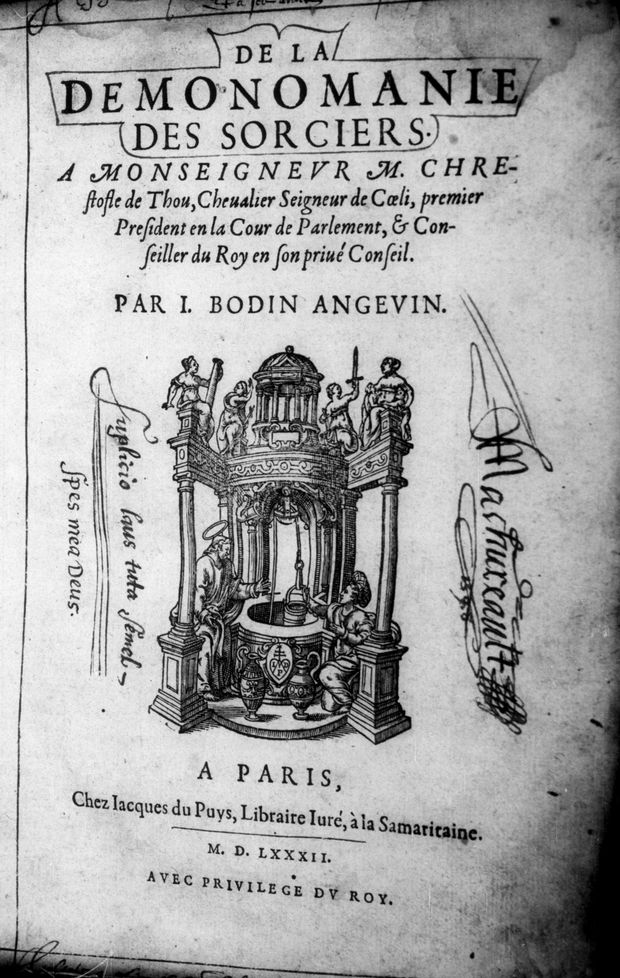
French: Paris, 1582, p. 15 (scan). Spelling as printed, except that long s is normalised and abbreviation marks are expanded. Highlighted: the words Lecky quotes.
Now it is well known that the Amorites and the other peoples whom God exterminated practised such kinds of sorcery, sacrificing men also to the Devils, with whom they spoke and whom they worshipped, chiefly the Sun, which they called by excellence Baal, that is to say in Hebrew, Lord; whence came Baalzebub, which means Master Fly, because there was not a fly in his temple, as it is said that in the Palace of Venice there is not a single fly, and in the palace of Toledo only one, which is no strange or new thing; for we read that the Cyrenaeans, after sacrificing to the god Acaron, god of flies, and the Greeks to Jupiter surnamed Myiodes, that is to say “Mouchard,” all the flies flew away in a cloud, as we read in Pausanias, in his Arcadica, and in Pliny, book xxix, chapter vi.
Original French
Or il est tout notoire, que les Amorrheans, & autres peuples que Dieu extermina, s’exerçoient en telles sortes de Sorceleries, sacrifians aussi les hommes aux Diables, ausquels ils parloient, & qu’ils adoroient, & principalement le Soleil, l’appellant par excellence Bahal c’est à dire en Hebrieu, Seigneur, d’où est venu Bahalzebuf, qui veut dire Maistre mouche, par ce qu’il n’y auoit pas vne mouche en son temple, comme on dict qu’au Palais de Venise il n’y a pas vne seule mouche & au palais de Tolede qu’il n’y en a qu’vne, qui n’est pas chose estrange, ou nouuelle: car nous lisons que les Cyrenaiques apres auoir sacrifié au Dieu Acaron Dieu des mouches, & les Grecs à Iuppiter surnommé Myiodes, c’est à dire Mouchard, toutes les mouches s’enuoloient en vne nuee, comme nous lisons en Pausanias in Arcadicis, & en Pline au liure xxix. chapitre vi.
What is not traced
Neither the Pausanias nor the Pliny reference has been checked against its source here; this edition gives Bodin’s references as he printed them. “Mouchard” in modern French means a spy or informer; what Bodin means by it here has not been checked, and it is left untranslated.
Book III, pp. 151–152: The Pardon of Trois-Échelles
French: Paris, 1582, pp. 151–152 (scan, pp. 151–152), conventions as above. “[…]” marks the omission of a paragraph about Coligny and a sorcery case reported by Leovicer, which fills the rest of p. 151; the name “Trois-Echelles” is split across the page break. Highlighted: the sentences Lecky quotes.
I will give an example that happened in Poitou in the year 1571. King Charles IX, after dinner, ordered that Trois-Échelles be brought to him, to whom he had given his pardon so that he would accuse his accomplices. And he confessed before the King, in the presence of several great lords, the manner of the sorcerers’ transport, the dances, the sacrifices made to Satan, the lewdness with the Devils in the shape of men and women; and that each of them took powders to kill men, beasts, and crops. […]
[p. 152] Trois-Échelles then related many similar things. And it must be believed that if the King, who was of a strong and robust constitution, had burnt this master sorcerer and his accomplices, it is to be presumed that God would have given him a happy and long life for such executions. For the word of God is most certain, that he who lets a man worthy of death escape pours upon himself the penalty of another, as the Prophet said to King Ahab, that he would die for having given pardon to the man worthy of death. Now it had never been heard that pardon was given for sorcerers. It is true one may say that it was in order to accuse his accomplices that he was pardoned; but they all escaped.
Original French
I’en metteray vn exemple aduenu en Poitou l’an 1571. Le Roy Charles 9. apres disner commanda qu’on luy amenast Trois-Echelles, auquel il auoit donné sa grace pour accuser ses complices. Et confessa deuant le Roy, en presence de plusieurs grands Seigneurs, la façon du transport des Sorciers, des dances, des sacrifices faits à Satan, des paillardises auec les Diables en figure d’hommes & de femmes: & que chacun prenoit des poudres pour faire mourir hommes, bestes, & fruicts. […]
[p. 152] Trois-Eschelles alors en raconta beaucoup de semblables: Et faut croire que si le Roy, qui estoit d’vne forte complexion & robuste, eust faict brusler ce maistre Sorcier & ses complices, il est à presumer que Dieu luy eust donné pour telles executions heureuse & longue vie. Car la parole de Dieu est tres-certaine, que celuy qui fait eschapper l’homme digne de mort, verse sur luy mesme la peine d’autruy, comme le Prophete dist au Roy Achab, qu’il mourroit pour auoir donné grace à l’homme digne de mort. Or iamais n’auoit esté ouy qu’on donnast grace pour les Sorciers. Vray est qu’on peut dire que c’estoit pour accuser les complices, qu’on luy donnoit grace, mais tous eschapperent.
Lecky’s account of this story is in note 89 of Chapter I (the note reads simply “P. 152.”). Set against Bodin’s text:
| Lecky, 1865 | Bodin, 1582 | |
|---|---|---|
| The pardon | Charles IX “had spared the life of the famous sorcerer, Trois Echelles, on the condition of his informing against his colleagues” | “auquel il auoit donné sa grace pour accuser ses complices” |
| The king’s early death | “it is to this grevious sin that the early death of the king is most probably to be ascribed” | Bodin says only that, had the king burnt the sorcerer, God would have given him “heureuse & longue vie”. He does not mention the king’s death. The inference about the early death is Lecky’s. |
| The principle | “he who suffers a man worthy of death to escape, draws the punishment upon himself” | “verse sur luy mesme la peine d’autruy” (“pours upon himself the penalty of another”) |
| The last sentence | “For no one had ever heard of pardon being accorded to sorcerers.” | “Or iamais n’auoit esté ouy qu’on donnast grace pour les Sorciers.” Lecky stops here; Bodin goes on to concede that the pardon was given in order to get accusations, “mais tous eschapperent”. |
| Scan | vol. I, p. 99 | pp. 151–152 |
Réfutation des opinions de Jean Wier, near p. 252: The Laws and Experience of All Peoples
French: Paris, 1582, the “Réfutation des opinions de Jean Wier” at the end of the book, on the page just before the one headed “DE IEAN VVIER. 252” (scan), conventions as above. The page number of this leaf is not legible in the scan; it is the page immediately before p. 252, and Lecky cites “p. 252”. The passage begins in the middle of a sentence that starts on the previous page. Bodin’s three marginal references are given after the text. Highlighted: the clauses Lecky quotes.
[…] to the laws of Plato, the Twelve Tables, the jurisconsults, the Emperors, and all peoples and lawgivers, Persians, Hebrews, Greeks, Latins, Germans, French, Italians, Spaniards, English, who have decreed capital penalties against sorcerers, and against those who harbour them or let them escape: whether one must rather stand by Wier than by the experience of all peoples, Kings, Princes, Lawgivers, Magistrates, Jurisconsults, who have known with the finger and with the eye the execrable impieties and wickednesses with which sorcerers are charged; whether one must rather stand by the disciple of the greatest sorcerer of his age than by the Prophets, Theologians, Doctors, Judges, and Magistrates, who have discovered the truth by thousands upon thousands of violent presumptions, accusations, testimonies, récolements, confrontations, convictions, acknowledgements, repentances, and voluntary confessions up to death. We have the judgement of God6, who declared that he had torn the peoples of Palestine from the earth for the horrible sorceries they practised, and for nothing else, and threatened to exterminate not only the sorcerers but all those who suffer them to live;7 and who told Jeremiah to preach loud and clear that he would raze with fire and blood the city of Jerusalem and all its inhabitants for the execrable sorceries of King Manasseh.8 That is what seemed to me could be answered to the books of Wier […]
(6) Deuteronomy 18.
(7) Leviticus 20.
(8) Jeremiah 15.
Original French
[…] aux loix de Platon, des douze tables, des Iurisconsultes, des Empereurs, & de tous les peuples & legislateurs, Perses, Hebrieux, Grecs, Latins, Allemans, François, Italiens, Espagnols, Anglois, qui ont decreté peines capitales contre les Sorciers, & contre ceux qui les recelent, ou qui les font euader: S’il faut plustost s’arrester à VVier que à l’experience de tous les peuples, Roys, Princes, Legislateurs, Magistrats, Iurisconsultes, qui ont cogneu au doigt, & à l’œil les impietez & meschancetez execrables, dont les Sorciers sont chargez: s’il faut plustost s’arrester au disciple du plus grand Sorcier, qui fut onques de son aage, que aux Prophetes, Theologiens, Docteurs, Iuges & Magistrats, qui ont descouuert la verité par mille & mille presomptions violentes, accusations, tesmoignages, recolemens, confrontations, conuictions, recognoissances, repentances, & confessions volontaires iusques à la mort. Nous auons le iugement de Dieu6, qui a declaré qu’il auoit arraché de la terre les peuples de la Palestine, pour les horribles Sorcelleries dont ils vsoient, & non pour autre chose, & a menassé d’exterminer non seulement les Sorciers, ains aussi tous ceux qui les souffriront viure,7 & qui a dit à Hieremie qu’il preschast haut & clair qu’il raseroit8 à feu & à sang la ville de Hierusalem, & tous les habitans pour les execrables Sorcelleries du Roy Manassés. Voila ce qu’il m’a semblé, qu’on peut respondre aux liures de VVier […]
(6) Deut. c. 18.
(7) Leuit. c. 20.
(8) Hier. cap. 15.
Notes on the translation
Récolement is a term of French criminal procedure: the reading back of a witness’s deposition to the witness for confirmation, before the confrontation. The gloss is this edition’s own. The “disciple of the greatest sorcerer of his age” is Agrippa, whom Wier served; Lecky identifies him in note 87.
Lecky quotes this passage in English on his p. 101 (note 91: “Bodin, p. 252”), as something Montaigne “was, no doubt, perfectly aware” of. Set against Bodin’s text:
| Lecky, 1865 | Bodin, 1582 | |
|---|---|---|
| The laws | “the laws of Plato, of the twelve tables, of the consuls, of the emperors, and of all nations and legislators” | “des Iurisconsultes” (“of the jurisconsults”). “Consuls” does not appear. |
| The peoples | “Persian, Hebrew, Greek, Latin, German, French, Italian, Spanish, English” | Perses, Hebrieux, Grecs, Latins, Allemans, François, Italiens, Espagnols, Anglois (same nine, in the same order) |
| The crime | “had decreed capital penalties against sorcerers” | “qui ont decreté peines capitales contre les Sorciers, & contre ceux qui les recelent, ou qui les font euader” (adds those who harbour or help them escape) |
| The evidence | “prophets, theologians, doctors, judges, and magistrates, had elucidated the reality of the crime by many thousand violent presumptions, accusations, testimonies, convictions, repentances, and voluntary confessions, persisted in to death” | “ont descouuert la verité par mille & mille presomptions violentes, accusations, tesmoignages, recolemens, confrontations, conuictions, recognoissances, repentances, & confessions volontaires iusques à la mort”. Lecky omits récolements, confrontations, and recognoissances, and renders descouuert la verité (“discovered the truth”) as “elucidated the reality of the crime”. |
| Scan | vol. I, p. 101 | leaf before p. 252 |
Lecky’s Quotation of Book I, p. 15, Compared
Lecky quotes the first passage in French in note 74 of Chapter I. His text differs from Bodin’s only in spelling and in one reference:
| Lecky, 1865 | Bodin, 1582 | |
|---|---|---|
| Spelling | avoit, estrange ou nouvelle, s’envolaient en une nuée, Tolède, Cyrénaïques | auoit, estrange, ou nouuelle, s’enuoloient en vne nuee, Tolede, Cyrenaiques |
| Pliny reference | au livre xxix. cap. 6. | au liure xxix. chapitre vi. |
| Scan | vol. I, p. 81 | p. 15 |
Lecky modernises Bodin’s spelling (u/v, accents) and gives the Pliny chapter in Arabic numerals. The French words are otherwise the same, and the quotation runs to the same place. He introduces it with his own words, “Beelzebub, as is well known, was god of flies”, where Bodin says “Bahalzebuf, qui veut dire Maistre mouche”.
Book I, f. 40: God “au grand nez”
French: Paris, 1582, p. 40 (scan). This printing numbers folios (leaves), not pages, and p. 40 is the recto. Spelling as printed, with long s normalised. The right margin has “Dicta frontis inspectio” and “Exodi cap. 34”. The two Hebrew phrases are printed in Hebrew letters; I give them in transliteration, which is my reading (’erekh ’appayim and qetsar ’appayim). Highlighted: the passage I take to be the “astounding instance of verbal criticism” Lecky says he does not “venture to quote” (his note 68). He does not describe it, so this identification is my inference.
… And such predictions are not unlawful, unless one wished to assert them as infallible, as we can say in a like case of metoposcopy, which judges the inner passions of a man from a mere look at the face; among these some are natural: as sudden blushing signifies shame, sudden paling signifies fear, and these have their natural causes; but there are some that are more human than natural, as the shining eyes of owls signify most often cruelty: Sulla and Cato the Censor had such, or if they are marked with drops of blood. So of the snub-nosed it is said that they are choleric and impatient; and on the contrary, large noses are more prudent and patient. It is one of the epithets that God has given to himself, speaking to Moses, among the eleven properties he calls himself [’erekh ’appayim], that is, Big-nose, as the Complutensian edition of Spain and that of Antwerp interpret it word for word, and in several places of the Bible where he is called the God with the big nose, which all interpreters turn “patient”; and by its contrary [qetsar ’appayim] that is, Short-nose: the Hebrews interpret it “Quick to anger”. By which it is shown to us also that natural metoposcopy is not unlawful, and in fact in all the East they are well practised in it. Yet it must not be made an infallible law: for there are men so masked, and who know so well how to cover and dissimulate their natures, that they are entirely masters of their faces, so that many, seeing themselves deceived, have …
Original French
… Et telles predictions ne sont point illicites, si ce n’est qu’on les voulust asseurer comme chose infaillible, comme nous pouuons dire en cas pareil de la metoposcopie, qui iuge des passions interieures de l’homme au seul regard du visage, entre lesquelles il y en a de naturelles: comme la rougeur soudaine signifie la honte, paillir soudain signifie crainte, & qui ont leurs causes naturelles: Mais il y en a qui sont plus humaines, que naturelles, comme les yeux de Hyboux luysans, signifient le plus souuent cruauté: Tels les auoit Sylla & Caton le Censeur, ou bien s’ils sont marquez de gouttes de sang. Ainsi dict-on des Camus, qu’ils sont choleres & impatiens: Et au contraire les grands nez sont plus prudens & patiens. C’est l’vn des epithetes que Dieu s’est donné à luymesmes, parlant à Moyse, entre les onze proprietez il s’appelle [’erekh ’appayim] c’est à dire, Grand-nez, ainsi que l’edition Complutense d’Espagne, & d’Anuers, de mot à mot interpreté, & en plusieurs lieux de la Bible, où il s’appelle le Dieu au grand nez, que tous les interpretes tournent patient, & par son contraire [qetsar ’appayim] c’est à dire, Court nez: les Hebrieux interpretent, Soudain en cholere. En quoy il nous est monstré aussi, que la Metoposcopie naturelle n’est point illicite, & de faict en tout l’Orient ils sont fort experimentez en cela. Si est-ce qu’il ne faut pas en faire loy infaillible: car il se trouue des hommes si masquez, & qui sçauent si bien couurir, & dissimuler leurs naturels, qu’ils sont entierement maistres de leurs visages, en sorte que plusieurs se voyans trompez en ont …
Notes on the Hebrew and the editions
The Hebrew idiom ’erekh ’appayim (Exodus 34:6) is literally “long of nose (or nostrils)”, and is normally translated “slow to anger” or “long-suffering”; qetsar ’appayim is the opposite. That is standard knowledge, not something I checked in Bodin. “L’edition Complutense d’Espagne, & d’Anuers” presumably means the Complutensian and the Antwerp polyglot Bibles; I have not checked what they print. Bodin’s page is on physiognomy: it follows a discussion of prophecies from natural signs.
Book IV, ff. 217–218: Stoning, Burning, and the Plague
French: Paris, 1582, p. 217 (recto) and its verso (scan), the page after the plea for burning alive. Conventions as above. The margin of p. 217 has “2. in lib. tertio” and a Hebrew line against “Moyse Raban”. Highlighted: what Lecky’s notes 88 and 137 rest on.
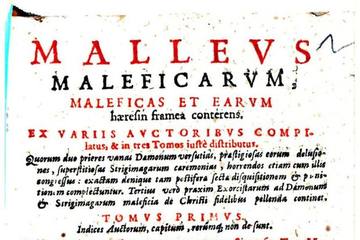
… We have noted above that when the Sorceress named Sibylle Dinscops, in the Duchy of Cleves, was burnt, the hand that was seen persecuting all passers-by ceased suddenly. After the Sorceress of Bieure, which is near this town of Laon, was burnt, the mortalities of men and beasts, which came by poisonings, ceased. It is also to be noted what I learned from Master Adam Martin, who conducted her trial: that she threatened a woman that she would never nurse a child, and suddenly her milk dried up; and though she afterwards had several children, still her milk always dried up: but her milk returned as soon as the sorceress was executed, and she was burnt quite alive by a just judgement of God, against the advice of the Judges, who had ordered that she be strangled: but the Executioner could not manage it, although the penalty of stoning ordained by the law of God is more rigorous than burning alive, as Moses Raban has noted. And I remember having read in the book entitled Malleus maleficarum, that the plague did not cease in a borough of Germany in the country of Constance until a Sorceress was dug up and her body reduced to ashes. As in a like case there was a woman in the village of Verigny near Coucy, who was convicted and accused of several maleficia, and, because of the difficulty of the proof, released: afterwards I learned from the inhabitants that an infinity of cattle and people had died. She died in the month of April 1579: since her death all the inhabitants of Verigny and the cattle are at rest, and no longer die as they used to. Which is well to show that, the principal cause ceasing, the effects cease, though God make afflictions fall on whom he pleases.
Original French
… Nous auons remarqué cy dessus que la Sorciere nommee Sibylle Dinscops, au Duché de Cleues, estant brusllee, la main qu’on voyoit qui persecutoit tous les passans, cessa soudain. Apres que la Sorciere de Bieure qui est pres de ceste ville de Lao fut brusllee, les mortalitez d’hommes & bestes, qui aduenoient par les venefices, cesserent. Encores est il à noter, ce que i’ay apprins de maistre Adam Martin, qui luy a faict son procez: c’est qu’elle menaça vne femme qu’elle n’allaicteroit iamais enfant, soudain son laict seicha: & combien qu’elle eust depuis plusieurs enfans, si est-ce que son laict tarissoit tousiours: mais son laict retourna aussi tost que la sorciere fut executee, & fut brusllee toute viue par vn iuste iugement de Dieu, contre l’aduis des Iuges, qui auoient ordonné qu’elle fust estranglee: mais le Bourreau n’y peut donner ordre, combien que la peine de lapidation ordonnee par la loy de Dieu est plus rigoureuse, que brusler vif: ainsi que Moyse Raban a noté. Et me souuient auoir leu au liure intitulé Malleus maleficarum, que la peste ne cessa point en vn bourg d’Allemagne au pays de Constance, iusques à ce qu’on eut deterré vne Sorciere, & redigé son corps en cendres. Comme en cas pareil il y eut vne femme au village de Verigny pres de Concy; laquelle fut attainte & accusee de plusieurs malefices: & pour la difficulté de la preuue relaschee: depuis i’ay sceu des habitans qu’il estoit mort vne infinité de bestail, & de personnes. Elle mourut au mois d’Auril 1579: depuis sa mort tous les habitans de Veriguy, & le bestail sont en repos, & ne se meurent plus comme de coustume. Qui est bien pour monstrer que la cause principale cessant, les effects cessent, encores que Dieu face tomber les afflictions sur ceux qu’il luy plaist.
Doubtful points
“Moyse Raban” is not identified here; “Rabin Maymon” on f. 228 (below) is presumably Maimonides. “Le Bourreau n’y peut donner ordre” is translated “could not manage it”; the sense may be that the executioner could not help it. I have not looked for the story in the Malleus. The text before “sonne accusé…” on the same page, about the procedure in cases of proof, is not transcribed.
Réfutation, f. 228: Stoning and God’s Fury
French: Paris, 1582, p. 228, in the Réfutation des opinions de Jean Wier (running head “De Iean Vvier”; scan). Conventions as above. The margin has “7. Deut. c. 18”, “6. Leuit. 20”, “8. lib. 3.” with a Hebrew word (against “Maymon”) and “9. cap. 19. Hierem. & 50”. Highlighted: the words that bear on Lecky’s notes 88 and 137.
… when God wished to show how much he abhorred sorceries, he says, Beware on your life of following the abominable customs of those nations that I have razed from the earth for sorceries, magics, divinations, where he puts nine kinds, which include all the others: but it is well to note that he does not say that he exterminated those peoples for homicides, parricides, incests, tyrannies, idolatries, but for sorceries, and because those peoples dedicated their children to the devil Moloch, to carry out their sorceries, God commands that he who shall do this abomination be stoned, which was the cruellest death of all, as Rabbi Maymon says. Then afterwards God adds that he will extend his fury against the people that shall suffer these wickednesses unpunished. And when Samuel wished to make Saul understand the greatness of his fault, “Your sin”, he said, “is as great as the sin of sorcerers”. And to show how much God abhorred King Manasseh, it is said, Manasseh angered God by his detestable wickednesses: then it is said that he was a Sorcerer, having a compact with the devils. He was deprived of his Kingdom and put in the stocks in a prison; and although he repented greatly, yet fifty years after his death God said to the Prophet Jeremiah, I will raze this city with fire and blood, for the execrable wickednesses of King Manasseh. And as to the place Tophet, where he had made his sacrifices to Satan, it is said that it will be the place of slaughters to avenge the wrath of God: which was done. And at …
Original French
… quand Dieu voulut monstrer combien il auoit en horreur les Sorcelleries, il dit, Gardez vous sur la vie de suyure les abhominables coustumes de ces nations, que i’ay rasé de la terre, pour les sorcelleries, magies, deuinations, où il en met neuf genres, qui comprennent tous les autres: Mais il fait bien à noter qu’il ne dict point qu’il a exterminé ces peuples pour les homicides, parricides, incestes, tyrannies, idolatries, mais pour les Sorcelleries, & d’autant que ces peuples-là dedioient leurs enfans au diable Moloch, pour executer leurs Sorcelleries, Dieu commande que celuy qui fera ceste abomination, soit lapidé: qui estoit la plus cruelle mort de toutes, comme dict le Rabin Maymon. Puis apres Dieu adiouste qu’il estendra sa fureur contre le peuple qui souffrira ces meschancetez impunies. Et quand Samuël voulut faire entendre à Saül, la grandeur de sa faute, Ton peché, dit-il, est aussi grand que le peché des sorciers. Et pour monstrer combien Dieu auoit en horreur le Roy Manassés, il est dict, Manassés irrita Dieu par ses meschancetez detestables: Puis il est dict, qu’il estoit Sorcier, ayant conuention auec les diables. Il fut priué de son Royaume, & mis aux seps en vne prison: Et combien qu’il se fust repenty grandement, si est-ce que cinquante ans apres sa mort Dieu dist au Prophete Hieremie, Ie raseray à feu & à sang ceste ville, pour les meschancetez execrables du Roy Manassés. Et quant au lieu Tophet, où il auoit faict ses sacrifices à Satan, il est dict que ce sera le lieu des meurtres pour venger l’ire de Dieu: ce qui fut faict. Et au …
Not transcribed
The verso of f. 228 (the next image, n491) goes on with the ten tribes and Babylon; I read it only in the poor OCR, and my download of that image was truncated, so it is not transcribed. The “Rabin Maymon” margin note points to a “lib. 3.” with a Hebrew title that I have not identified.
Burnt for eating meat on a Friday: Angers, 1539 (Book IV, f. 216)
French: Paris 1582, Book IV, f. 216 recto, scan. Margin: “l. Manichæos de hæret. Cod. … cap. ad abolendam § præsenti, de hæret. lib. 6”. Highlighted: what Lecky reports in ch. III, note 135.
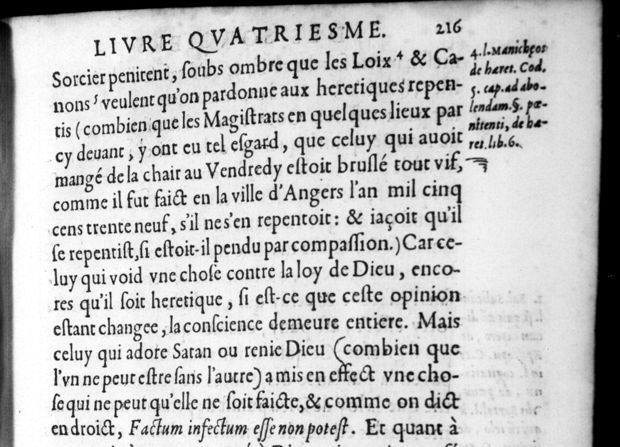
[One must not spare the] penitent sorcerer on the pretext that the laws and canons require repentant heretics to be pardoned (although magistrates in some places have hitherto had such regard to it that whoever had eaten meat on a Friday was burnt alive, as was done in the town of Angers in the year fifteen hundred and thirty-nine, if he did not repent; and even if he repented, he was hanged, out of compassion). For he who sees a thing contrary to the law of God, though he be a heretic, yet once that opinion is changed, his conscience remains whole. But he who worships Satan or denies God (though the one cannot be without the other) has carried out a deed that cannot be undone, and as the lawyers say, what is done cannot be made undone.
Original French
[On ne doit pas pardonner au] Sorcier penitent, soubs ombre que les Loix & Canons veulent qu’on pardonne aux heretiques repentis (combien que les Magistrats en quelques lieux par cy devant, y ont eu tel esgard, que celuy qui avoit mangé de la chair au Vendredy estoit bruslé tout vif, comme il fut faict en la ville d’Angers l’an mil cinq cens trente neuf, s’il ne s’en repentoit : & iaçoit qu’il se repentist, si estoit-il pendu par compassion.) Car celuy qui void une chose contre la loy de Dieu, encores qu’il soit heretique, si est-ce que ceste opinion estant changee, la conscience demeure entiere. Mais celuy qui adore Satan ou renie Dieu (combien que l’un ne peut estre sans l’autre) a mis en effect une chose qui ne peut qu’elle ne soit faicte, & comme on dict en droict, Factum infectum esse non potest.
Lecky reports the Angers executions accurately but not their setting. Bodin mentions them in a parenthesis, to concede that repentant heretics were sometimes treated leniently (hanging instead of burning), on the way to arguing that a repentant witch must not be pardoned at all, because a pact with Satan is a deed, not an opinion.
Two old priests and their demon mistresses (f. 107)
French: Paris 1582, livre II, f. 107 (the leaf headed “Livre second. 107”), scan n240.
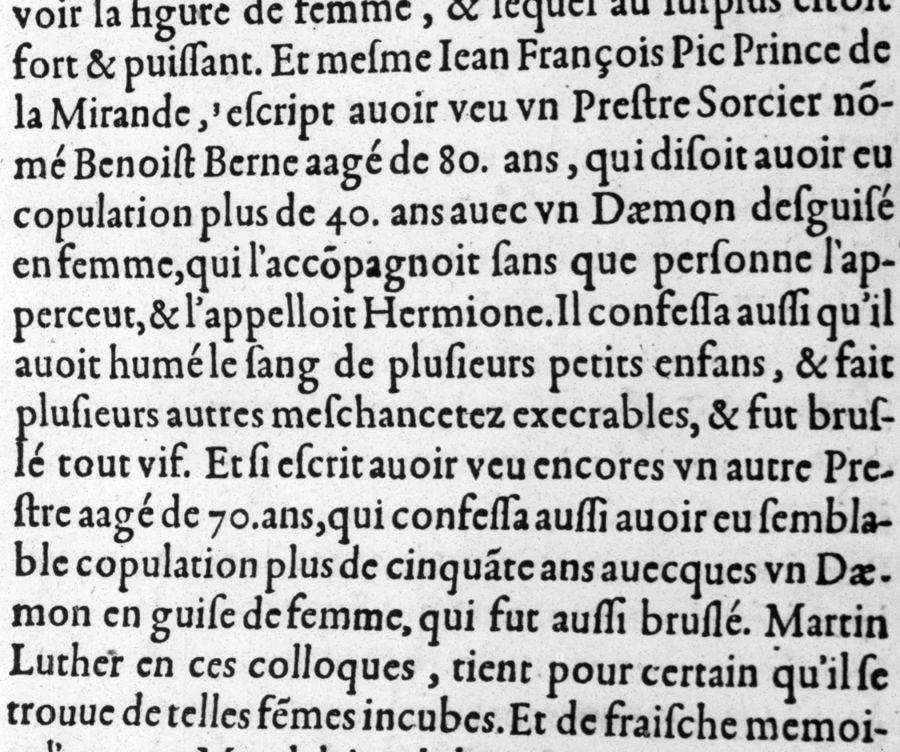
… And Gianfrancesco Pico, Prince of Mirandola, writes that he saw a sorcerer priest named Benoist Berne, eighty years old, who said he had had intercourse for more than forty years with a demon disguised as a woman, who went about with him without anyone noticing her, and whom he called Hermione. He confessed too that he had sucked the blood of several little children and done many other execrable wickednesses, and he was burnt alive. He writes that he saw yet another priest, seventy years old, who also confessed to such intercourse for more than fifty years with a demon in the shape of a woman, who was also burnt. Martin Luther, in his Table Talk, holds it for certain that such incubus women exist.
Original French
… Et mesme Iean François Pic Prince de la Mirande, escript auoir veu vn Prestre Sorcier nommé Benoist Berne aagé de 80. ans, qui disoit auoir eu copulation plus de 40. ans auec vn Dæmon desguisé en femme, qui l’accompagnoit sans que personne l’apperceut, & l’appelloit Hermione. Il confessa aussi qu’il auoit humé le sang de plusieurs petits enfans, & fait plusieurs autres meschancetez execrables, & fut bruslé tout vif. Et si escrit auoir veu encores vn autre Prestre aagé de 70. ans, qui confessa aussi auoir eu semblable copulation plus de cinquante ans auecques vn Dæmon en guise de femme, qui fut aussi bruslé. Martin Luther en ces colloques, tient pour certain qu’il se trouue de telles fémes incubes.
Lecky’s ch. I note 21: “Bodin mentions a priest who had commerce with one for more than forty years, and another priest who found a faithful mistress in a devil for half a century: they were both burnt alive (Démonomanie des Sorciers, p. 107). Luther was a firm believer in this intercourse (Ibid).” The leaf, the figures and Luther all match. Two details: Bodin is reporting what Gianfrancesco Pico says he saw, and only the first priest is said to have been burnt alive; of the second Bodin says only that he “was also burnt”.
The witches called “cochemares” (ff. 108v–109)
French: Paris 1582, f. 108 verso, running on to f. 109, scan n243.
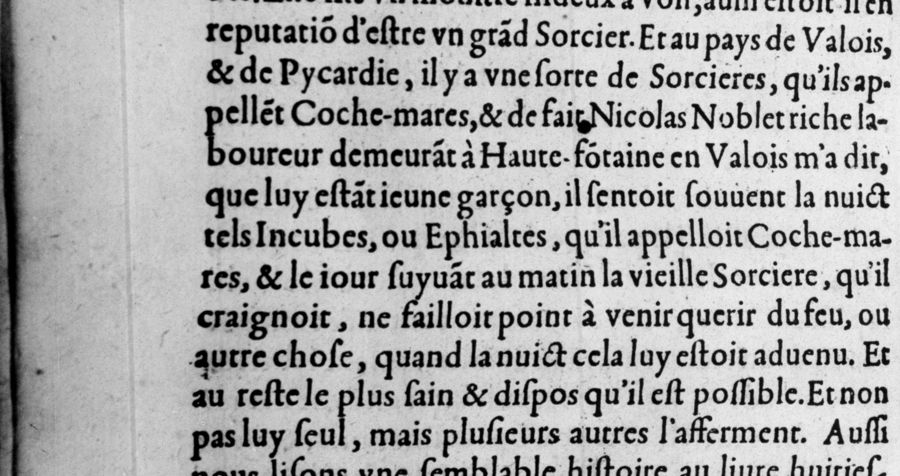
And in Valois and Picardy there is a kind of witch they call “cochemares” [nightmares]; and in fact Nicolas Noblet, a rich farmer living at Hautefontaine in Valois, told me that when he was a young boy he often felt such incubi or ephialtes at night, which he called cochemares; and the next morning the old witch he was afraid of never failed to come and ask for fire or something else, whenever this had happened to him in the night. And otherwise he was as healthy and fit as could be. And not he alone: many others affirm it.
Original French
Et au pays de Valois, & de Pycardie, il y a vne sorte de Sorcieres, qu’ils appellent Coche-mares, & de fait Nicolas Noblet riche laboureur demeurant à Haute-fontaine en Valois m’a dit, que luy estant ieune garçon, il sentoit souuent la nuict tels Incubes, ou Ephialtes, qu’il appelloit Coche-mares, & le iour suyuant au matin la vieille Sorciere, qu’il craignoit, ne failloit point à venir querir du feu, ou autre chose, quand la nuict cela luy estoit aduenu. Et au reste le plus sain & dispos qu’il est possible. Et non pas luy seul, mais plusieurs autres l’afferment.
Lecky’s ch. I note 21: “The ordinary phenomenon of nightmare, as the name imports, was associated with this belief (see a curious passage in Bodin, p. 109).” The passage is on the verso of f. 108 and its story (from a history of Scotland) runs on to f. 109, so Lecky’s leaf fits loosely. The French word itself, cauchemar, here spelled “coche-mare”, is Bodin’s evidence: the night-terror was a witch sitting on the sleeper.
Lecky’s Notes 68, 88 and 137 Compared
| Lecky (ch. I) | Bodin | Comment |
|---|---|---|
| Note 68: “another astounding instance of verbal criticism, which I do not venture to quote, in Bodin, Dem. p. 40.” | f. 40: God’s epithet ’erekh ’appayim read as “Grand-nez”, within a discussion of physiognomy. | The page and the “verbal criticism” fit. Nothing on the page is indecent in the ordinary sense; the likely reason Lecky does not quote it is its irreverence (“le Dieu au grand nez”). That is my inference. |
| Text, ch. I: “Some persons … question[ed] the lawfulness of strangling the witch before she was burnt … the penalty in the Levitical code was stoning, and stoning had been pronounced by the Jewish theologians to be a still more painful death than the stake.” Note 137: “Bodin, p. 217.” | f. 217: the judges had ordered a witch strangled; she was “burnt quite alive by a just judgement of God”, though stoning “is more rigorous than burning alive, as Moses Raban has noted”. f. 228: stoning “the cruellest death of all, as Rabbi Maymon says”. | The “stoning is worse than the stake” point is Bodin’s, on both pages, citing a rabbinic authority. The claim that people questioned strangling before burning is not on the page: Bodin reports the judges’ order to strangle and the executioner’s failure, and approves the burning as God’s judgement. Lecky cites the page only for the stoning remark, which is fair. |
| Text, ch. I: those who pardon sorcerers “had outraged the majesty of Heaven … and pestilence and famine would inevitably desolate their dominions.” Note 88: “Pp. 217, 228.” | ff. 217–218: plague and cattle-death in villages ended only when a witch was burnt or died. f. 228: God “will extend his fury against the people that shall suffer these wickednesses unpunished”. | Plague is on pp. 217–218. “Famine” is not on the pages I read; the verso of f. 228, not transcribed, may have it. Bodin does not make the argument about pardons on these pages (that is the Trois-Échelles passage, p. 152); Lecky is gathering Bodin’s general view. |
Editor’s notes on this page
Bodin’s book, a huge compilation of authorities and trial reports in French, was the standard reply to Wier’s attack on the witch trials. Lecky devotes pp. 95–99 of Chapter I to it as the sceptics’ chief opponent, and cites it for a handful of details and quotations.
The three passages here are the ones Lecky gives page numbers for and quotes in French or paraphrases closely. Lecky modernises Bodin’s spelling and condenses and rearranges his lists; where he adds to or departs from Bodin, the comparisons below say so.
Further down the rabbit hole
Sources that Lecky cites in the notes next to the ones that cite this page.
- Maury, La magie et l’astrologieRoman laws against diviners, the first medieval doubters, and the praying heretics
- Thiers, Traité des SuperstitionsThree papal bulls but no rebellion
- Madden, PhantasmataAn Irish doctor’s history of delusions, and the witch-burnings in an Alpine valley
- Naudé, Apologie pour tous les grands personnages qui ont esté faussement soupçonnez de magieA librarian clears the great men of magic: Pope Sylvester, Pietro d’Abano, Agrippa
- Garinet, Histoire de la Magie en FranceA history of magic in France, from the Frankish kings to the author’s own day
- Sprenger, Malleus MaleficarumThe witch-hunters’ handbook of the fifteenth century
Backlinks
Every place in Rationalism in Europe that links to this page (generated automatically when the site is built).