Pars I, Quaestio III, p. 32: “Because of the Angels”

Latin: Lyon, 1620, vol. I, Pars I, Quaestio III (“An per Daemones detur procreatio” in the running title), p. 32 (scan). Spelling regularised: u/v and æ normalised and abbreviations expanded. The right-hand margin carries the note “Mulieres velantur propter Incubos” (“Women are veiled because of incubi”). Highlighted: the sentence Lecky reports.
Moreover, as to the Apostle’s saying, 1 Cor. 11, “A woman ought to have a veil upon her head because of the angels”, many Catholics explain the words that follow, “because of the angels”, as meaning incubi. Bede, in his Histories of the Angels, is to the same effect. So too William, in the book On the Universe, last part, treatise 6, at some length. The Holy Doctor also decides this in the first part, q. 25, in the second Scriptum, dist. 8, and in Quodlibet 6, and in his commentary on Isaiah 13 and 14. Hence to deny such things, says St. Thomas, is a mark of imprudence; for what seems so to many cannot be wholly false, according to the Philosopher, in the end of On Sleep and Waking and in book 2 of the Ethics. I say nothing of the many authentic histories, of Catholics as of pagans, which openly assert that there are incubi.
Original Latin
Insuper illud Apostoli, 1. Cor. 11, “Mulier debet habere velamen super caput suum propter Angelos”, multi Catholici exponunt quod sequitur “propter Angelos”, id est Incubos. Ad idem est Beda in Historiis Angelorum. Item Guliel. in lib. de universo, par. ultima, tractat. 6, multipliciter. Praeterea hoc determinat S. Doctor prima par. q. 25, et in secundo scripto di. 8, et Quodlibet. 6, quo atque super Esaiam c. 13 et 14. Unde talia negare, dicit S. Tho., imprudentiae est. Id enim quod multis videtur, non potest omnino falsum esse, secundum Philosophum, de somno et vigilia, in fine, et in 2. Ethicorum. Sileo de historiis multis et authenticis tam Catholicorum quam Ethnicorum, qui Incubos esse palam asserunt.
Doubtful readings and untraced references
The phrase “quo atque super Esaiam” is read from a dark page and may be wrong. “Beda in Historiis Angelorum” is as printed; no work of that title by Bede has been identified here. The Thomist and Aristotelian citations (“S. Doctor”, “the Philosopher”) are given as printed and have not been traced to their texts. The question number is taken from the running heads of the two preceding pages, which read “Quaestio III”; the page itself carries only the shorter title “An per Daemones detur proc. &c.”.
Pars II, Quaestio II, Cap. I, p. 273: Incubi and Women’s Hair
Latin: Lyon, 1620, vol. I, Pars II, Quaestio II, cap. I, p. 273 (scan), conventions as above. The writer is not Sprenger: the sentence reports “Guilhelmus” (William of Paris, as the same text is credited in the Formicarius printed later in the volume). The margin note reads “Puellae pulchros crines habentes magis sentiunt incubos” (“Girls with beautiful hair feel incubi the more”). Highlighted: the clause that bears on Lecky’s sentence.
It is also noted by William that incubi are seen to vex more those women and girls who have beautiful hair, either because such women devote themselves to the care or adornment of their hair, or because they wish, or are accustomed, to inflame men by their hair, or because they take empty pride in it, or because divine goodness permits it, so that women may be frightened off inflaming men by the very things by which the Demons also wish men to be inflamed.
Original Latin
Notatur etiam a Guilhelmo quod Incubi plus vexare videntur mulieres et puellas pulchros crines habentes, ideo quia aut curae aut ornatui crinium incumbunt huiusmodi, aut quia per crines viros inflammare cupiunt vel consueverunt, aut quia in eis inaniter gloriantur, aut quia divina bonitas hoc permittit, ut terreantur mulieres viros inflammare per ea quae etiam Daemones inflammari viros volunt.
Lecky’s sentence (note 21) is: “It was observed that they had a peculiar attachment to women with beautiful hair; and it was an old Catholic belief that St. Paul alluded to this in that somewhat curious passage, in which he exhorts women to cover their heads because of the ‘angels’ (Sprenger, Mall. Mal. Pars i. Quaest. 4; and Pars ii. Quaest. 2).” Set against the two passages:
| Lecky, 1865 | Lyon, 1620 | |
|---|---|---|
| The hair | incubi “had a peculiar attachment to women with beautiful hair” | “plus vexare videntur mulieres et puellas pulchros crines habentes” (they are seen to vex such women more). William offers four reasons, one of them that God permits it as a warning; none speaks of “attachment”. |
| Paul and the angels | “an old Catholic belief that St. Paul alluded to this” | “multi Catholici exponunt quod sequitur ‘propter Angelos’, id est Incubos” (many Catholics explain it as incubi). The Malleus does not itself connect the verse with the hair; Lecky joins the two passages. |
| Reference | “Pars i. Quaest. 4; and Pars ii. Quaest. 2” | Pars I, Quaestio III, p. 32; Pars II, Quaestio II, cap. I, p. 273. The Pauline passage is not in Quaestio IV in this edition. |
| Scan | vol. I, p. 26 | p. 32, p. 273 |
The question-number difference may be a slip, or a difference between editions: the 1486 and later editions are numbered differently, and only the Lyon 1620 has been checked here.
Pars II, Quaestio II, Cap. VI, pp. 300 and 305: Exorcism Before Baptism
Latin: Lyon, 1620, vol. I, Pars II, Quaestio II, cap. VI, p. 300 (scan) and p. 305 (scan), conventions as above. “[…]” marks omitted text. The margin note on p. 305 reads “In primitiva Ecclesia sine exorcismo baptismus peragebatur” (“In the primitive Church baptism was carried out without exorcism”). Highlighted: the sentences that bear on Lecky’s note.
P. 300. […] Hence, since the first dedication by which a man is consecrated to God is in baptism, a man must also be exorcised before he is baptised, by a much stronger reason than other things. For the reason why the Devil received power over other things that exist for man’s sake lies in man himself: namely original or actual sin. […]
P. 305. Nor is it a valid objection that in the primitive Church people were baptised without exorcisms, or that even now a baptised person can receive the baptismal character without exorcism; for in that case Gregory would have instituted exorcisms in vain, and the Church would be erring rather than right in her ceremonies. Therefore I have not dared altogether to censure those who would rebaptise the bewitched on condition, and so perhaps recover what had been neglected.
Original Latin
P. 300. […] Unde cum prima satisfactio qua homo Deo consecratur sit in baptismo, oportet quod etiam homo prius exorcizetur quam baptizetur, multo fortiori ratione quam aliae res. Quia in ipso homine est causa quare Diabolus potestatem accepit in alia quae sunt propter hominem, scilicet peccatum originale vel actuale. […]
P. 305. Nec obiectio valet quod sine exorcismis in primitiva Ecclesia baptizabantur, aut etiam quod nunc characterem baptismalem sine exorcismo valeat baptizatus recipere, quia sic Gregorius in vanum exorcismos instituisset, et Ecclesia in suis caeremoniis potius erraret. Quare ne ausus sum omnino reprehendere qui maleficiatos sub conditione vellent rebaptizare, et neglecta fortassis recuperare.
Lecky’s note (note 22) says that he did not identify the ancient exorcists’ inscriptions with those of the baptismal exorcists, “because Sprenger asserts that the employment of exorcising at baptisms was not introduced till a later period (Mall. Mal. Pars ii. Quaest. 2). Sprenger does not give his authority, but as he is usually well informed on matters of tradition, and as he treats the omission as a difficulty, I have adopted his view.” Set against the print:
| Lecky, 1865 | Lyon, 1620 | |
|---|---|---|
| The claim | Sprenger “asserts” that exorcism at baptisms “was not introduced till a later period” | p. 305 does not say this in so many words. It admits that the early Church baptised without exorcism (the margin note says so outright), and it implies that exorcisms were later “instituted” by a Gregory (Gregorius … exorcismos instituisset); the passage is in effect an answer to the objection, not an assertion of the late date. |
| “Does not give his authority” | Sprenger “does not give his authority” | No source is named for the statement about Gregory in the lines read; the Gregory is not otherwise identified there. |
| “Treats the omission as a difficulty” | “treats the omission as a difficulty” | Fits: “Nec obiectio valet” introduces and answers the objection. |
| Reference | “Pars ii. Quaest. 2” | Pars II, Quaestio II, cap. VI (pp. 300, 305). Exact. |
| Scan | vol. I, p. 27 | p. 300, p. 305 |
Lecky’s summary is a fair reading of the substance, since the passage does concede that the early Church had no baptismal exorcism. “Asserts” is stronger than the text. Only these two pages were read; a plainer statement on another page of the same chapter has not been ruled out.
Pars I, Quaestio VI, p. 65: “Femina” from Fe and minus
Latin: Lyon, 1620, vol. I, Pars I, Quaestio VI (p. 65; the running titles of the following pages read “Cur foem. superstitiosa reperiantur”; scan). Conventions as above. The right margin has the note “Foemina dicta à Fe, & Minus”. The middle of the page (the sentences on Terence, Lactantius, Proverbs, the creation of Eve, Cato and Samson’s wife) is omitted here; it is marked by dots. Highlighted: the etymology Lecky reports.
But since in modern times this perfidy is found more among women than among men, as experience itself teaches, we may say, investigating the cause more curiously, beyond what has been said above, that since women are defective in all the powers of soul as of body, it is no wonder that they procure more acts of witchcraft against those whom they envy. …
It is plain in the first woman, that by nature she has less faith, since when the serpent asked her why they did not eat of every tree of paradise, she answered “Of every”, etc., “lest perhaps we die”: in which she showed that she doubted and had no faith in the words of God. All of which the etymology of the name also demonstrates. For Femina is said to come from Fe and minus, because she always has and keeps less faith: and this by nature, as regards fidelity; although by grace and nature faith never failed in the most blessed Virgin, whereas in all the men it had failed at the time of Christ’s Passion.
Original Latin
Sed quia adhuc modernis temporibus haec perfidia amplius in mulieribus, quam in viris invenitur, ut ipsa experientia docet, curiosius causam investigando, ultra praemissa dicere possumus, quod in omnibus viribus, tam animae, quam corporis, cum sint defectuosae, non mirum, si plura maleficia in eos, quos aemulantur, fieri procurant. …
Patet in prima muliere, quod ex natura minorem habet fidem, cum dixit serpenti interroganti, quare non ederent de omni ligno paradisi. Respondit de omni, &c. ne forte moriamur: in quo ostendit se dubitare, & fidem non habere ad verba Dei: quae omnia etiam Etymologia nominis demonstrat. Dicitur enim Foemina à Fe & minus: quia semper minorem habet & servat fidem: Et hoc ex natura, quod ad fidelitatem: licet ex gratia & natura fides in beatissima virgine nunquam defecerit, cum tamen in omnibus viris defecisset tempore Passionis Christi.
Pars I, Quaestio I, p. 26: “Maleficiendo” or “Male de Fide Sentiendo”
Latin: Lyon, 1620, vol. I, Pars I, Quaestio I (running title “An sit haeresis maleficos asserere”), p. 26 (scan). Conventions as above. The left margin has the note “Malefica dicta à malè de fide sentiendo”. Highlighted: the words Lecky reports. Lecky gives no page for this one; he cites p. 65 for the femina etymology in the same sentence.
… But it also differs from every harmful and superstitious art, in that above all kinds of divination the heresy of witches itself holds the highest degree of malice, because it even takes to itself a name from “doing harm” (maleficiendo) or “thinking wrongly about the faith” (male de fide sentiendo), as was touched on before.
Original Latin
… Verum etiam differt ab omni noxia & superstitiosa arte, in hoc quod super omnia genera Divinationum ipsa Maleficorum haeresis supremum obtinet gradum malitiae, quod etiam nomen à maleficiendo seu male de fide sentiendo, sibi usurpat, ut prius tactum est.
I have not found the earlier passage the text refers back to (“ut prius tactum est”).
Pars I, Quaestio IV, p. 41: The Names of the Devil
Latin: Lyon, 1620, vol. I, Pars I, Quaestio IV, the page Lecky cites as p. 41 (scan). The page number in the print is smudged in this scan (the first digit is a 4; the second is unclear), so “p. 41” is matched here by content, not by reading the number. Conventions as above. The right margin has “Diabolus, à Dia & Bolus”. Highlighted: what Lecky quotes.
For it is the usage of Scripture and of speech to call any unclean spirit a Devil (Diabolus), from dia, which is “two”, and bolus, which is “a morsel”: because he kills two things, namely body and soul. And according to the etymology, although it is interpreted in Greek, Diabolus is “shut up in a prison”: and this suits him, since he is not permitted to do harm as much as he would wish. Or Diabolus as if “flowing down”: because he has flowed down, that is, fallen, both in rank and in place. He is also named Demon, that is “wise above blood”, or “bloody” …
Original Latin
Est enim usus scripturae & locutionis, quemlibet immundum Spiritum nominare Diabolum, à Dia, quod est duo, & bolus quod est morsellus: quia duo occidit, scilicet corpus & animam. Et secundum etymologiam licet Graece interpretetur Diabolus clausus ergastulo: & hoc sibi convenit, cum non permittitur sibi nocere quantum vellet. Vel Diabolus quasi defluens: quia defluxit, id est, corruit, & specialiter & localiter. Nominatur etiam Daemon, id est sapiens super sanguinem, vel sanguineus …
Pars II, Quaestio I, cap. XI: St. Silvanus and the Devil
Latin: Lyon, 1620, vol. I, Pars II, Quaestio I, Caput XI (scan; the running title reads “Par. II. Quaest. I. Cap. XI.”, and the page number is cut off at the top of this scan). Conventions as above. The right margin has “Satan se transformat in Siluanum Nazarenum Episcopum”. Highlighted: the story Lecky retells. The sentence begins in a list of the harms that witches, with the Devil’s help, can do: to property (Job), to reputation (this story), to the body (Job’s leprosy).
For as to property, it is plain from Job 1 and 2, as was shown above. As to reputation, it is plain in the Legend of Blessed Jerome, as John Andreae relates in the Hieronymianus (“Io. And. in Hieronymiano”), that the Devil transformed himself into the form of St. Silvanus, bishop at Nazareth, a lover of Jerome. This Demon began first, by night in bed, to solicit and provoke a noblewoman to lust with words, and then by deeds urged her to evil; and when she cried out, the Demon, in the appearance of the holy Bishop, hid himself under the woman’s bed, where, being sought and found, he gave himself out by lustful words to be Bishop Silvanus. On the next day, therefore, the holy man was most gravely defamed once the Devil had disappeared: which defamation was at last cleared, at the tomb of St. Jerome, when the Devil confessed in a possessed body.
Original Latin
De rebus namque patet Iob. 1. & 2. ut supra patuit. De fama patet in Legenda B. Hieronymi, ut refert Io. And. in Hieronymiano, quod Diabolus se transformavit in formam S. Siluani Episcopi in Nazareth, amatoris Hieronymi. Qui Daemon primo foeminam nobilem nocte in lecto procare & provocare coepit ad luxuriam verbis, & deinde factis sollicitavit ad malum, quae cum clamaret, Daemon sub specie sancti Episcopi sub lecto foeminae se abscondit, ubi requisitus & inventus per luxuriosa verba se mentitus est esse Episcopum Siluanum. In crastinum ergo sanctus vir, disparente Diabolo diffamatus est gravissime: quae diffamia tandem circa sepulchrum San. Hieronymi fatente Diabolo in obsesso corpore purgata est.
Doubtful points
“Io. And.” is expanded as “John Andreae”, probably Giovanni d’Andrea’s Hieronymianus; I have not checked this against that work. “Procare” (for procari, “to solicit”) is as printed. “Amatoris Hieronymi” could also be read “a friend of Jerome”. The page number is lost, so the Lecky reference rests on the chapter number, which agrees.
The Malleus Itself, pp. 150–151: Serenus and Equitius
Latin: Lyon, 1620, vol. I, p. 150 (scan) and p. 151 (scan), running titles “Quibus malef. nocere non potest” and “Par. II. Quaest. I.”: the opening chapter of Part II, on the people whom witches cannot harm. Margins: “Castificati ab Angelis”, “De S. Sereno ab Angelo castificato”, “De S. Equitio ab angelo eunuchato”. Located in October 2026 from the volume’s index (“Angelus eximit Abbati Sancto Sereno viscera libidinis”). Abbreviations expanded. Highlighted: the two saints Lecky names.
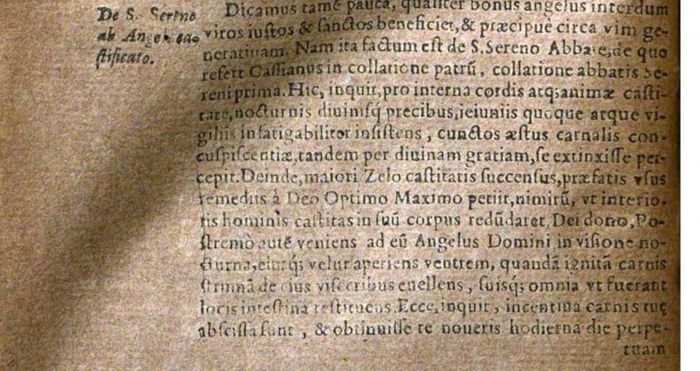
It should be noted, moreover, that while some are protected against all witchcraft, and some against some kinds and not all, there are some who are so singularly made chaste by good angels in their generative power that they can in no way be bewitched in that power by evil ones. …
Let us say a little, however, about how a good angel sometimes benefits just and holy men, especially in the generative power. For so it happened with St. Serenus, abbot, of whom Cassian tells in the Conferences of the Fathers, in Abbot Serenus’s first conference. He, it says, persisting tirelessly in prayers by night and day, in fasts and vigils, for the inward chastity of heart and soul, perceived at last that by divine grace he had extinguished in himself all the heats of carnal desire. Then, fired with a greater zeal for chastity and using the same remedies, he asked of God, Best and Greatest, that by God’s gift the chastity of the inner man might overflow into his body. At last an angel of the Lord came to him in a vision by night and, as if opening his belly, tore out of his bowels a kind of fiery tumour of the flesh, and put all his entrails back in their places, saying: “Behold, the incentives of your flesh are cut away” …
So too of blessed Equitius, abbot, blessed Gregory says in book 1 of the Dialogues: when in his youth the incentives of the flesh wearied him with a fierce struggle, the very anguish of his temptation made him more zealous for prayer. And as he sought a remedy for this from almighty God with continual prayers, one night, an angel standing by, he saw himself made a eunuch, and in his vision it appeared that the angel cut away all motion from his genital members; and from that time he was as free from temptation as if he had no sex in his body.
Original Latin
Insuper notandum, quod licet aliqui contra omnia maleficia muniantur, aliqui vero contra aliqua, et non contra omnia, sunt tamen aliqui, qui singulariter a bonis Angelis super vim generativam ita castificantur, quod nullo modo a malis maleficiari circa illam potentiam possunt. …
Dicamus tamen pauca, qualiter bonus angelus interdum viros iustos et sanctos beneficiet, et praecipue circa vim generativam. Nam ita factum est de S. Sereno Abbate, de quo refert Cassianus in collatione patrum, collatione abbatis Sereni prima. Hic, inquit, pro interna cordis atque animae castitate, nocturnis diurnisque precibus, ieiuniis quoque atque vigiliis infatigabiliter insistens, cunctos aestus carnalis concupiscentiae tandem per divinam gratiam se extinxisse percepit. Deinde, maiori zelo castitatis succensus, praefatis usus remediis a Deo Optimo Maximo petiit, nimirum, ut interioris hominis castitas in suum corpus redundaret Dei dono. Postremo autem veniens ad eum Angelus Domini in visione nocturna, eiusque velut aperiens ventrem, quandam ignitam carnis strumam de eius visceribus evellens, suisque omnia ut fuerant locis intestina restituens: Ecce, inquit, incentiva carnis tuae abscissa sunt …
Sic etiam de beato Equitio abbate, dicit beatus Gregor. 1. lib. dialog. Hunc, inquit, cum iuventutis suae tempore acre certamen carnis incentiva fatigaret, ipsum suae tentationis angustiae ad orationis studium solertiorem fecerunt. Cumque hac in re ab omnipotenti Deo remedium continuis precibus quaereret, nocte quadam assistente Angelo eunuchari se vidit, eiusque visione apparuit, quod omnem motum ex genitalibus membris abscinderet: atque ex eo tempore ita fuit alienus a tentatione, ac si sexum non haberet in corpore.
So the story Lecky gives is in the Malleus after all, but in Part II, Question I (on those whom witches cannot harm), not in “Pars I. Quaest. vii” as his note says; the page of Part I, Question VII checked earlier (p. 77) has nothing of it. Nider’s Formicarius, printed later in the same volume (below), tells the same two stories from the same two sources, Cassian and Gregory, in nearly the same words; Nider wrote in the 1430s, half a century before the Malleus, so the borrowing probably ran from Nider to Sprenger. “Strumam” (a swelling) expands the print’s “strumã”, which is partly in shadow.
Nider’s Formicarius in the Same Volume, pp. 503–504: Serenus and Equitius
Latin: Lyon, 1620, vol. I, p. 503 (scan), within the extracts from Johannes Nider’s Formicarius (running title “Formic. de malefic. decept.”) that this volume prints after the Malleus. Conventions as above. The speakers are Piger (“the Lazy One”) and Theologus. Highlighted: the angelic operations Lecky mentions. Lecky’s note cites both Sprenger and Nider “c. v.”; the Sprenger passage is above.
Piger. Although these benefits of the good angels, flowing even to the unjust, are innumerable, and I was unaware of them till now (but shall be grateful hereafter), I am not asking mainly about those, but about their benefits regarding the generative power: for instance, whether they make some men chaste, as evil spirits make some wicked men cold by their witchcraft.
Theologus. Without doubt they do so, but where and when it is expedient. For so it happened with St. Serenus, abbot, of whom Cassian tells in the first Collation of Abbot Serenus. He, it says, persisting tirelessly in prayers by night and day, fasts and vigils, for the inner chastity of heart and soul, at length perceived that by divine grace he had put out in himself all the heats of carnal concupiscence. Then, kindled with greater zeal for chastity, and using the aforesaid remedies, he asked God that the chastity of the inner man might overflow into the body by God’s gift; and at last an Angel came to him in a night vision, and, as if opening his belly, plucked out of his viscera a kind of fiery lump of flesh and threw it away, and put all the intestines back in their places as they had been, saying: “Behold, the incentives of your flesh have been cut away, and know that today you have obtained perpetual purity of body, according to the vow with which you asked for it, so that you shall not be stirred even by that natural motion which is avoided even in infants and sucklings.”
So, too, of Blessed Equitius, abbot, Blessed Gregory says in book 1 of the Dialogues: when in his youth the incentives of the flesh troubled him with fierce struggle, the very anguish of his temptation made him more zealous for prayer. And when in this matter he sought a remedy from Almighty God with continual prayers, one night, with an Angel standing by, he saw himself made a eunuch; and it appeared in his vision that the angel had cut off all motion from his genital members; and from that time he was as free from temptation as if he had no sex in his body. Relying on this power, with the help of Almighty God, as he had before ruled over vices, so he began afterwards to rule over women too.
Original Latin
Piger. Licet haec sint innumerabilia bonorum Angelorum etiam in iniustos profluxa beneficia, de quibus heu nescius fui hactenus, sed gratus ero in antea, tamen de his non quaero principaliter, sed de beneficiis eorum circa generativam potentiam, ut puta an quosdam castificent, sicut mali spiritus quosdam malos infrigidant per sua maleficia.
Theologus. Haud dubie ita faciunt, sed ubi & quando expedit. Nam ita factum est de S. Sereno, abbate, de quo refert Cass. in coll. par. abba. Sereni, prima. Hic, inquit, pro interna cordis atque animae castitate nocturnis, diurnisque precibus, ieiuniis quoque ac vigiliis infatigabiliter insistens, cunctos aestus carnalis concupiscentiae tandem per divinam gratiam in se extinxisse percepit: Deinde maiori zelo castitatis succensus, praefatis usus remediis, à Deo petiit, ut interioris hominis castitas in corpus redundaret Dei dono; postremo autem adveniens ad eum Angelus in visione nocturna, eiusque velut aperiens uterum, quandam ignitam carnis strumam, de eius visceribus evellens ac proiiciens, suisque omnia, ut fuerant, locis intestina restituens: Ecce, inquit, incentiva carnis tuae abscissa sunt, & obtinuisse te noveris hodierna die perpetuam corporis puritatem, iuxta votum quo id poposcisti, ut ne ipse quidem naturali motu, qui etiam in parvulis atque lactantibus evitatur, ulterius pulseris.
Sicut de B. Equitio Abbate dicit B. Gregorius primo libro Dialogorum. Hunc, inquit, cum iuventutis suae tempore acri certamine carnis incentiva fatigarent, ipsae suae tentationis angustiae ad orationis studium solertiorem fecerunt. Cumque hac in re ab omnipotenti Deo remedium continuis precib. quaereret, nocte quadam assistente Angelo eunuchari se vidit, eiusque visioni apparuit, quod omnem motum ex genitalibus membris eius absciderit, atque ex eo tempore ita fuit alienus à tentatione ac si sexum non haberet in corpore. Qua virtute fretus ex Dei omnipotentis auxilio ut vitiis ante praeerat, ita coepit postmodum etiam foeminis praeesse.
On the next page (p. 504) Nider tells a third story, of a monk called Helias whom three angels “made a eunuch”; there the text adds that the testicles seemed to be cut off, “not that it was really so, but because it seemed so”. Lecky does not mention Helias.
Lecky’s Notes 68, 78 and 79 Compared
| Lecky (ch. I) | The print | Comment |
|---|---|---|
| Note 68: “‘Fœmina,’ he assures us, is derived from Fe and minus, because women have less faith than men (p. 65).” | p. 65: “Dicitur enim Foemina à Fe & minus: quia semper minorem habet & servat fidem.” | Accurate, and the page number is right. “Than men” is implied by the context, not said in that sentence. Lecky omits the exception the text makes straight away for the Virgin Mary, and its remark that men’s faith failed too, at the Passion. |
| Note 68: “Maleficiendo, is from male de fide sentiendo.” | p. 26 (no page given by Lecky): “à maleficiendo seu male de fide sentiendo”. | Lecky’s sentence makes the two a single derivation. The print gives them as alternatives (seu, “or”) for the name of the witches, so “Maleficiendo, is from male de fide sentiendo” is a compression, not what is printed. |
| Note 68: “‘a dia quod est duo, et bolus quod est morsellus, quia duo occidit, scilicet corpus et animam. Et secundum etymologiam, licet Græce, interpretetur diabolus clausus ergastulo: et hoc sibi convenit cum non permittitur sibi nocere quantum vellet. Vel diabolus quasi defluens, quia defluxit, id est corruit, et specialiter et localiter’ (p. 41).” | The Quaestio IV page, same words, beginning with a sentence Lecky omits (“Est enim usus scripturae & locutionis …”). | Word for word apart from spelling and punctuation, so far as I can read. The page number in this scan is smudged, so I match it by content. |
| Note 79: “the curious story of St. Sylvanus, Bishop of Nazareth, in Sprenger (Pars II. Quæst. 1, cap. xi.). The Devil not only assumed the appearance of this holy man, in order to pay his addresses to a lady, but when discovered, crept under a bed, suffered himself to be dragged out, and declared that he was the veritable bishop. Happily, after a time, a miracle was wrought which cleared the reputation of the calumniated prelate.” | Pars II, Quaestio I, cap. XI: the Devil solicits a noblewoman in her bed; she cries out; he hides under the bed, is “sought and found”, and says he is the bishop; later the Devil, in a possessed body at Jerome’s tomb, confesses. | The reference is exact. “Dragged out” is not in the Latin (“requisitus & inventus”: sought and found). “A miracle was wrought” is Lecky’s gloss for the Devil’s confession at the tomb. What Lecky leaves out is the use the Malleus makes of the story: it is its example of witchcraft’s power over reputation (fama), set beside Job’s goods and body. |
| Note 78: “Sprenger, Pars I. Quæst. vii. At the request of St. Serenus and St. Equitius the angels performed on those saints a counteracting surgical operation. (Nider, Formic de Mal., c. v.)” | Nider, pp. 503–504: the Serenus and Equitius stories, in the Formicarius extracts at the end of the same volume. | The stories are as Lecky says (“surgical operation” is a fair description of the vision of the angel removing the lump of flesh and the “eunuch” vision). But in this edition they are not in Pars I, Quaestio VII (p. 77 checked; the rest of that question was not). Lecky’s “c. v.” may be book V of the Formicarius (the book on witches); I have not checked Nider’s numbering. Both are visions, and Serenus’s story is Cassian’s, retold by Nider. |
Pp. 461–462: The Cologne Approbation, and the Preachers
Latin: Lyon, 1620, vol. I, pp. 461–462 (scan, p. 461; p. 462), conventions as above. These pages are the preface to the approbation of the Malleus by the University of Cologne: the inquisitors’ own account of why they compiled the tract, before the doctors’ signatures (from p. 463). The sentence runs across the page break. Highlighted: the words Lecky’s “rebellion” rests on.
P. 461. And because some rectors of souls and preachers of the word of God did not fear to assert and affirm publicly in their sermons to the people
P. 462. that witches do not exist, or that they could do no harm to creatures by any operation. From these incautious sermons it sometimes happened that the secular arm was deprived of the power to punish such witches, and this was a very great increase of witches and a strengthening of that heresy. Therefore the aforesaid inquisitors, wishing to meet all dangers and insults with all their might, compiled a certain treatise, no less laboriously than carefully. […] But since it is agreeable to reason that things done for the common good should also be strengthened by the common approval of the Doctors, […] they offered it to the University of Cologne, or to some professors of sacred theology there, to be discussed and collated, so that if anything blameworthy, out of tune with Catholic truth, were found, it might be refuted by their judgement, and what was in harmony with Catholic truth might be approved.
Original Latin
P. 461. Et quia nonnulli animarum rectores, et verbi Dei praedicatores, publice in eorum sermonibus ad populum asserere et affirmare non verebantur
P. 462. maleficas non esse, aut qui nihil in nocumentum creaturarum quacunque operatione efficere possent. Ex quibus incautis sermonibus nonnunquam saeculari brachio ad puniendum huiusmodi maleficas amputabatur facultas: et hoc in maximum augmentum maleficarum et confortationem illius haereseos. Ideo praefati inquisitores, totis eorum viribus, cunctis periculis et insultibus obviare volentes, tractatum quendam non tam studiose quam laboriose collegerunt. […] At quoniam consonum rationi est, ut ea quae pro communi utilitate fiunt, etiam communi approbatione Doctorum roborentur, […] eundem almae universitati Coloniensi seu nonnullis ibidem sacrae paginae professoribus ad discutiendum et collationandum obtulerunt, ut si qua reprehensibilia, a Catholica veritate dissona reperirentur, eorum iudice sic refutarentur: quod tamen consona Catholicae veritati approbarentur.
Lecky’s sentence (note 83, p. 92) is: “An assembly of doctors of the University of Cologne, which was held in 1487, lamented, and severely and authoritatively condemned, a still more startling instance of rebellion, arising from a quarter in which it was least to be expected. When the panic was raging most fiercely in the diocese of Cologne, some priests had attempted to allay the alarm by questioning the reality of the crime.” Set against the print:
| Lecky, 1865 | Lyon, 1620 | |
|---|---|---|
| Who spoke | “some priests” | “nonnulli animarum rectores, et verbi Dei praedicatores” (some rectors of souls and preachers). Fits. |
| What they said | “questioning the reality of the crime” | “maleficas non esse, aut … nihil in nocumentum … efficere possent”: witches do not exist, or can do no harm. Fits, and slightly stronger than “questioning”. |
| “Allay the alarm” | “attempted to allay the alarm” | Not in these lines. The text says the sermons hindered punishment of witches and helped the heresy; it does not say the priests aimed at calming a panic. That motive is Lecky’s. |
| Who condemned | the Cologne doctors “lamented, and severely and authoritatively condemned” it | The preface is the inquisitors’ account. The doctors’ part, as the text describes it, is to examine and approve the inquisitors’ treatise; the passage read does not itself record them condemning the preachers. Their signatures (from p. 463) were not read. |
| “In the diocese of Cologne” | the panic raging “in the diocese of Cologne” | Not in these lines. The preceding page lists five archbishoprics (including Cologne) for the inquisitors’ commission, but does not say the preachers were from the diocese of Cologne. |
| “1487” | the assembly was in 1487 | Not read on these pages; the approbation itself (p. 463 on) carries the date. |
| Reference | “vol. i. pp. 460–468” | The approbation runs from about p. 459 to p. 468 in this printing; the preface read here is on pp. 461–462. |
| Scan | vol. I, p. 92 | p. 461, p. 462 |
Lecky has turned the inquisitors’ complaint about incautious preachers into a condemnation by the Cologne doctors of a “rebellion”. The facts of the preachers’ statement are right; the framing and the doctors’ part are his own.
Further reading
“The book has three parts. Part 1 is basically Summa Theologica, except all the questions are about witches. Part 2 is basically the DSM 5, except every condition is witchcraft. Part 3 is a manual for judges presiding over witch trials.”
Scott Alexander, “Book Review: Malleus Maleficarum”, Astral Codex Ten. A modern reader’s review of the whole book, including the question it ends on: why a whole civilisation spent three centuries killing people over a threat that did not exist. It is a popular essay, not a scholarly edition, and I have not checked its quotations from the Malleus against the Lyon 1620 text used on this page.
Editor’s notes on this page
The Malleus is the best-known manual of the witch-hunters, and Lecky uses it as his chief witness for what inquisitors believed. In notes 21 and 22 he cites it for two details: that St. Paul’s instruction that women cover their heads “because of the angels” was read as a reference to incubi, and that exorcism before baptism was a later addition to the rite.
Two of Lecky’s three statements are close to the print. The third attributes to the Malleus a claim it does not make in so many words, and the first cites the wrong question number for this edition. See the comparisons below.
Notes 68, 78 and 79 add the etymologies of femina, maleficus and diabolus, the story of St. Silvanus, and the angels’ treatment of Serenus and Equitius. The etymologies are word for word; the Silvanus story is retold with one invented detail (the Devil is “dragged out”); and the Serenus and Equitius stories are in Nider’s text at the end of the volume, not in the place Lecky cites. See the second comparison.
Further down the rabbit hole
Sources that Lecky cites in the notes next to the ones that cite this page.
- Maury, La magie et l’astrologieRoman laws against diviners, the first medieval doubters, and the praying heretics
- Bodin, Démonomanie des SorciersThe great lawyer who wrote the witch-hunters’ handbook
- Garinet, Histoire de la Magie en FranceA history of magic in France, from the Frankish kings to the author’s own day
- Augustine, De civitate DeiSeventy reports, not miracles, and a town, not a province
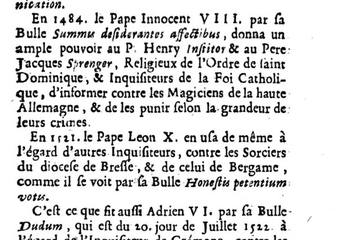
- Thiers, Traité des SuperstitionsThree papal bulls but no rebellion
- Naudé, Apologie pour tous les grands personnages qui ont esté faussement soupçonnez de magieA librarian clears the great men of magic: Pope Sylvester, Pietro d’Abano, Agrippa
Backlinks
Every place in Rationalism in Europe that links to this page (generated automatically when the site is built).