Taxes without consent (Second Treatise, ch. XI, § 140)
English: Second Treatise, chapter XI (“Of the Extent of the Legislative Power”), § 140. Highlighted: Lecky’s quotation (note 100).
It is true, governments cannot be supported without great charge, and it is fit every one who enjoys his share of the protection, should pay out of his estate his proportion for the maintenance of it. But still it must be with his own consent, i.e. the consent of the majority, giving it either by themselves, or their representatives chosen by them: for if any one shall claim a power to lay and levy taxes on the people, by his own authority, and without such consent of the people, he thereby invades the fundamental law of property, and subverts the end of government: for what property have I in that, which another may by right take, when he pleases, to himself?
Lecky: “If anyone shall claim a power to lay or levy taxes on the people without their consent …”; he omits “by his own authority”.
The end of government (Second Treatise, ch. XIV, § 163)
English: Second Treatise, chapter XIV (“Of Prerogative”), § 163. Highlighted: Lecky’s quotation (note 98).
And therefore they have a very wrong notion of government, who say, that the people have encroached upon the prerogative, when they have got any part of it to be defined by positive laws … for the end of government being the good of the community, whatsoever alterations are made in it, tending to that end, cannot be an encroachment upon any body, since no body in government can have a right tending to any other end: and those only are encroachments which prejudice or hinder the public good.
Lecky has “whatever” for “whatsoever” and “any right” for “a right”.
Why answer Filmer? (Preface)
English: the Preface to the Two Treatises. Highlighted: Lecky’s quotation (note 97).
… if any one … will but take the pains himself … to strip Sir Robert’s discourses of the flourish of doubtful expressions, and endeavour to reduce his words to direct, positive, intelligible propositions, and then compare them one with another, he will quickly be satisfied, there was never so much glib nonsense put together in well-sounding English. … I should not speak so plainly of a gentleman, long since past answering, had not the pulpit, of late years, publicly owned his doctrine, and made it the current divinity of the times. It is necessary those men, who taking on them to be teachers, have so dangerously misled others, should be openly shewed of what authority this their Patriarch is, whom they have so blindly followed …
The legislative cannot transfer its power (§§ 141–142)
English: London 1821, Second Treatise ch. XI, pp. 311–312, scan n330–n331. Highlighted: Lecky’s quotation (note 101) and the rule his text paraphrases at note 102.
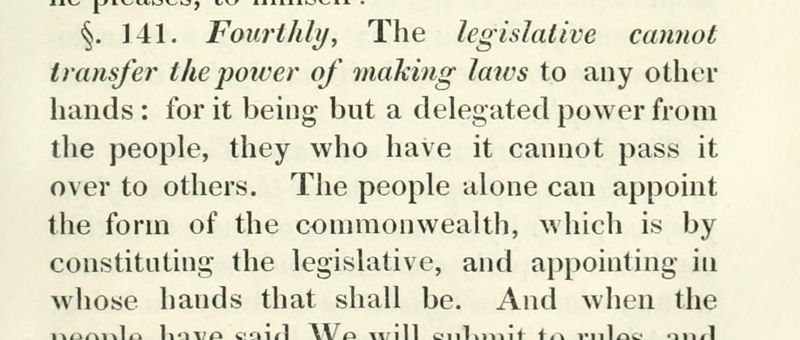
§. 141. Fourthly, The legislative cannot transfer the power of making laws to any other hands: for it being but a delegated power from the people, they who have it cannot pass it over to others. The people alone can appoint the form of the commonwealth, which is by constituting the legislative, and appointing in whose hands that shall be. And when the people have said, We will submit to rules, and be governed by laws made by such men, and in such forms, no body else can say other men [p. 312] shall make laws for them …
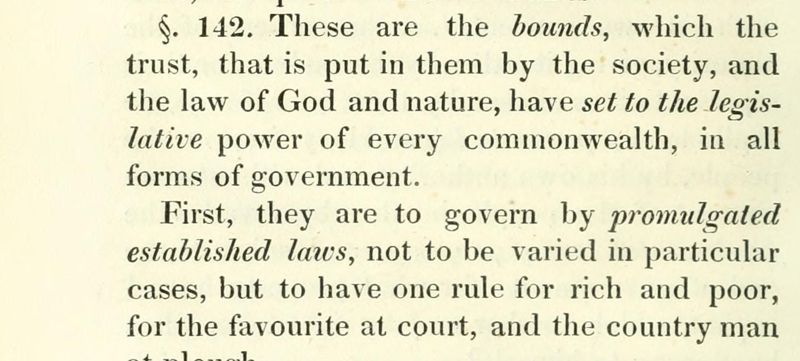
§. 142. These are the bounds, which the trust, that is put in them by the society, and the law of God and nature, have set to the legislative power of every commonwealth, in all forms of government.
First, they are to govern by promulgated established laws, not to be varied in particular cases, but to have one rule for rich and poor, for the favourite at court, and the country man at plough.
Lecky (vol. II, ch. V, note 101): “‘The legislature cannot transfer the power of making laws, for, it being but a delegated power from the people, they who have it cannot pass it over to others.’” Locke wrote “legislative”, not “legislature”, and “to any other hands: for”. Lecky adds that Grattan and Plunket used the doctrine against the Act of Union; that is not on these pages.
Further down the rabbit hole
Sources that Lecky cites in the notes next to the ones that cite this page.
- Bossuet, Defensio declarationis cleri gallicaniKings as fathers: “Abimelech” means “My father the king”
- Hallam, Literature of Europe and Constitutional HistoryHow Lecky quotes Hallam on persecution
- Macaulay, History of England and EssaysMacaulay on Puritans, bear-baiting and the servile Church
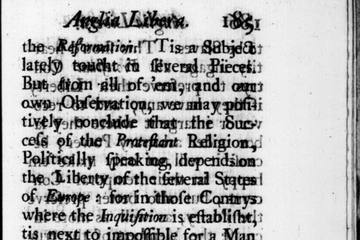
- Toland, Anglia LiberaA freethinker argues that Protestantism needs free states to survive
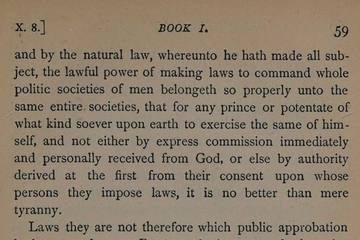
- Hooker, Of the Laws of Ecclesiastical PolityLaws without consent are “no better than mere tyranny”, and what Hooker meant by consent
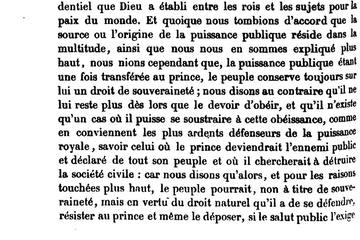
- Bianchi, Traité de la puissance ecclésiastiqueAn Ultramontane friar on when a people may depose its king, and the Scot who ‘sold his pen’ to James I
Backlinks
Every place in Rationalism in Europe that links to this page (generated automatically when the site is built).