Chapter 35
Latin: Octavius, pp. 175–176 (p. 175, p. 176), ch. XXXV, §§ 2–3. Spelling regularised (æ as ae). The editor’s notes on both pages are omitted. Highlighted: the words Lecky quotes.
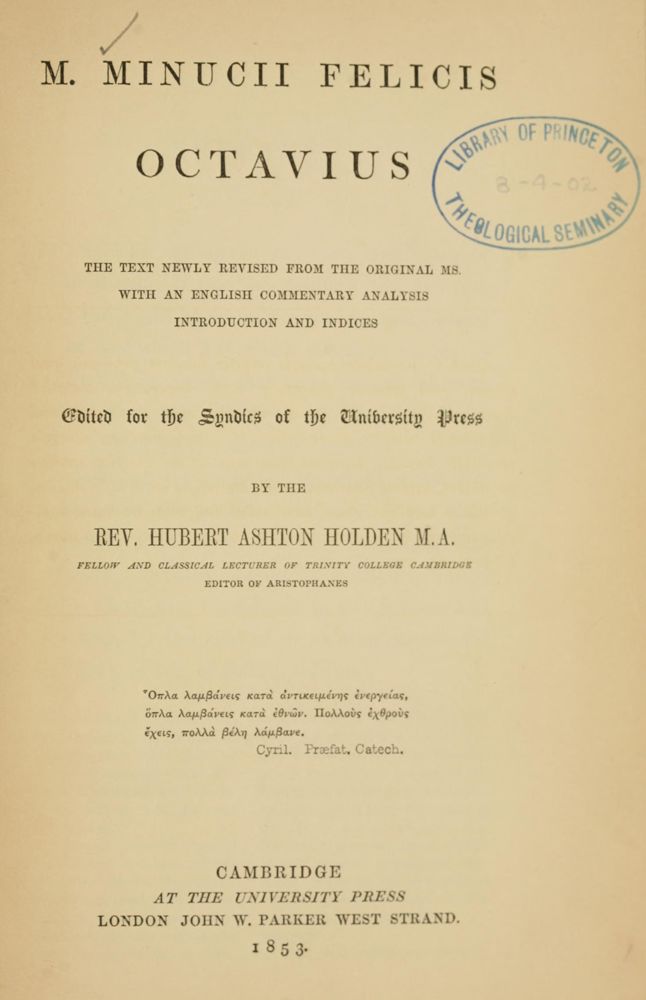
And so, among them, even Jupiter, the king himself, swears religiously by the burning banks and the black abyss: for he foresees and shudders at the punishment appointed for himself with his worshippers. Nor is there any limit or end to the torments. There the subtle fire burns and restores the limbs; it tears and feeds, as the fires of lightning touch bodies without consuming them: as the fires of Mount Etna and Mount Vesuvius, and of burning places everywhere on earth, blaze without being used up: so that penal fire is not fed by the loss of those it burns, but is nourished by the unconsumed tearing of bodies. That those who do not know God are rightly tormented, as impious and unjust, no one but a profane man doubts …
Original Latin
Ideo apud eos etiam ipse rex Iupiter per torrentes ripas et atram voraginem iurat religiose: destinatam enim sibi cum suis cultoribus poenam praescius perhorrescit. Nec tormentis aut modus ullus aut terminus. Illic sapiens ignis membra urit et reficit; carpit et nutrit, sicut ignes fulminum corpora tangunt nec absumunt: sicut ignes Aetnae montis et Vesui montis et ardentium ubique terrarum flagrant nec erogantur: ita poenale illud incendium non damnis ardentium pascitur, sed inexesa corporum laceratione nutritur. Eos autem merito torqueri qui Deum nesciunt, ut impios, ut iniustos, nisi profanus nemo deliberat …
Doubtful points
“Sapiens ignis” (“wise fire”) the editor glosses as “the subtle fire”; I follow that. The first sentence’s opening word (“Ideo”, here preceded in the print by “Et”) is taken from the text layer, as above. “Erogantur” I take as “are spent”. “Inexesa” (“unconsumed”) is the editor’s note’s reading for “inexesorum”; I did not follow his emendation.
Lecky’s Quotation Compared
| Lecky, 1865 | 1853 edition |
|---|---|
| ‘Ipse rex Jupiter per torrentes ripas et atram voraginem jurat religiose: destinatam enim sibi cum suis cultoribus pœnam præscius perhorrescit: nec tormentis aut modus ullus aut terminus. Illic sapiens ignis membra urit et reficit: carpit et nutrit sicut ignes fulminum corpora tangunt nec absumunt: sicut ignes Ætnæ et Vesuvii et ardentium ubique terrarum flagrant nec erogantur: ita pœnale illud incendium non damnis ardentium pascitur sed inexesa corporum laceratione nutritur.’ | Et ideo apud eos etiam ipse rex Iupiter per torrentes ripas et atram voraginem iurat religiose: destinatam enim sibi cum suis cultoribus poenam praescius perhorrescit. Nec tormentis aut modus ullus aut terminus. Illic sapiens ignis membra urit et reficit; carpit et nutrit, sicut ignes fulminum corpora tangunt nec absumunt: sicut ignes Aetnae montis et Vesui montis et ardentium ubique terrarum flagrant nec erogantur: ita poenale illud incendium non damnis ardentium pascitur, sed inexesa corporum laceratione nutritur. |
Lecky starts at “ipse rex” (omitting “Et ideo apud eos etiam”), turns two full stops into colons or runs them together, and writes “Ætnæ et Vesuvii” where the edition has “Aetnae montis et Vesui montis” (“Mount Etna and Mount Vesuvius”). The change of “Vesui” to “Vesuvii” is a standard form of the name; “montis” is dropped. None of these changes the sense. His “cap. xxxv.” is right.
Editor’s notes on this page
In Chapter III Lecky quotes, as “a somewhat ferocious passage”, Minucius Felix on the punishments of hell: that the pagan king of the gods himself swears by the burning banks of the Styx, that the fire of hell “subtle” and wise burns and restores the limbs it torments, as lightning and the fires of Etna and Vesuvius touch bodies without consuming them, so that the punishment is fed by the bodies’ unconsumed laceration.
The Latin is accurate except for the names of the two volcanoes: Lecky’s “Ætnæ et Vesuvii” has dropped the word “montis” after each, and a few words of punctuation differ. See the comparison.
Further down the rabbit hole
Sources that Lecky cites in the notes next to the ones that cite this page.
- Swinden, An Enquiry into the Nature and Place of HellAn Anglican clergyman proves that hell is in the sun
- Daillé, De poenis et satisfactionibus humanisWould even the Virgin Mary pass through the fire? A Protestant reads the Fathers on purgatory
- Tertullian, ApologeticumWhat Lecky leaves out of Tertullian on fear
- Bodin, Démonomanie des SorciersThe great lawyer who wrote the witch-hunters’ handbook
- Agobard, Liber de imaginibusLecky’s five Agobard quotes checked against Baluze
- Aquinas, Summa theologiae, Supplement, q. 94Lecky’s quotation that is really a paraphrase
Backlinks
Every place in Rationalism in Europe that links to this page (generated automatically when the site is built).
- Chapter III: note 139