“Deus Inquisitorum primus”: Adam stripped of Paradise (Book I, pp. 45–46)
Latin: Book I, Title 2, chapter VII (“Prima mundi aetas”), p. 45 (scan) to p. 46 (scan). Abbreviations expanded. Highlighted: what Lecky paraphrases.
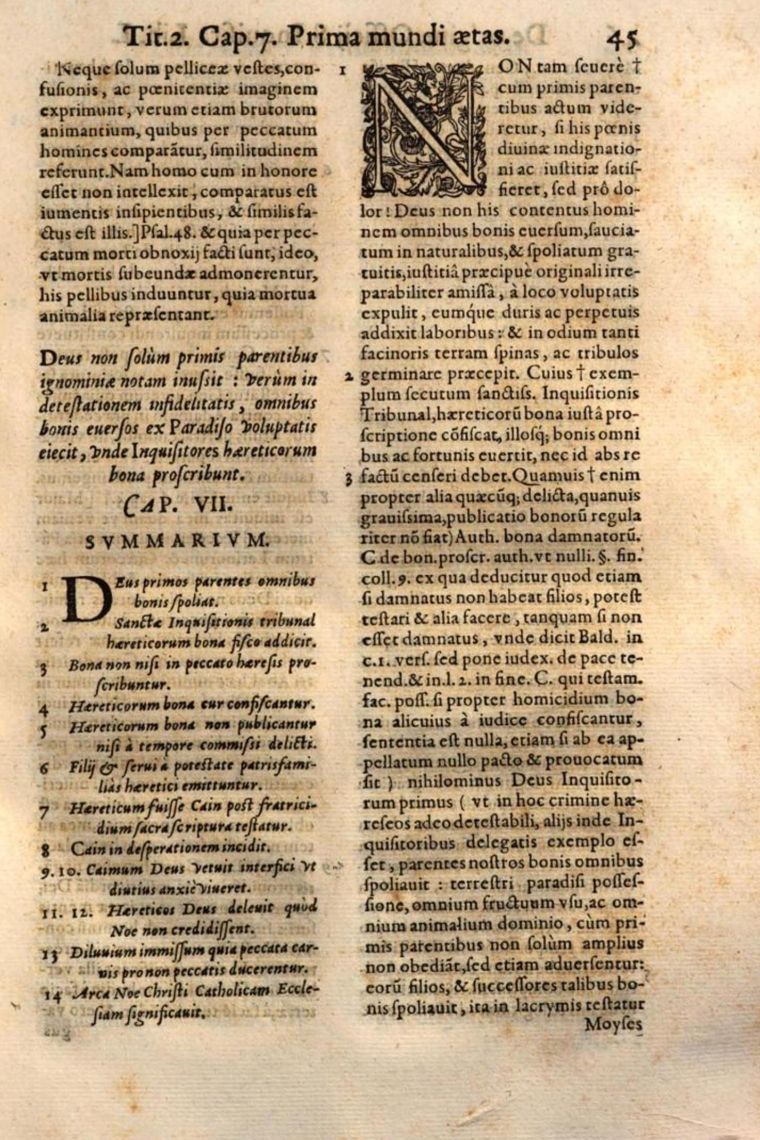
It would not seem that the first parents were dealt with so severely, if divine indignation and justice had been satisfied with these punishments; but, alas, God, not content with them, drove man out of the place of delight, overthrown in all his goods, wounded in his natural gifts and stripped of the gifts of grace, original justice above all being irreparably lost, and condemned him to hard and endless labours; and in hatred of so great a crime he commanded the earth to bring forth thorns and thistles. Following his example the tribunal of the most holy Inquisition confiscates the goods of heretics by just proscription and ruins them in all their goods and fortunes; nor should this be thought done without reason. For although for other crimes, however grave, confiscation is not the rule … nevertheless God, the first of the inquisitors (so as to be an example, in this so detestable crime of heresy, to the other inquisitors later delegated) stripped our parents of all their goods: of the possession of the earthly paradise, of the use of all fruits and of dominion over all animals, since these not only no longer obey the first parents but even turn against them; he stripped their children and successors of such goods, as Moses testifies in tears …
Original Latin
Non tam severe cum primis parentibus actum videretur, si his pœnis divinæ indignationi ac iustitiæ satisfieret, sed pro dolor: Deus non his contentus hominem omnibus bonis eversum, sauciatum in naturalibus, et spoliatum gratuitis, iustitia præcipue originali irreparabiliter amissa, a loco voluptatis expulit, eumque duris ac perpetuis addixit laboribus: et in odium tanti facinoris terram spinas, ac tribulos germinare præcepit. Cuius exemplum secutum sanctiss. Inquisitionis Tribunal, hæreticorum bona iusta proscriptione confiscat, illosque bonis omnibus ac fortunis evertit, nec id abs re factum censeri debet. Quamvis enim propter alia quæcumque delicta, quamvis gravissima, publicatio bonorum regulariter non fiat … nihilominus Deus Inquisitorum primus (ut in hoc crimine hæreseos adeo detestabili, aliis inde Inquisitoribus delegatis exemplo esset) parentes nostros bonis omnibus spoliavit: terrestris paradisi possessione, omnium fructuum usu, ac omnium animalium dominio, cum primis parentibus non solum amplius non obediant, sed etiam adversentur: eorum filios, et successores talibus bonis spoliavit, ita in lacrymis testatur Moyses …
Lecky’s summary, that Paramo calls “the Almighty … the First Inquisitor” who “deprived both Adam and his descendants of the Garden of Eden” in justification of confiscation, is accurate. The same chapter’s summary (item 6) adds that the children and servants of a heretic father are released from his authority. The argument about the heretic’s “impurity” falling on his relatives was not found on these pages.
“Juste enim proceditur contra defunctos hæreticos” (Book III, p. 588)
Latin: p. 588, left column, scan, after the marginal note 84 (“cui vivo communicare non licet, nec mortuo licebit”). Highlighted: Lecky’s words.
… For it is justly proceeded against dead heretics. First, that his memory may be condemned. Second, that his goods may be taken away, through the fisc, from the heirs of the deceased or from any other possessors. Third, that the dead man may be exhumed and cast out of sacred ground and burned.
Original Latin
… Justè enim proceditur contra defunctos hæreticos. Primo ut memoria ejus damnetur. Secundo ut bona illius per fiscum ab hæredibus defuncti, seu à quibuslibet aliis possessoribus auferantur. Tertio, ut defunctus exhumetur, & extra locum sacrum projiciatur & comburatur.
| Lecky, 1865 (note 43) | Paramo, 1598, p. 588 | |
|---|---|---|
| First reason | ut memoria ejus damnatur | ut memoria ejus damnetur |
| Second reason | ut bona illius per fiscum ab hæredibus defuncti seu a quibuslibet aliis possessoribus auferantur | identical (comma after “defuncti”) |
| Third reason | omitted | Tertio, ut defunctus exhumetur … |
Lecky’s “damnatur” (indicative) for Paramo’s subjunctive “damnetur” is a small slip or a variant reading; I could not tell which. The omitted third reason does not weaken his point: the same page (marginal notes 83–88) says the action can be brought at any time, however long after death, that the heirs are notified, and that the dead man’s statue is paraded and handed to the secular court. The confiscation is plainly a main purpose.
Editor’s notes on this page
Lecky says the Inquisition’s trials of dead men were not “impotent malice” but aimed to rob the heirs. Paramo’s sentence, on p. 588, confirms this: one reason for proceeding against the dead heretic is that his goods may be taken “through the fisc” from his heirs or any other possessors. The Latin is Paramo’s, with one small change; Lecky leaves out the third reason, that the dead man’s body may be exhumed and burned.
Further down the rabbit hole
Sources that Lecky cites in the notes next to the ones that cite this page.
- Eymericus, Directorium inquisitorumLecky cuts the sequel to the Barcelona burning
- Van Bruyssel, Histoire du commerce et de la marine en BelgiqueThirty kingdoms trading with Flanders, and a friar who called murder ‘meritorious’
- Llorente, Histoire critique de l’Inquisition d’EspagneHow many did the Spanish Inquisition burn? Its former secretary counts
- Troplong, Du prêt: the history of lending at interest“The people cannot live without loans”: a French judge’s history of usury, Lecky’s source for Nicaea and St Louis
- Bédarride, Les Juifs en France, en Italie et en EspagneWhen Christianity came to power, the Jews’ persecution began, and a Pope wrote that God does not rejoice in bloodshed
- Simancas, De Catholicis InstitutionibusAn inquisitor’s handbook: no faith with heretics, and torture
Backlinks
Every place in Rationalism in Europe that links to this page (generated automatically when the site is built).