“Six malheureuses femmes” (p. 463)
French: Annuaire des Deux Mondes, vol. VIII (1857–1858), p. 463, scan n470. The paragraph begins on p. 462. Highlighted: what Lecky’s text and note report.
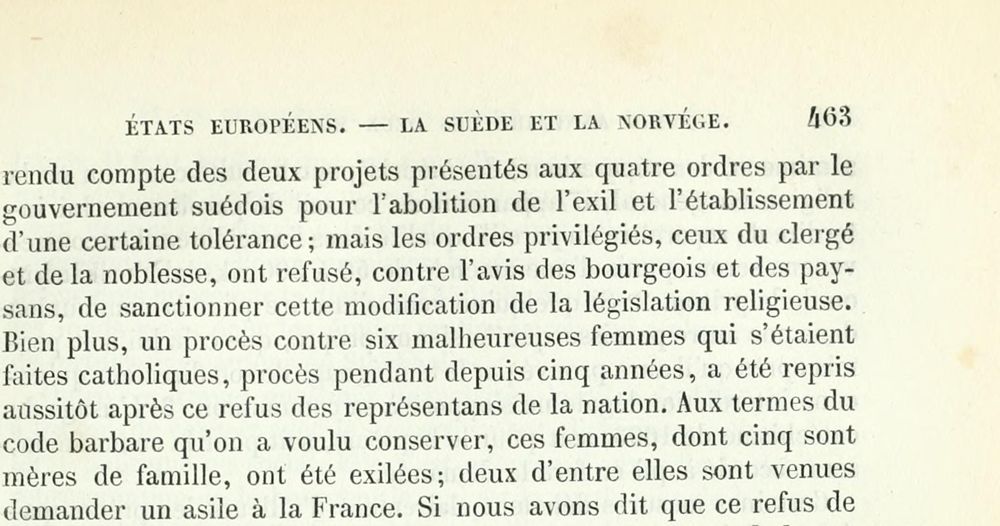
… [we have] given an account of the two bills laid before the four estates by the Swedish government for the abolition of exile and the establishment of a certain tolerance; but the privileged orders, those of the clergy and the nobility, refused, against the opinion of the burghers and the peasants, to sanction this change in the religious laws. Worse still, a prosecution of six unhappy women who had become Catholics, a prosecution pending for five years, was taken up again immediately after this refusal by the representatives of the nation. Under the terms of the barbarous code that it was wished to preserve, these women, five of whom are mothers of families, have been exiled; two of them have come to ask asylum of France.
Translation: this edition’s draft. The bracketed words supply the start of the sentence on p. 462, which was not read on the image.
Original French
[p. 462] … [p. 463] rendu compte des deux projets présentés aux quatre ordres par le gouvernement suédois pour l’abolition de l’exil et l’établissement d’une certaine tolérance; mais les ordres privilégiés, ceux du clergé et de la noblesse, ont refusé, contre l’avis des bourgeois et des paysans, de sanctionner cette modification de la législation religieuse. Bien plus, un procès contre six malheureuses femmes qui s’étaient faites catholiques, procès pendant depuis cinq années, a été repris aussitôt après ce refus des représentans de la nation. Aux termes du code barbare qu’on a voulu conserver, ces femmes, dont cinq sont mères de famille, ont été exilées; deux d’entre elles sont venues demander un asile à la France.
Lecky (vol. II, ch. IV, text at note 98): “Only a few years ago, six ladies were exiled from Sweden because they had embraced the Roman Catholic faith”; note 98: the bill “adopted by the Houses of the Middle Class and of the Peasants, was rejected by those of the Nobles and of the Clergy”. Lecky’s “ladies” is gentler than the Annuaire’s “malheureuses femmes”, and he leaves out the detail that most of them were mothers. Further down the same page the Annuaire lists what the Diet did pass: the abolition of the edict against conventicles (konventikel-placat) of 12 January 1726, so that Lutherans might meet to pray together without a pastor present (read on the page image at preview size only).
Further down the rabbit hole
Sources that Lecky cites in the notes next to the ones that cite this page.
- Proast, The Argument of the Letter concerning TolerationLocke’s Oxford opponent, licensed by the Vice-Chancellor
- Coleridge, Notes on English Divines“Most dearly do I love Jeremy Taylor”: Coleridge on a broken principle
- Taylor, A Discourse of the Liberty of ProphesyingLecky quotes Taylor accurately on water and Spirit
- Aquinas, Summa theologiae, II-IIHeretics and forgers; the usurper’s subjects
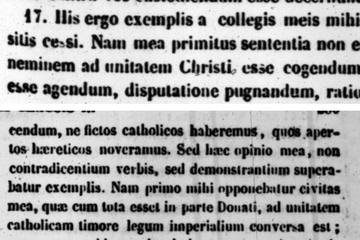
- Augustine, Letters 93 and 185“My opinion at first was that no one should be coerced”: how Augustine changed his mind
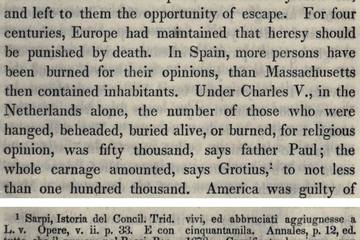
- Bancroft, History of the United States, vol. IHanging Quakers in Boston, and where Lecky’s 50,000 Dutch martyrs came from
Backlinks
Every place in Rationalism in Europe that links to this page (generated automatically when the site is built).
- Chapter IV, Part II: note 98