The Fathers on the corporeity of the soul
English: vol. 3, p. 325, scan. Highlighted: what Lecky quotes.
III. But as Dr. Cudworth in the sequel again appeals to the testimony of the ancient Christian fathers, it may be worth while to give a brief exposition of their sentiments generally on the nature of the soul. Not one of them entertained the same opinion as the majority of Christians do at the present day, that it is perfectly simple, and entirely destitute of all body, figure, form, and extension. On the contrary, they all acknowledge it to contain something corporeal, although of a different kind and nature from the bodies of this mortal sphere. But yet they are divided into two opinions. For some contend that there are two things in the soul, spirit and a very thin and subtle body in which this spirit is clothed: while others hold it to be altogether corporeal, and nothing more than a certain subtle and aerial body. … For those who follow Plato and the Platonists, for example Clement, Origen, and their disciples, adopt the Platonic doctrine respecting the soul also, and pronounce it to be most simple in itself, but yet always invested with a subtle body. But the others who keep farther aloof from Plato, and consider his philosophy to be prejudicial to Christian principles, repudiate this doctrine of his as well, and maintain that the soul altogether is nothing more than a most subtle body. … They very frequently assail the Platonists with bitter invectives, for inculcating that the soul is a nature most simple in itself, and devoid of all concretion …
Lecky’s version: “‘Not one of them (the early Fathers) entertained the same opinion as the majority of Christians do at the present day, that the soul is perfectly simple …’” with “(the early Fathers)” and “the soul” inserted for Mosheim’s “it”; “Platonists (i.e. Clement, Origen, and their disciples)” is Lecky’s parenthesis. The sentence “I am aware that some of them pronounce the soul to be a mere spirit …” is passed over by Lecky.
“A privilege proper to the Deity only”: Origen on souls without bodies (pp. 318–319)
English, with Origen’s Latin as Cudworth gives it (De principiis book II, ch. 2): vol. 3, p. 318 (scan) and p. 319 (scan), with Mosheim’s note 5 (abridged). Highlighted: what Lecky’s note 165 points to.
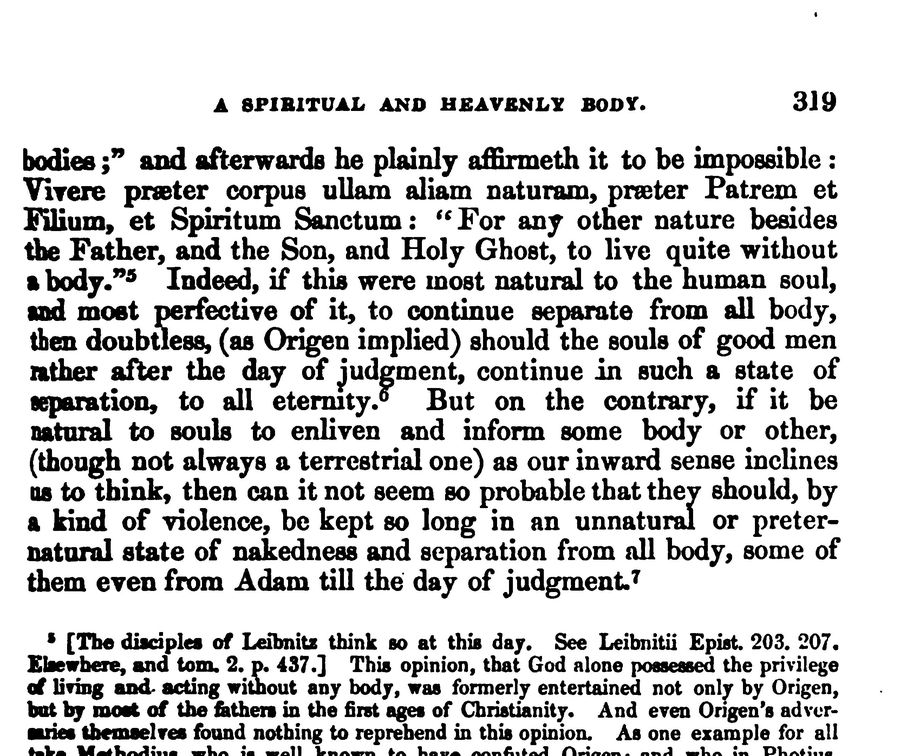
… From whence it is evident that they who are said to live to God, are not therefore supposed to be less alive, than they were, when they lived unto men. Now, it seemeth to be a privilege or prerogative proper to the Deity only, to live and act alone, without vital union or conjunction with any body. Quærendum, saith Origen, si possibile est, penitus incorporeas remanere rationabiles creaturas, cum ad summum sanctitatis ac beatitudinis venerent? An necesse est eas semper conjunctas esse corporibus? “It is worth our inquiry, whether it be possible for rational creatures to remain perfectly incorporeal and separate from all body, when they are arrived to the highest degree of holiness and happiness? or whether they be always of necessity conjoined with some bodies;” and afterwards he plainly affirmeth it to be impossible: Vivere praeter corpus ullam aliam naturam, praeter Patrem et Filium, et Spiritum Sanctum: “For any other nature besides the Father, and the Son, and Holy Ghost, to live quite without a body.”
[Mosheim’s note 5:] … This opinion, that God alone possessed the privilege of living and acting without any body, was formerly entertained not only by Origen, but by most of the fathers in the first ages of Christianity. And even Origen’s adversaries themselves found nothing to reprehend in this opinion. …
Lecky’s sentence, “Origen added that the Deity alone could exist as a pure spirit unallied with matter”, is a fair summary; Mosheim’s note goes further and makes it the opinion of “most of the fathers”.
“Those very apparitions of ghosts”: Origen against Celsus (p. 330)
English, with Origen’s Greek as Cudworth gives it (from Contra Celsum; Cudworth’s reference not read): vol. 3, p. 330, scan, with Mosheim’s note 4. Greek omitted here; Cudworth’s translations kept. Highlighted: what Lecky’s “(Ibid. p. 330)” points to.
“Though this might seem to have been smartly opposed by Celsus, yet are those very apparitions of ghosts notwithstanding, a sufficient argument or proof of a certain necessary opinion, that souls do subsist after death. Neither did Plato vainly conclude the immortality and permanency of the soul, besides other things, from those shadow-like phantasms of the dead, that have appeared to many about graves and monuments.” Whereupon he giveth this further account of these apparitions: … “For these apparitions of the dead are not mere groundless imaginations, but they proceed from souls themselves, really remaining and surviving after death, and subsisting in that which is called a luciform body.” … Besides which, the same Origen tells us, that the thing which St. Thomas the apostle disbelieved, was not our Saviour’s appearing after death, as if he had thought it impossible for ghosts or souls departed visibly to appear, but only his rising and appearing in that same solid body, which had been before crucified, and was laid in the sepulchre.
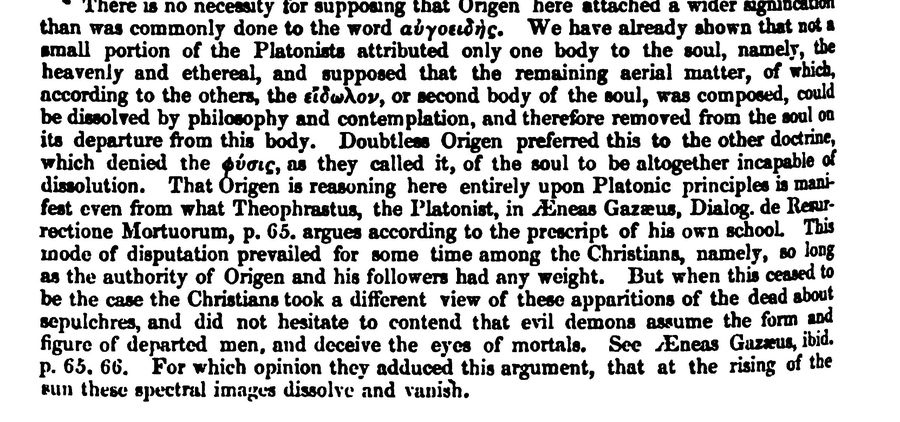
[Mosheim’s note 4:] … That Origen is reasoning here entirely upon Platonic principles is manifest even from what Theophrastus, the Platonist, in Aeneas Gazaeus, Dialog. de Resurrectione Mortuorum, p. 65. argues according to the prescript of his own school. This mode of disputation prevailed for some time among the Christians, namely, so long as the authority of Origen and his followers had any weight. But when this ceased to be the case the Christians took a different view of these apparitions of the dead about sepulchres, and did not hesitate to contend that evil demons assume the form and figure of departed men, and deceive the eyes of mortals. See Aeneas Gazaeus, ibid. p. 65, 66. For which opinion they adduced this argument, that at the rising of the sun these spectral images dissolve and vanish.
Editor’s notes on this page
Lecky’s long quotation is accurate in substance, with ellipses. The page reads “Not one of them entertained the same opinion as the majority of Christians do at the present day, that it is perfectly simple, and entirely destitute of all body, figure, form, and extension”; Lecky has “that the soul is perfectly simple”. Mosheim’s “For some contend that there are two things in the soul, spirit and a very thin and subtle body in which this spirit is clothed” and the Platonist/anti-Platonist division agree with Lecky’s version. Mosheim’s “those who follow Plato and the Platonists, for example Clement, Origen, and their disciples” is Lecky’s “(i.e. Clement, Origen, and their disciples)”.
Further down the rabbit hole
Sources that Lecky cites in the notes next to the ones that cite this page.
- Hallam, Literature of Europe and Constitutional HistoryHow Lecky quotes Hallam on persecution
- Tertullian, De animaLecky’s almost exact quote on the bodily soul
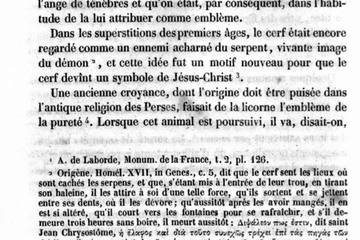
- Maury, Essai sur les légendes pieuses du moyen âgeThe stag that sucks serpents out of their holes, and the angel who carried the star of Bethlehem
- Augustine, De civitate DeiSeventy reports, not miracles, and a town, not a province
- Didron, Iconographie chrétienneHow medieval art pictured Christ the Judge
- Agobard, Liber de imaginibusLecky’s five Agobard quotes checked against Baluze
Backlinks
Every place in Rationalism in Europe that links to this page (generated automatically when the site is built).