“The reign of law in nature is, indeed, … universal” (p. 380)
English: vol. 116 (October 1862), p. 380, scan. Highlighted: the sentences Lecky quotes (with omissions, marked by him with dots).
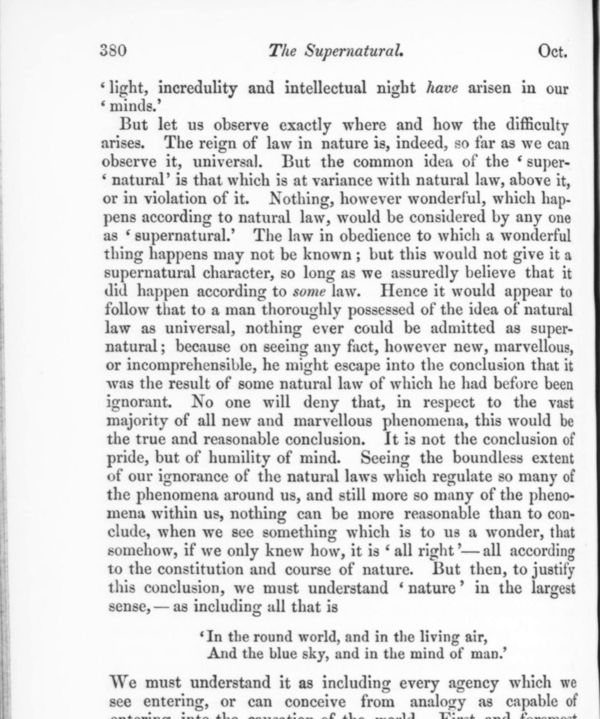
But let us observe exactly where and how the difficulty arises. The reign of law in nature is, indeed, so far as we can observe it, universal. But the common idea of the ‘supernatural’ is that which is at variance with natural law, above it, or in violation of it. Nothing, however wonderful, which happens according to natural law, would be considered by any one as ‘supernatural.’ The law in obedience to which a wonderful thing happens may not be known; but this would not give it a supernatural character, so long as we assuredly believe that it did happen according to some law. Hence it would appear to follow that to a man thoroughly possessed of the idea of natural law as universal, nothing ever could be admitted as supernatural; because on seeing any fact, however new, marvellous, or incomprehensible, he might escape into the conclusion that it was the result of some natural law of which he had before been ignorant. No one will deny that, in respect to the vast majority of all new and marvellous phenomena, this would be the true and reasonable conclusion. It is not the conclusion of pride, but of humility of mind. … But then, to justify this conclusion, we must understand ‘nature’ in the largest sense,—as including all that is
‘In the round world, and in the living air,
And the blue sky, and in the mind of man.’We must understand it as including every agency which we see entering, or can conceive from analogy as capable of entering, into the causation of the world. First and foremost among these is the agency of our own mind and will.
Lecky compresses the third sentence (“But then we must understand nature as including every agency …”) and has “capable of entering” for “as capable of entering”. The verse is from Wordsworth’s “Lines written a few miles above Tintern Abbey”, where it reads “And the round ocean and the living air”.
Further down the rabbit hole
Sources that Lecky cites in the notes next to the ones that cite this page.
- Mansel and Fitzgerald, Aids to FaithIf a man can throw a stone, God can work a miracle: the Victorian defence of miracles
- Rose, The State of Protestantism in GermanyDid Kant make the German theologians rationalists? Not quite, says an English critic
- Montalembert, Le Père LacordaireThe heresiarch who took no one with him
- Augustine, De civitate DeiSeventy reports, not miracles, and a town, not a province
- Brewster, Memoirs of the Life, Writings, and Discoveries of Sir Isaac NewtonLecky’s Newton quote and the missing last sentence
- Farmer, A Dissertation on MiraclesA dissenting minister argues that the Devil cannot work miracles
Backlinks
Every place in Rationalism in Europe that links to this page (generated automatically when the site is built).
- Chapter II: note 24