Augustine on the laws against pagan sacrifice (ch. XXVIII, note 56)
English and Latin: Gutenberg 733, chapter XXVIII (“Final destruction of paganism”), footnote 56.
[56] Such a charge should not be lightly made; but it may surely be justified by the authority of St. Augustin, who thus addresses the Donatists: “Quis nostrum, quis vestrum non laudat leges ab Imperatoribus datas adversus sacrificia Paganorum? Et certe longe ibi poena severior constituta est; illius quippe impietatis capitale supplicium est.” Epist. xciii. No. 10, quoted by Le Clerc, (Bibliothèque Choisie, tom. viii. p. 277,) who adds some judicious reflections on the intolerance of the victorious Christians. * Note: Yet Augustine, with laudable inconsistency, disapproved of the forcible demolition of the temples. …
Lecky (note 30): “‘Quis enim nostrum, quis vestrum non laudat leges ab imperatoribus datas contra sacrificia paganorum? Et certe longe ibi poena severior constituta est; illius quippe impietatis capitale supplicium est.’ (Epist. xciii., in some editions xcviii.) See Gibbon, ch. xxviii.” Differences: Lecky adds “enim”, has “contra” for Gibbon’s “adversus”, and lower-case “imperatoribus”, “paganorum”. Lecky’s text is therefore not a transcription of Gibbon’s note, though it is the same sentence; whether Augustine’s own text has “enim” and “contra” I have not checked.
The Jewish player at Nero’s court (ch. XVI, text and note 40)
English: Gutenberg 732, chapter XVI (“The conduct of the Roman government towards the Christians”).
… But the Jews possessed very powerful advocates in the palace, and even in the heart of the tyrant; his wife and mistress, the beautiful Poppæa, and a favorite player of the race of Abraham, who had already employed their intercession in behalf of the obnoxious people.40 …
40. The player’s name was Aliturus. Through the same channel, Josephus, (de vitâ suâ, c. 2,) about two years before, had obtained the pardon and release of some Jewish priests, who were prisoners at Rome.
Lecky (ch. VI, note 103): “Gibbon has noticed the great honour in which he [Nero] held the Jewish actor Aliturus, and the repeated and successful efforts of that actor to obtain a relaxation of the persecutions of the Jews.” Gibbon’s “favorite player” supports the favour; “great honour” and “repeated” are Lecky’s. Gibbon speaks of intercession “in behalf of the obnoxious people” and of the release of priests, not of a relaxation of persecutions.
Editor’s notes on this page
Lecky’s Latin quotation of Augustine in note 30 is the same sentence Gibbon gives in a footnote to chapter 28, which Gibbon introduces with “Such a charge should not be lightly made; but it may surely be justified by the authority of St. Augustin”, and which he cites as “Epist. xciii. No. 10, quoted by Le Clerc”. Lecky’s “in some editions xcviii” is his own addition. Lecky was probably quoting Gibbon’s footnote, and his “See Gibbon, ch. xxviii” points to it.
On Aliturus, Lecky’s statement is stronger than Gibbon’s. Gibbon says that Poppaea and “a favorite player of the race of Abraham” had “already employed their intercession in behalf of the obnoxious people”, with a note that the player’s name was Aliturus and that Josephus, through the same channel, had obtained the release of some Jewish priests two years before. “Great honour” and “repeated and successful efforts to obtain a relaxation of the persecutions” go beyond that.
Further down the rabbit hole
Sources that Lecky cites in the notes next to the ones that cite this page.
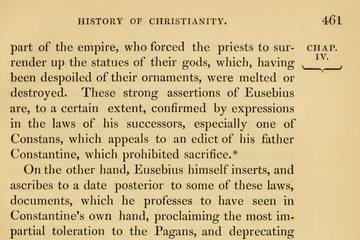
- Milman, The History of ChristianityDid Constantine ban the pagan sacrifices? A dean weighs Eusebius against Constantine
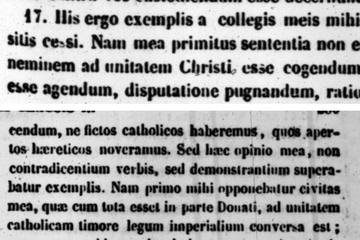
- Augustine, Letters 93 and 185“My opinion at first was that no one should be coerced”: how Augustine changed his mind
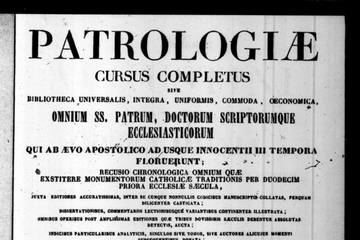
- Augustine, De natura et gratiaLecky’s three tiny changes to Augustine’s exception
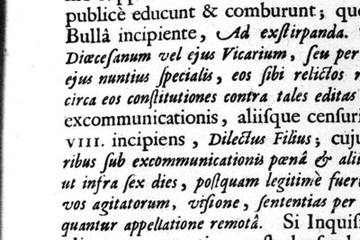
- Limborch, Historia InquisitionisSix days to burn the heretic, or be excommunicated
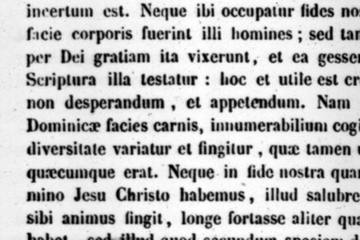
- Augustine, De TrinitateNobody knows what Christ looked like
- Palmer, A Treatise on the Church of Christ“Whosoever is separated from the Catholic Church … will not have life”

Backlinks
Every place in Rationalism in Europe that links to this page (generated automatically when the site is built).