“The clergy, and especially several popes” (p. 221)
English, from the page image. Highlighted: the words Lecky quotes.
… This, as is well known, was an exceedingly common practice with the Romans; and is mentioned, with certain ceremonies prescribed, in the Frankish and other early laws. The clergy, and especially several popes, enforced it as a duty upon laymen; and inveighed against the scandal of keeping Christians in bondage.* But they were not, it is said, equally ready in performing their own parts: the villeins upon church lands were among the last who were emancipated.† As society advanced in Europe, the manumission of slaves grew more frequent.‡ …
| Lecky, 1865 | Hallam, 1822 | |
|---|---|---|
| Object | enforced manumission as a duty | enforced it as a duty (“it” = manumission, from the sentence before) |
| Readiness | as ready in performing | equally ready in performing |
| Punctuation | … bondage; but they were not … parts. The villeins upon the Church lands were … | … bondage. But they were not … parts: the villeins upon church lands were … |
The changes do not alter the sense. “It” has no antecedent without the sentence before, so Lecky’s “manumission” is a sensible gloss, but he should have used brackets. The Church’s own record on emancipating villeins comes from the second sentence, which Hallam qualifies with “it is said”; Lecky’s “it is probable that this last fact in some degree lessened her zeal” (in his text, before note 19) goes a step beyond Hallam on this page.
How freemen became serfs (pp. 217–218)
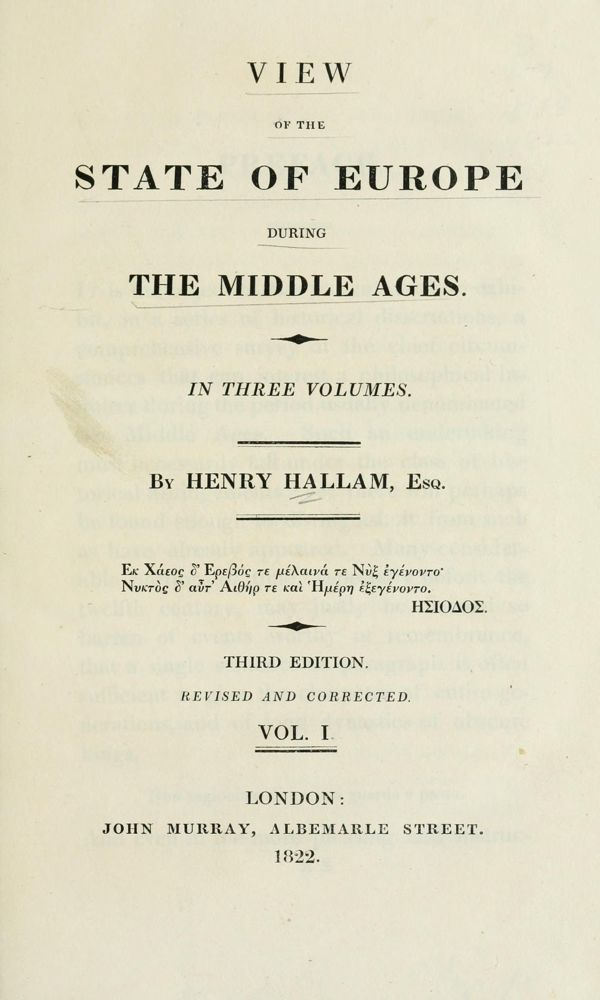
English: 1822 ed., vol. 1, pp. 217–218, scan and scan.
… Where the small proprietors lost their lands by mere rapine, we may believe that their liberty was hardly less endangered. … as the labour either of artizans or of free husbandmen was but sparingly in demand, they were often compelled to exchange their liberty for bread.* In seasons also of famine, not unfrequent, many freemen sold themselves into slavery. … Many were reduced into this state through inability to pay those pecuniary compositions for offences, which were numerous and sometimes heavy in the barbarian codes of law; and many more by neglect of attendance on military expeditions of the king, the penalty of which was a fine called Heribann, with the alternative of perpetual servitude. A source of loss of liberty which may strike us as more extraordinary was superstition; men were infatuated enough to surrender themselves, as well as their properties, to churches and monasteries, in return for such benefit as they might reap by the prayers of their new masters.
Lecky (ch. VI, text above note 18): “The rapacity of the nobles, and the famines that were so frequent during the middle ages, induced the poor to exchange their liberty for protection and for bread; and the custom of punishing all crimes by fines, with the alternative of servitude in case of non-payment, still further increased the evil. At the same time the mildness of the ecclesiastical rule, and also the desire to obtain the advantage of the prayers of the monks, induced many to attach themselves as serfs to the monasteries.” Note 18: “See on all these causes Hallam’s Middle Ages, vol. i. pp. 217–218.” Every cause is on these two pages: rapine, famine, fines and the Heribann, and surrender to monasteries for their prayers. “The mildness of the ecclesiastical rule” is Lecky’s addition; Hallam attributes the surrender to superstition. “Protection” (Hallam: vassals “for the sake of his protection”) is Lecky’s wording for the lord’s part.
The villein’s condition and the slaves of Italy (p. 222)
English: 1822 ed., vol. 1, p. 222, scan. Page 223, which note 20 also cites, was not read.
… It was only in respect of his lord, it must be remembered, that the villein, at least in England, was without rights; he might inherit, purchase, sue in the courts of law … Hence the eleventh and twelfth centuries saw the number of slaves in Italy begin to decrease; early in the fifteenth, a writer quoted by Muratori [continues on p. 223] …
Lecky (ch. VI, note 20): “The decline of serfdom has been treated by Hallam, Hist. of Middle Ages, vol. i. pp. 222, 223.” Page 222 begins the account of the decline of slavery and serfdom (Italy, the eleventh to fifteenth centuries); I did not read p. 223. The rest of note 20 (Scottish colliers, M’Culloch) is not Hallam’s.
Editor’s notes on this page
In note 19 Lecky puts a sentence of Hallam’s in quotation marks. It is Hallam’s, with three small changes: “enforced it” becomes “enforced manumission”, “equally ready” becomes “as ready”, and “church lands” becomes “the Church lands”. Hallam’s “it is said” marks the claim as hearsay, and Lecky keeps it.
Further down the rabbit hole
Sources that Lecky cites in the notes next to the ones that cite this page.
- M’Culloch, Principles of Political Economy and the Wealth of NationsFoundlings, Calvin on interest, and Scotland’s last serfs, in a Victorian economist’s footnotes
- Bianchi, Traité de la puissance ecclésiastiqueAn Ultramontane friar on when a people may depose its king, and the Scot who ‘sold his pen’ to James I
- Eden, The State of the PoorBecket’s harvest labour, the 1102 law and Irish slaves
- Bossuet, Defensio declarationis cleri gallicaniKings as fathers: “Abimelech” means “My father the king”
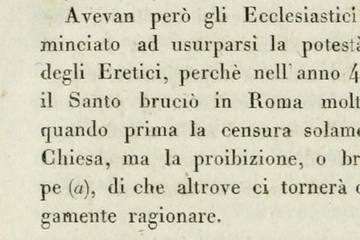
- Giannone, Istoria civile del regno di NapoliThe first pope to burn books on his own authority
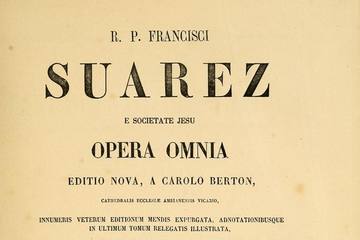
- Suárez, Defensio fidei catholicae, Book VIMay the Pope release subjects from their oath to a king? The Jesuit reply to James I

Backlinks
Every place in Rationalism in Europe that links to this page (generated automatically when the site is built).