Windmills and the charter of 1105 (pp. 62–63)
French: tome I, p. 62 (scan n77) and p. 63 (n78), with the footnotes; the one on p. 62 is marked “(d. R.)” as Roquefort’s; the Mabillon note on p. 63 is already in the 1782 edition, and Roquefort has added to it. Highlighted: what Lecky’s note 174 gives.
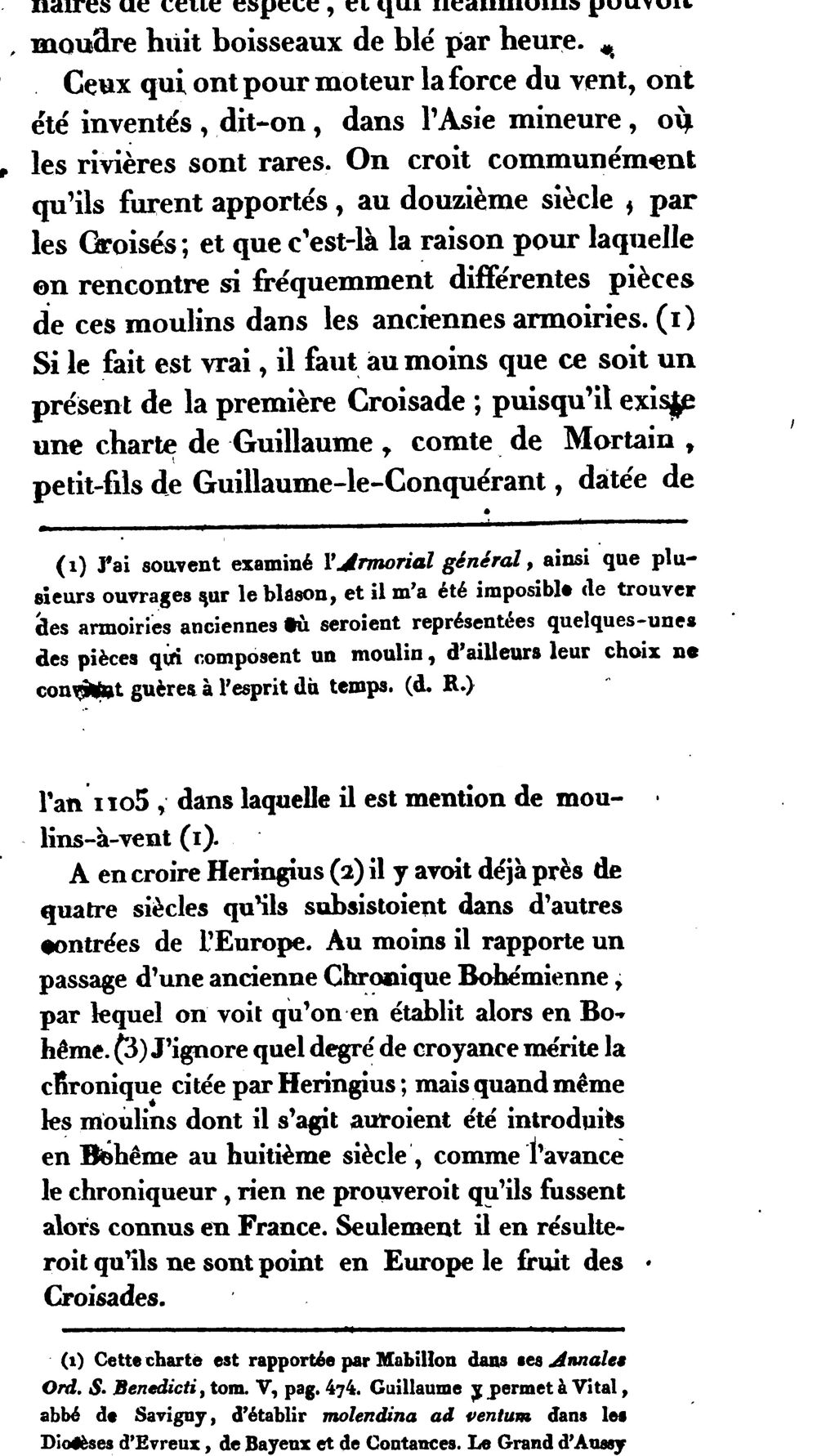
Those that are driven by the force of the wind were invented, it is said, in Asia Minor, where rivers are rare. It is commonly believed that they were brought to us in the twelfth century by the crusaders, and that this is why pieces of these mills are so often found in old coats of arms. If that is so, they must at least be a gift of the first Crusade, since there is a charter of William, Count of Mortain, grandson of William the Conqueror, dated 1105, in which windmills are mentioned.
If Heringius is to be believed, they had already existed for nearly four centuries in other countries of Europe. At least he quotes a passage of an old Bohemian chronicle showing that they were set up in Bohemia at that time. I do not know how far the chronicle cited by Heringius deserves belief; but even if the mills in question had been brought into Bohemia in the eighth century, as the chronicler says, nothing would prove that they were then known in France. It would only follow that in Europe they are not the fruit of the Crusades.
[Note:] This charter is printed by Mabillon in his Annales Ordinis S. Benedicti, vol. V, p. 474. In it William allows Vitalis, abbot of Savigny, to set up molendina ad ventum (windmills) in the dioceses of Évreux, Bayeux and Coutances.
Translation: this edition’s draft.
Original French
Ceux qui ont pour moteur la force du vent, ont été inventés, dit-on, dans l’Asie mineure, où les rivières sont rares. On croit communément qu’ils furent apportés, au douzième siècle, par les Croisés; et que c’est-là la raison pour laquelle on rencontre si fréquemment différentes pièces de ces moulins dans les anciennes armoiries. Si le fait est vrai, il faut au moins que ce soit un présent de la première Croisade; puisqu’il existe une charte de Guillaume, comte de Mortain, petit-fils de Guillaume-le-Conquérant, datée de l’an 1105, dans laquelle il est mention de moulins-à-vent.
A en croire Heringius il y avoit déjà près de quatre siècles qu’ils subsistoient dans d’autres contrées de l’Europe. Au moins il rapporte un passage d’une ancienne Chronique Bohémienne, par lequel on voit qu’on en établit alors en Bohême. J’ignore quel degré de croyance mérite la chronique citée par Heringius; mais quand même les moulins dont il s’agit auroient été introduits en Bohême au huitième siècle, comme l’avance le chroniqueur, rien ne prouveroit qu’ils fussent alors connus en France. Seulement il en résulteroit qu’ils ne sont point en Europe le fruit des Croisades.
[Note:] Cette charte est rapportée par Mabillon dans ses Annales Ord. S. Benedicti, tom. V, pag. 474. Guillaume y permet à Vital, abbé de Savigny, d’établir molendina ad ventum dans les Diocèses d’Évreux, de Bayeux et de Coutances.
The note continues (read on the image, not transcribed here; this part is Roquefort’s, since it corrects “Le Grand d’Aussy”) that d’Aussy was wrong to say the charter was cited by Du Cange. His own note on p. 62 says he could find no old coats of arms containing parts of a mill. The Bohemian passage, quoted in Latin in note 3 on p. 63, dates the first water-mill in Bohemia to 718, “when before they used only mills driven by the wind and built on hills”.
Further down the rabbit hole
Sources that Lecky cites in the notes next to the ones that cite this page.
- Voltaire, Dictionnaire philosophique, “Patrie”Lecky reverses Voltaire and drops a word
- Augustine, Enarratio in Psalmum XXXVI, sermo 3, § 6More than given, even in wheat or wine, is usury
- Bayle, Dictionnaire historique et critiqueWhat Bayle really said about Augustine and Socinus
- Benedict XIV, Vix pervenitAny gain beyond the loan is unlawful usury
- Blanqui, Histoire de l’économie politique en EuropeHow medieval kings policed luxury, and what Florence spent
- Bossuet, Maximes et réflexions sur la comédieWhy the Church refused actors communion and Christian burial
Backlinks
Every place in Rationalism in Europe that links to this page (generated automatically when the site is built).
- Chapter VI: note 174