Roman slaves: the crystal vase and the quail (pp. 91–92)
French: ch. on Rome under the Republic and the Empire, p. 91 (scan n110) and p. 92 (n111). Loiseleur’s note numbers omitted. Highlighted: the two cases Lecky’s text gives before note 4.
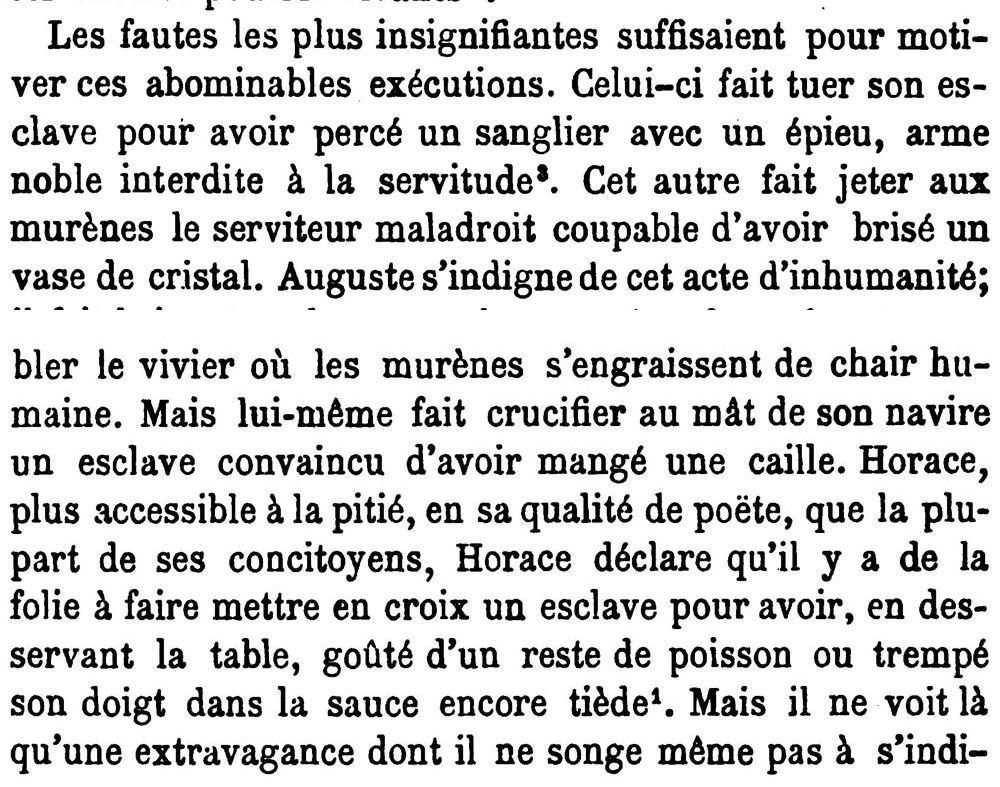
The most trifling faults were enough to bring on these abominable executions. One master has his slave killed for spearing a boar with a hunting spear, a noble weapon forbidden to slaves. Another has the clumsy servant who broke a crystal vase thrown to the lampreys. Augustus is indignant at this act of inhumanity; he has all the vases of this savage master broken and the fishpond filled in where the lampreys fattened on human flesh. But he himself has a slave crucified on the mast of his ship for being convicted of eating a quail. Horace, more open to pity as a poet than most of his fellow citizens, declares it madness to crucify a slave who, clearing the table, has tasted the remains of a fish or dipped his finger in the still-warm sauce. But he sees in it only an extravagance, at which it does not even occur to him to be indignant.
Translation: this edition’s draft. The bracketed words at the turn of the page are from the OCR.
Original French
Les fautes les plus insignifiantes suffisaient pour motiver ces abominables exécutions. Celui-ci fait tuer son esclave pour avoir percé un sanglier avec un épieu, arme noble interdite à la servitude. Cet autre fait jeter aux murènes le serviteur maladroit coupable d’avoir brisé un vase de cristal. Auguste s’indigne de cet acte d’inhumanité; [il fait briser tous les vases de ce maître farouche et com]bler le vivier où les murènes s’engraissent de chair humaine. Mais lui-même fait crucifier au mât de son navire un esclave convaincu d’avoir mangé une caille. Horace, plus accessible à la pitié, en sa qualité de poète, que la plupart de ses concitoyens, Horace déclare qu’il y a de la folie à faire mettre en croix un esclave pour avoir, en desservant la table, goûté d’un reste de poisson ou trempé son doigt dans la sauce encore tiède. Mais il ne voit là qu’une extravagance dont il ne songe même pas à s’indigner.
On the next page (OCR) Loiseleur turns to the law by which all the slaves in the house of a murdered citizen were tortured and then put to death, the subject of Lecky’s case of the 400 from Tacitus.
Beccaria’s treatise (pp. 334–336)
French: Épilogue, p. 335, scan n354. The sentence begins at the foot of p. 334 (OCR). Highlighted: the reception of Beccaria that Lecky’s note points to.
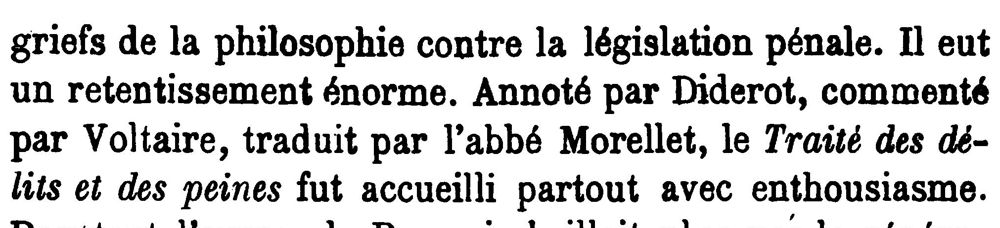
[But it was in Italy that the book appeared which undertook to sum up all] the grievances of philosophy against the penal law. It made an enormous stir. Annotated by Diderot, commented on by Voltaire, translated by the abbé Morellet, the Treatise on Crimes and Punishments was greeted everywhere with enthusiasm.
Translation: this edition’s draft. The bracketed opening is from the OCR of p. 334.
Original French
[Mais c’est en Italie que parut le livre qui se chargea de résumer tous les] griefs de la philosophie contre la législation pénale. Il eut un retentissement énorme. Annoté par Diderot, commenté par Voltaire, traduit par l’abbé Morellet, le Traité des délits et des peines fut accueilli partout avec enthousiasme.
Loiseleur continues (OCR): “Yet Beccaria’s work shone more by the generosity of its intention than by originality of thought or depth of learning … the philosophes applauded their own ideas in him.” He quotes Lerminier calling the book “not a scientific book but a warm pamphlet”, and goes on to the Bern prize for a criminal code, which Voltaire doubled, and to Jousse’s attack of 1771. On p. 336 he records that Catherine II, four years after Beccaria, drew on Montesquieu and Beccaria for her instructions for a new code, and that Leopold of Tuscany abolished torture and the death penalty.
Torture abolished in France: 1780 and 1789 (p. 337)
French: Épilogue, p. 337, scan n356. Highlighted: the two steps Lecky gives in note 157.
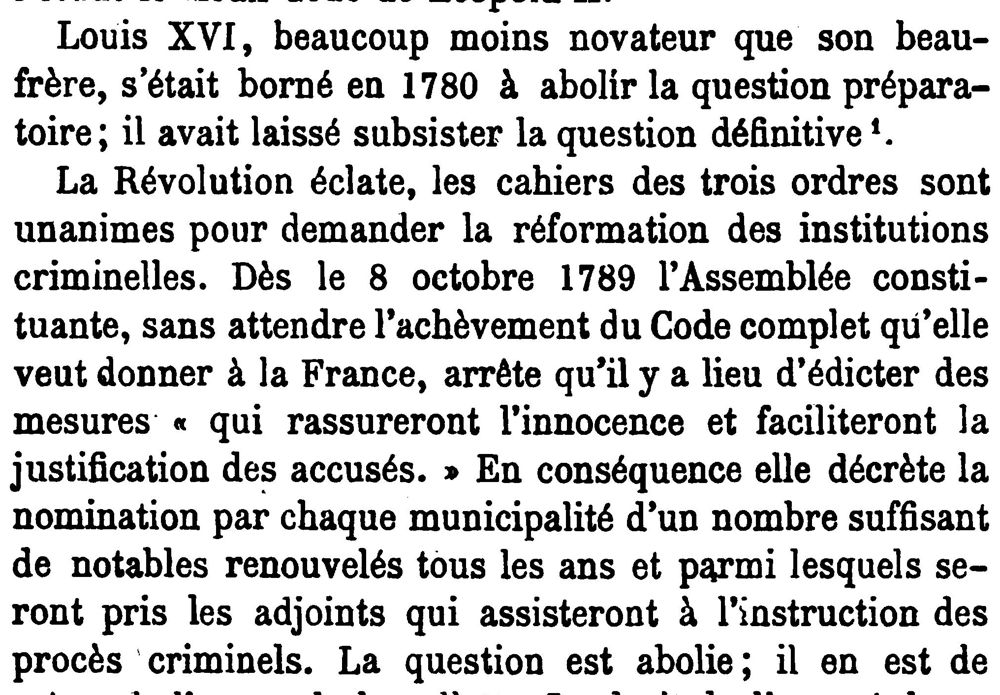
Louis XVI, much less of an innovator than his brother-in-law, had confined himself in 1780 to abolishing the question préparatoire; he had let the question définitive stand.
The Revolution breaks out; the cahiers of the three orders unanimously demand the reform of the criminal institutions. As early as 8 October 1789 the Constituent Assembly, without waiting for the complete Code it means to give France, resolves to enact measures “which will reassure innocence and make it easier for the accused to clear themselves.” It therefore decrees that each municipality shall name a sufficient number of notables, renewed every year, from among whom the assessors shall be taken who will attend the preparation of criminal trials. Torture is abolished; […]
Translation: this edition’s draft. Loiseleur explains the terms earlier in the book (OCR only): the question préparatoire aimed at a confession and was abolished by Louis XVI on 24 August 1780; the question préalable (here “définitive”) was pronounced only against those condemned to death, to make them reveal their accomplices.
Original French
Louis XVI, beaucoup moins novateur que son beau-frère, s’était borné en 1780 à abolir la question préparatoire; il avait laissé subsister la question définitive.
La Révolution éclate, les cahiers des trois ordres sont unanimes pour demander la réformation des institutions criminelles. Dès le 8 octobre 1789 l’Assemblée constituante, sans attendre l’achèvement du Code complet qu’elle veut donner à la France, arrête qu’il y a lieu d’édicter des mesures « qui rassureront l’innocence et faciliteront la justification des accusés. » En conséquence elle décrète la nomination par chaque municipalité d’un nombre suffisant de notables renouvelés tous les ans et parmi lesquels seront pris les adjoints qui assisteront à l’instruction des procès criminels. La question est abolie; […]
“His brother-in-law” is Leopold of Tuscany, whose code Loiseleur has just described. Loiseleur’s footnote on this page (OCR, not checked on the image) adds that Louis XVI also suppressed the question définitive by a declaration of 1 May 1788, while reserving the right to restore it, which is why the Assembly abolished torture again “absolutely and without reserve” by the law of 8 October 1789.
Further down the rabbit hole
Sources that Lecky cites in the notes next to the ones that cite this page.
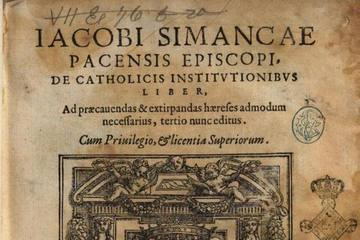
- Simancas, De Catholicis InstitutionibusAn inquisitor’s handbook: no faith with heretics, and torture
- Buckle, History of Civilization in EnglandWeather and credulity, and the Scottish clergy’s Devil who had been studying for five thousand years
- Llorente, Histoire critique de l’Inquisition d’EspagneHow many did the Spanish Inquisition burn? Its former secretary counts
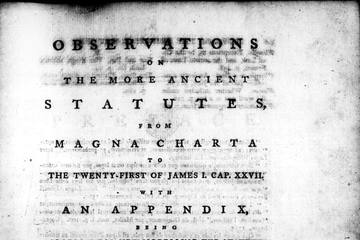
- Barrington, Observations on the More Ancient StatutesHenry VIII’s 72,000 hangings, and why English thieves had “better hearts”
- Strutt, Horda Angel-cynnan; or, the Manners and Customs of the Inhabitants of EnglandGod on the upper stage and the Devil at Coventry: an antiquary’s view of old England
- Augustine, De civitate DeiSeventy reports, not miracles, and a town, not a province

Backlinks
Every place in Rationalism in Europe that links to this page (generated automatically when the site is built).