The Will as a Beast (pp. 69–71)
Latin: 1664 edition, pp. 69–70 (p. 69, p. 70; the “Satan” half continues at the foot of the annotation, p. 71). The text is Luther’s; the editor’s “Annotatio (t)” on p. 70 comments on “ceu iumentum”. Spelling regularised. Highlighted: the words Lecky quotes.
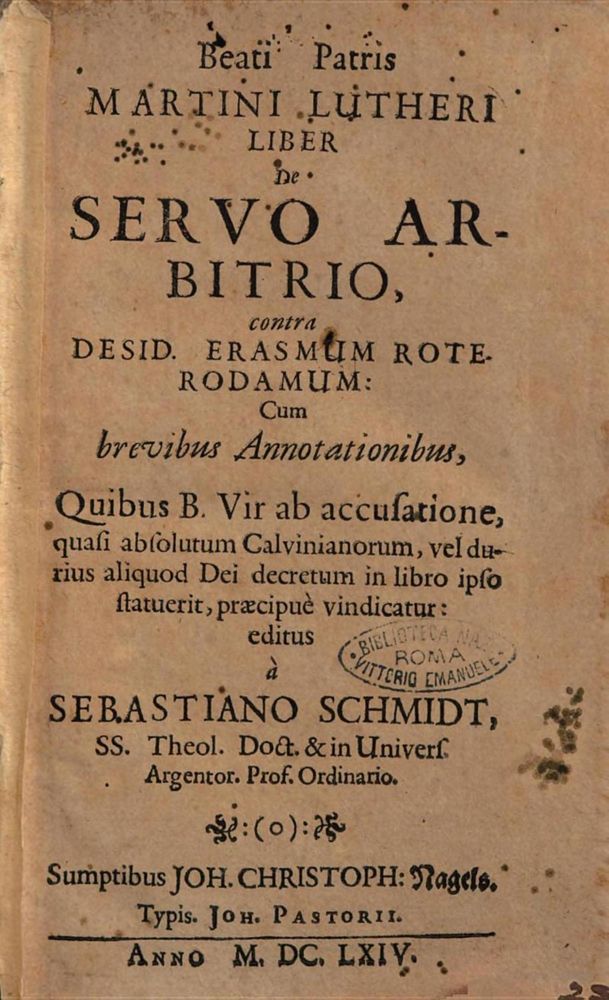
… So the human will is placed in the middle like a beast of burden: if God has taken his seat on it, it wills and goes where God wills, as the Psalm says: I have become as a beast of burden, and I am always with you. If Satan has taken his seat, it wills and goes where Satan wills, nor is it in its power to run to either rider or to seek him, but the riders themselves contend for obtaining and possessing it.
Original Latin
… Sic humana voluntas in medio posita est ceu iumentum: si insederit Deus, vult et vadit, quo vult Deus, ut Psal. dicit: Factus sum sicut iumentum, et ego semper tecum. Si insederit Satan, vult et vadit, quo vult Satan, nec est in eius arbitrio ad utrum sessorem currere aut eum quaerere, sed ipsi sessores certant ob ipsum obtinendum et possidendum.
What I did not check
I read the first sentence in the main text (the foot of p. 69 and top of p. 70). The “Si insederit Satan …” sentence I read only as it is quoted at the head of the next page, after the editor’s annotation (p. 71); I did not look for it in the main text. I have not tried to match Vaughan’s section number (“pars i. sec. 24”). The editor’s own comment (that Luther does not mean the will is equally disposed to good and evil) is worth reading but is not transcribed.
The Highest Degree of Faith (p. 62)
Latin: 1664 edition, p. 62 (scan). The passage occurs twice on the page: in the main text and again in the editor’s “Annotatio (r)” below it, which quotes it in full. Spelling regularised. Highlighted: the words Lecky quotes.
… This is the highest degree of faith: to believe him merciful who saves so few and damns so many; to believe him just who by his own will makes us necessarily damnable, so that he seems, as Erasmus reports, to take delight in the torments of the wretched, and to be worthy of hatred rather than love. If therefore I could by any reasoning comprehend how that God is merciful and just who shows such wrath and iniquity, there would be no need of faith.
Original Latin
… Hic est fidei summus gradus, credere illum esse clementem, qui tam paucos salvat, tam multos damnat, credere iustum, qui sua voluntate nos necessario damnabiles facit, ut videatur, referente Erasmo, delectari cruciatibus miserorum, et odio potius quam amore dignus. Si igitur possem ulla ratione comprehendere, quomodo is Deus sit misericors et iustus, qui tantam iram et iniquitatem ostendit, non esset opus fide.
Lecky’s Quotations Compared
| Lecky, 1865 | 1664 |
|---|---|
| Note 30 | Lecky: ‘Sic humana voluntas in medio posita est ceu jumentum, si insederit Deus vult et vadit quo vult Deus, ut Psalmus dicit: “Factus sum sicut jumentum et ego semper tecum.” Si insederit Satan vult et vadit quo vult Satan; nec est in ejus arbitrio ad utrum sessorem currere aut eum quærere, sed ipsi sessores certant ob ipsum obtinendum et possidendum.’ 1664: … ceu jumentum: si insederit Deus, vult & vadit, quo vult Deus, ut Psal. dicit: Factus sum sicut jumentum & ego semper tecum. Si insederit Satan, vult & vadit, quo vult Satan, nec est in eius arbitrio … possidendum. |
| Note 31 | Lecky: ‘Hic est fidei summus gradus, credere illum esse clementem qui tam paucos salvat tam multos damnat, credere justum qui sua voluntate nos necessario damnabiles facit, ut videatur, referente Erasmo, delectari cruciatibus miserorum, et odio potius quam amore dignus. Si igitur possem ulla ratione comprehendere quomodo is Deus misericors et justus, qui tantam iram et iniquitatem ostendit, non esset opus fide.’ 1664: the same words with different punctuation, except that the print has “quomodo is Deus sit misericors & iustus”. |
The differences are slight. Lecky writes “ut Psalmus dicit” where the 1664 text abbreviates “ut Psal. dicit” (a likely silent expansion, or a different edition); his punctuation is lighter. In note 31 Lecky leaves out one word: “quomodo is Deus sit misericors et iustus” in the print becomes “quomodo is Deus misericors et justus”, which makes his sentence ungrammatical as printed. Neither change alters the sense. The pages Lecky gives (Vaughan’s sections 23 and 24) could not be checked here. One caution on interpretation: the 1664 editor, Schmidt, argues in his commentary that these sentences, like the “beast” image, do not mean that Luther taught absolute predestination (he says Luther intends only the “passive aptitude” of the will); Lecky reads them in the opposite way. I did not evaluate that dispute.
“Hoc fulmine” (pp. 32–34)
Latin: 1664 edition, p. 32 (scan, image = page + 25), where the sentence stands as a heading for the editor’s Annotatio (n), and p. 34 (scan), where “Hoc fulmine …” follows the editor’s bracketed note. Spelling regularised.
It is therefore also, above all, necessary and salutary for a Christian to know that God foreknows nothing contingently, but that he foresees, and purposes, and does all things by an unchangeable, eternal and infallible will. … By this thunderbolt free will is laid low and utterly crushed; therefore those who wish free will to be affirmed must either deny this thunderbolt, or conceal it, or in some other way put it from them. …
Original Latin
Est itaque et hoc in primis necessarium et salutare Christiano, nosse, quod Deus nihil praescit contingenter, sed quod omnia incommutabili et aeterna, infallibilique voluntate et praevidet, et proponit, et facit. … Hoc fulmine sternitur et conteritur penitus lib. arbit. ideo qui lib. arbitr. volunt assertum, debent hoc fulmen vel negare, vel dissimulare, aut alia ratione a se abigere. …
Lecky (note 32): “‘Est itaque et hoc imprimis necessarium et salutare Christiano nosse, quod Deus nihil præscit contingiter, sed quod omnia incommutabilia et æterna, infallibilique voluntate et prævidet et præponit et facit. Hoc fulmine sternitur et conteritur penitus liberum arbitrium.’ (Sec. 10.)” Differences: Lecky’s “contingiter” is not Latin; the 1664 text has “contingenter” (a printer’s slip or a misreading in Lecky’s book); “incommutabilia” for “incommutabili”; “præponit” for “proponit”; “imprimis” for “in primis”; and “liberum arbitrium” expands the edition’s abbreviation “lib. arbit.”. Lecky’s two sentences stand on different parts of the page here (the second after the editor’s note, p. 34), so he is quoting them as one passage from an original in which they are close together. His section number (10) is Vaughan’s, which I have not seen.
Editor’s notes on this page
In Chapter IV Lecky illustrates the severity of Luther’s predestinarianism with two Latin quotations from De servo arbitrio: the will placed “like a beast” between God and Satan, and the “highest degree of faith”, to believe that God is merciful who saves so few and damns so many.
Both are in the 1664 text. The first agrees except for an abbreviation Lecky expands; in the second Lecky drops the word “sit”. See the comparison.
Further down the rabbit hole
Sources that Lecky cites in the notes next to the ones that cite this page.
- Llorente, Histoire critique de l’Inquisition d’EspagneHow many did the Spanish Inquisition burn? Its former secretary counts
- Edwards, Freedom of the WillThe great Calvinist concedes that God is “the Author of Sin”, in a sense
- Bossuet, Histoire des variations des Églises protestantesWhat Lecky leaves out of Bossuet on punishing heretics
- Palmer, A Treatise on the Church of Christ“Whosoever is separated from the Catholic Church … will not have life”
- Laing, Notes of a Traveller on the Social and Political State of France, Prussia, Switzerland, ItalyThe Swiss, moral in conduct yet irreligious
- Augustine, Contra mendaciumAugustine rejects lying even to catch heretics

Backlinks
Every place in Rationalism in Europe that links to this page (generated automatically when the site is built).