Socinus and Zwingli on original sin
English: p. 658, scan. Highlighted: what Lecky summarises.
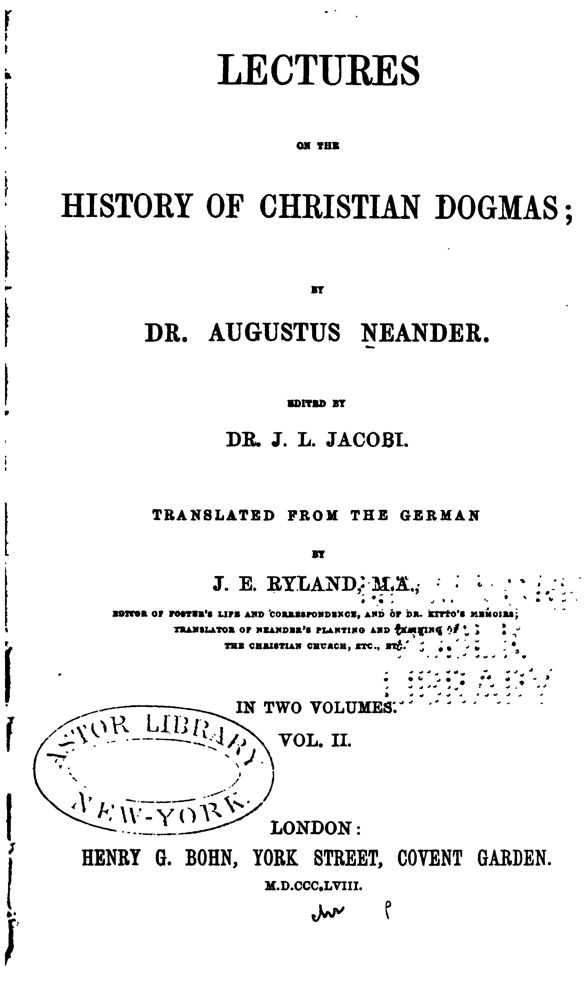
… all this Socinus interpreted as a punishment for Adam. He totally denied the doctrine of Original Sin. Incapable of recognising the continuity of the moral life, he asks, How could a single sin produce such great effects? The inclination to Evil, about which it is still questionable whether it really exists in all, he deduces from the power of evil custom.*
Zwingli, led on by his freedom of inquiry, diverged from the common view respecting the imputation of the first Sin. Original Sin is not, he says,† in a proper, but only in a metaphorical sense a crime; it is only a moral weakness. The source of Original Sin is selfishness; Adam allowed himself to be governed by it, and this Evil must now pass upon all men. Selfishness is not in a strict sense a crime, …
* Praelectiones, c. 4. — Ceterum cupiditas ista mala, quae cum plerisque hominibus nasci dici potest, non ex peccato illo primi parentis manat … † De Peccato Originali Declaratio ad Urbanum Rhegium (1526), Opp. iii. p. 627.
Lecky’s “nothing more than a malady or evil tendency” goes slightly beyond Neander’s “moral weakness”, and “did not in any degree involve guilt” is his reading of “not … in a proper … sense a crime”. His mention of Zwingli’s tolerance of error is not on this page.
Editor’s notes on this page
Lecky says that Socinus “discarded with unqualified severity the orthodox doctrines of the sinfulness of error and of the transmission of guilt” (note 16) and that Zwingli held original sin to be “nothing more than a malady or evil tendency, and that it did not in any degree involve guilt” (note 17). Neander’s p. 658 supports both: Socinus “totally denied the doctrine of Original Sin”, asking how a single sin could produce such great effects; Zwingli, “led on by his freedom of inquiry, diverged from the common view”, holding that original sin is “not, in a proper, but only in a metaphorical sense a crime; it is only a moral weakness”, whose source is selfishness. Neander gives the Latin of Socinus (Praelectiones, c. 4) and Zwingli’s De peccato originali declaratio (1526) in the footnotes.
Further down the rabbit hole
Sources that Lecky cites in the notes next to the ones that cite this page.
- Bossuet, Histoire des variations des Églises protestantesWhat Lecky leaves out of Bossuet on punishing heretics
- Palmer, A Treatise on the Church of Christ“Whosoever is separated from the Catholic Church … will not have life”
- Fulgentius, De fide ad PetrumUnbaptised infants in fire, no salvation outside the Church
- Taylor, A Discourse of the Liberty of ProphesyingLecky quotes Taylor accurately on water and Spirit
- Wall, The History of Infant BaptismWall’s two firsts, and the hedge Lecky dropped
- Pascal, PenséesLecky stops where Pascal explains man to himself
Backlinks
Every place in Rationalism in Europe that links to this page (generated automatically when the site is built).