“The chief abettors of that opinion” (pp. lxv–lxvi)
English: Calvin Translation Society, Edinburgh 1844, vol. I, pp. lxv–lxvi, scan n70–n71. Highlighted: what Lecky reports.
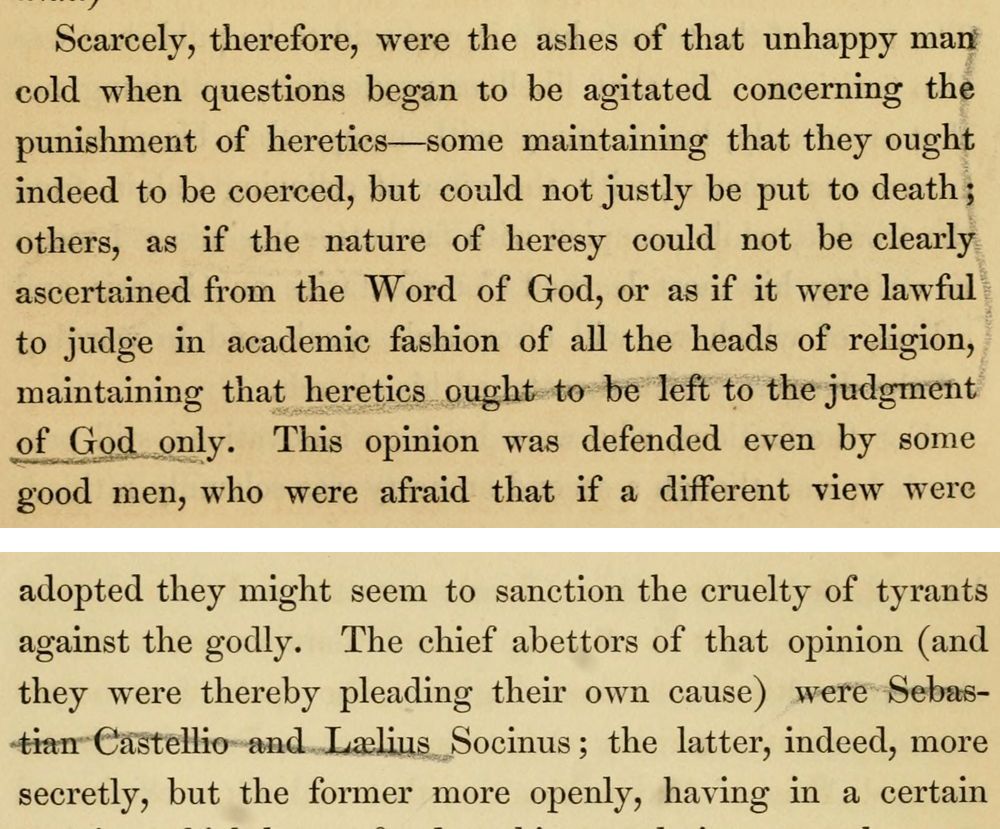
Scarcely, therefore, were the ashes of that unhappy man cold when questions began to be agitated concerning the punishment of heretics—some maintaining that they ought indeed to be coerced, but could not justly be put to death; others, as if the nature of heresy could not be clearly ascertained from the Word of God, or as if it were lawful to judge in academic fashion of all the heads of religion, maintaining that heretics ought to be left to the judgment of God only. This opinion was defended even by some good men, who were afraid that if a different view were [p. lxvi] adopted they might seem to sanction the cruelty of tyrants against the godly. The chief abettors of that opinion (and they were thereby pleading their own cause) were Sebastian Castellio and Lælius Socinus; the latter, indeed, more secretly, but the former more openly, having in a certain treatise, which he prefixed to his translation, or rather perversion, of the sacred books, plainly studied to deprive the Divine Word of clear authority …
Beza goes on to say that the anonymous book of “Martin Bellius” was Castellio’s own work, “although he afterwards swore it was not”, and that he, Beza, answered it to spare Calvin the trouble (his De haereticis of 1554). This printing dates Calvin’s refutation of Servetus “in the beginning of the year 1544”, a slip for 1554 in the translation or its source; not checked against the Latin.
Further down the rabbit hole
Sources that Lecky cites in the notes next to the ones that cite this page.
- Hallam, Literature of Europe and Constitutional HistoryHow Lecky quotes Hallam on persecution
- Beza, De haereticis a civili magistratu puniendisBeza’s “gates of hell” answer to Bellius
- Montaigne, EssaisLecky cuts Montaigne short and changes a word
- Henry, The Life and Times of John Calvin, vol. II“Placet mihi Luthero”: Luther signs for the sword
- Bossuet, Histoire des variations des Églises protestantesWhat Lecky leaves out of Bossuet on punishing heretics
- Castellio, Traité des hérétiquesLecky quotes only the first third of the passage
Backlinks
Every place in Rationalism in Europe that links to this page (generated automatically when the site is built).
- Chapter IV, Part II: note 72