The Black Death’s Toll (p. 30)
English: Hecker, tr. Babington, 1844, p. 30 (scan), the end of the section on the Black Death in Europe. Highlighted: what Lecky’s note 57 and the sentence it supports rest on.
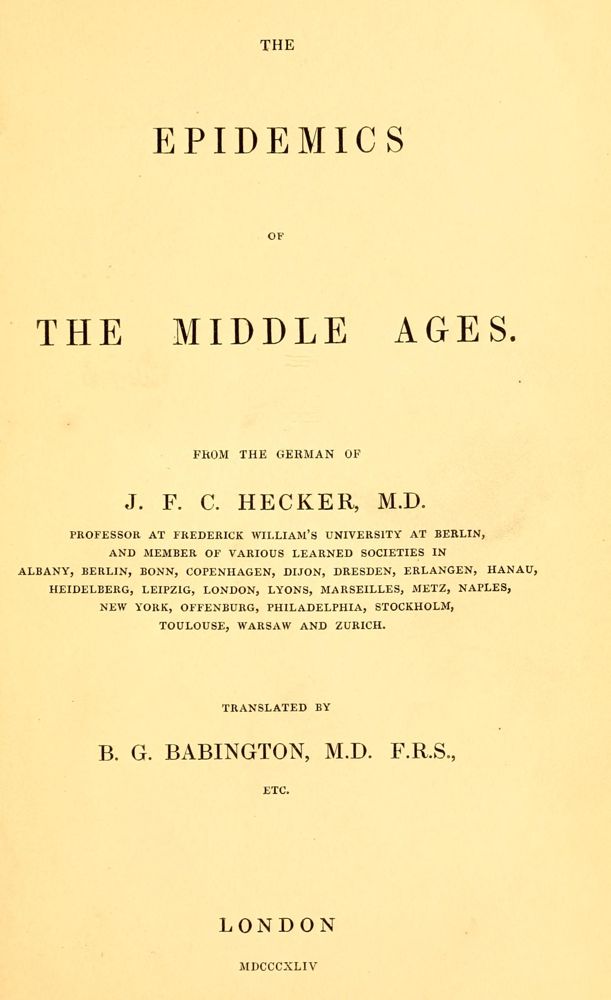
Of all the estimates of the number of lives lost in Europe, the most probable is, that altogether, a fourth part of the inhabitants were carried off. Now, if Europe at present contain 210,000,000 inhabitants, the population, not to take a higher estimate, which might easily be justified, amounted to at least 105,000,000 in the 16th century.
It may, therefore, be assumed, without exaggeration, that Europe lost during the Black Death, 25,000,000 of inhabitants.
A slip in the book
Hecker’s sentence says “in the 16th century”, but he is computing the population of the 14th, when the plague struck (1347–51). Lecky does not repeat the slip. Lecky’s “six years of its continuance” is not on this page (Hecker’s account of the plague’s course, I have not checked).
The Dancers and the Blood; the Pointed Shoes (pp. 88–89)
English: Hecker, tr. Babington, 1844, p. 88 (scan; middle of page) and p. 89 (scan), in the chapter on the dancing mania (“St. John’s Dance”). Footnote letters omitted. Highlighted: the sentences behind Lecky’s notes 58 and 60.
While dancing they neither saw nor heard, being insensible to external impressions through the senses, but were haunted by visions, their fancies conjuring up spirits whose names they shrieked out; and some of them afterwards asserted that they felt as if they had been immersed in a stream of blood, which obliged them to leap so high. Others, during the paroxysm, saw the heavens open and the Saviour enthroned with the Virgin Mary, according as the religious notions of the age were strangely and variously reflected in their imaginations.
[p. 89] … In towns and villages they took possession of the religious houses, processions were everywhere instituted on their account, and masses were said and hymns were sung, while the disease itself, of the demoniacal origin of which no one entertained the least doubt, excited everywhere astonishment and horror. In Liege the priests had recourse to exorcisms, and endeavoured, by every means in their power, to allay an evil which threatened so much danger to themselves; for the possessed assembling in multitudes, frequently poured forth imprecations against them, and menaced their destruction. They intimidated the people also to such a degree that there was an express ordinance issued that no one should make any but square-toed shoes, because these fanatics had manifested a morbid dislike to the pointed shoes which had come into fashion immediately after the Great Mortality in 1350. They were still more irritated at the sight of red colours …
Hecker’s own note on the shoes
In a footnote on p. 89 (citing the Limburg Chronicle) Hecker calls the aversion a “singular phenomenon” that reminds him of the “Demon of Fashion” of the Middle Ages: the enemies of fashion cried down every novelty “as the work of the devil”, and so “it is extremely probable that the fanatic penitential sermons of zealous priests excited this singular aversion of the St. Vitus dancers”. This is Hecker’s inference, which I give as he gives it.
Lecky’s Notes Compared
| Lecky (ch. I) | Hecker | Comment |
|---|---|---|
| Text: “the number of those who died of the pestilence during the six years of its continuance, may be estimated, by a very moderate computation, at twenty-five millions, or a fourth part of the inhabitants of Europe.” Note 57: “Hecker … p. 29.” | p. 30: “a fourth part of the inhabitants were carried off”; 25,000,000 on a base of 105,000,000. | The figure and the fraction are Hecker’s, but the two are not independent: Hecker gets 25 millions from a quarter of a base he sets at 105 millions (a quarter of 105 is 26.25). “Very moderate computation” is Lecky’s gloss; Hecker says “without exaggeration” and “not to take a higher estimate”. “Six years” is not on this page. The page reference does not match this printing (p. 30). |
| Text: “the dancing mania of Flanders and Germany, when thousands assembled … proclaiming, amid their wild dances and with shrieks of terror, the power and the triumph of Satan.” Note 58: “Hecker, p. 82. The dancers often imagined themselves to be immersed in a stream of blood. They were habitually exorcised.” | p. 88: “some of them afterwards asserted that they felt as if they had been immersed in a stream of blood.” p. 89: “In Liege the priests had recourse to exorcisms.” | “Often” is Lecky’s; Hecker says “some of them”. “Habitually exorcised” generalises from the Liège case on p. 89 (and Hecker adds that masses, hymns and processions were also used). Hecker says the possessed shrieked the names of spirits; I did not find on these pages that they proclaimed “the triumph of Satan”. The text sentence is Lecky’s summary. |
| Text: the plague was “regarded as a divine chastisement, or as an evidence of Satanic power; and the most grotesque explanations were hazarded. Boots with pointed toes had been lately introduced, and were supposed by many to have been peculiarly offensive to the Almighty.” Note 60: “Hecker, p. 82.” | p. 89: the dancers, “these fanatics”, had “a morbid dislike to the pointed shoes which had come into fashion immediately after the Great Mortality in 1350”; Hecker’s note puts it down to priests’ sermons against fashion. | The detail is real but Lecky has moved it. In Hecker it is the aversion of the dancers (and a magistrates’ ordinance for square-toed shoes), not a general explanation of the plague, and nothing on p. 89 says the shoes “offended the Almighty”. Lecky’s “supposed by many” may reflect the sermons Hecker infers, but that is his surmise, not what Hecker reports. I did not search the book’s other pages for a plague-explanation involving shoes. |
Editor’s notes on this page
Lecky’s account of the fourteenth-century background of witch-persecution leans on Hecker for the Black Death (“twenty-five millions, or a fourth part of the inhabitants of Europe”) and for the dancing manias that followed it. All three notes can be checked in the English translation.
The total is Hecker’s own, but Lecky changes its basis: Hecker takes a fourth part of the population (which he reckons at about 105 millions, on a modern figure of 210 millions) and gets 25 millions; he does not say the number is “very moderate”. Lecky’s note 60 puts the pointed shoes in the account of the plague: in Hecker they are the aversion of the dancers, which Hecker himself puts down to priests’ sermons against fashion. See the comparison.
Further down the rabbit hole
Sources that Lecky cites in the notes next to the ones that cite this page.
- Madden, PhantasmataAn Irish doctor’s history of delusions, and the witch-burnings in an Alpine valley
- Binsfeld, Tractatus de confessionibus maleficorum et sagarumThe suffragan bishop of Trier on why witches float, and why women fall
- Thiers, Traité des SuperstitionsThree papal bulls but no rebellion
- Garinet, Histoire de la Magie en FranceA history of magic in France, from the Frankish kings to the author’s own day
- Michelet, La SorcièreHow many witches were burnt, and when the last: Michelet gives two answers, and Lecky takes one from each
- Sprenger, Malleus MaleficarumThe witch-hunters’ handbook of the fifteenth century
Backlinks
Every place in Rationalism in Europe that links to this page (generated automatically when the site is built).