Trèves, Geneva, Würzburg, Bamberg: the Introduction’s count (p. x)
French: Paris 1862, Introduction, p. x, scan n17.
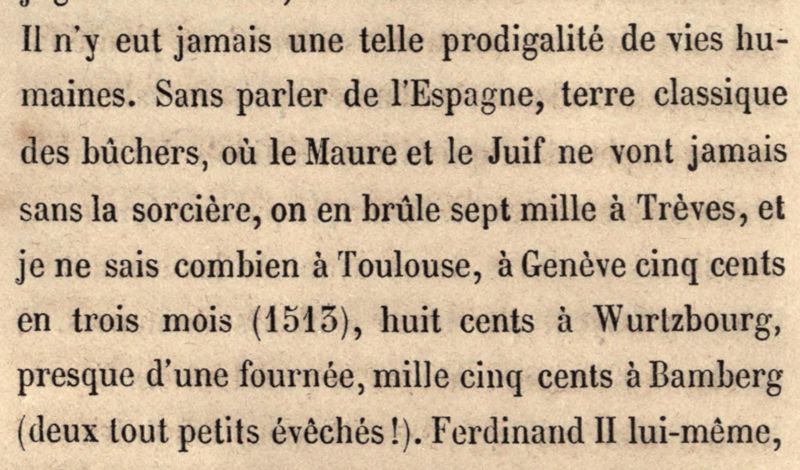
… They were tried in batches, condemned on a word. Never was there such prodigality of human lives. To say nothing of Spain, the classic land of the stake, where the Moor and the Jew never go without the witch, they burn seven thousand at Trèves, and I do not know how many at Toulouse, at Geneva five hundred in three months (1513), eight hundred at Würzburg, almost in one batch, fifteen hundred at Bamberg (two tiny bishoprics!). Ferdinand II himself, the bigot, the cruel emperor of the Thirty Years’ War, had to keep watch on these good bishops; they would have burnt all their subjects.
Original French
… On les jugeait en masse, on les condamnait sur un mot. Il n’y eut jamais une telle prodigalité de vies humaines. Sans parler de l’Espagne, terre classique des bûchers, où le Maure et le Juif ne vont jamais sans la sorcière, on en brûle sept mille à Trêves, et je ne sais combien à Toulouse, à Genève cinq cents en trois mois (1513), huit cents à Wurtzbourg, presque d’une fournée, mille cinq cents à Bamberg (deux tout petits évêchés!). Ferdinand II lui-même, le bigot, le cruel empereur de la Guerre de Trente ans, fut obligé de surveiller ces bons évêques; ils eussent brûlé tous leurs sujets.
Lecky’s ch. I note 2 cites “Michelet, La Sorcière, p. 10” (with Wright) for “Seven thousand victims are said to have been burned at Treves, six hundred by a single bishop of Bamberg, and eight hundred in a single year in the bishopric of Wurtzburg.” Seven thousand and eight hundred are here; Bamberg’s six hundred is not (this page says fifteen hundred), and “in a single year” is Lecky’s rendering of “almost in one batch”. The Geneva date on this page is printed 1513; on p. 206 it is 1515.
Geneva’s five hundred, and the second count (p. 206)
French: Paris 1862, p. 206, scan n239.
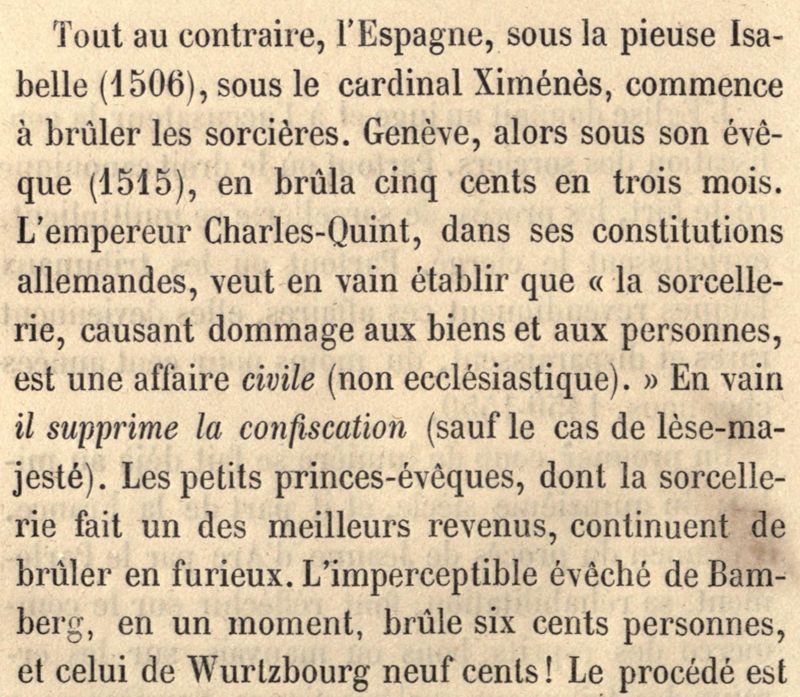
Quite the opposite: Spain, under the pious Isabella (1506), under Cardinal Ximénez, begins to burn witches. Geneva, then under its bishop (1515), burnt five hundred in three months. The Emperor Charles V, in his German constitutions, tries in vain to establish that “witchcraft, since it does damage to goods and persons, is a civil (not an ecclesiastical) matter.” In vain he abolishes confiscation (except in cases of high treason). The little prince-bishops, for whom witchcraft is one of the best sources of revenue, go on burning like madmen. The imperceptible bishopric of Bamberg, in a moment, burns six hundred persons, and that of Würzburg nine hundred!
Original French
Tout au contraire, l’Espagne, sous la pieuse Isabelle (1506), sous le cardinal Ximénès, commence à brûler les sorcières. Genève, alors sous son évêque (1515), en brûla cinq cents en trois mois. L’empereur Charles-Quint, dans ses constitutions allemandes, veut en vain établir que « la sorcellerie, causant dommage aux biens et aux personnes, est une affaire civile (non ecclésiastique). » En vain il supprime la confiscation (sauf le cas de lèse-majesté). Les petits princes-évêques, dont la sorcellerie fait un des meilleurs revenus, continuent de brûler en furieux. L’imperceptible évêché de Bamberg, en un moment, brûle six cents personnes, et celui de Wurtzbourg neuf cents!
Lecky’s ch. I note 6 (“Michelet, La Sorcière, p. 206”) supports “In Geneva, which was then ruled by a bishop, five hundred alleged witches were executed in three months”: exact. The same page is evidently where Lecky’s Bamberg “six hundred” (note 2) comes from, while his Würzburg “eight hundred” comes from p. x, which gives Bamberg fifteen hundred. Michelet does not reconcile his two counts.
The old gods as rag dolls (p. 36, note)
French: Paris 1862, ch. III “Le petit démon du foyer”, note beginning on p. 35 and continued on p. 36, scan n69.
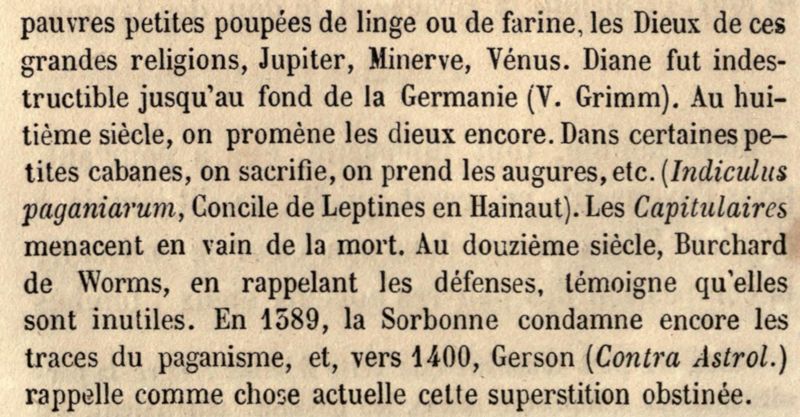
[p. 35] Nothing is more touching than this fidelity. In spite of persecution, in the fifth century, the peasants carried round, as [p. 36] poor little dolls of rag or flour, the gods of those great religions, Jupiter, Minerva, Venus. Diana was indestructible to the depths of Germany (see Grimm). In the eighth century they still carry the gods in procession. In certain little huts they sacrifice, take the auguries, and so on (Indiculus paganiarum, Council of Leptines in Hainault). The Capitularies threaten death in vain. In the twelfth century Burchard of Worms, repeating the prohibitions, testifies that they are useless. In 1389 the Sorbonne still condemns the traces of paganism, and about 1400 Gerson (Against the astrologers) mentions this obstinate superstition as a thing of the present.
Original French
[p. 35] Rien de plus touchant que cette fidélité. Malgré la persécution, au cinquième siècle, les paysans promenaient, en [p. 36] pauvres petites poupées de linge ou de farine, les Dieux de ces grandes religions, Jupiter, Minerve, Vénus. Diane fut indestructible jusqu’au fond de la Germanie (V. Grimm). Au huitième siècle, on promène les dieux encore. Dans certaines petites cabanes, on sacrifie, on prend les augures, etc. (Indiculus paganiarum, Concile de Leptines en Hainaut). Les Capitulaires menacent en vain de la mort. Au douzième siècle, Burchard de Worms, en rappelant les défenses, témoigne qu’elles sont inutiles. En 1389, la Sorbonne condamne encore les traces du paganisme, et, vers 1400, Gerson (Contra Astrol.) rappelle comme chose actuelle cette superstition obstinée.
Lecky’s ch. I note 36 (“Michelet, La Sorcière, p. 36, note”) supports his sentence that pagan rites “continued, after the nominal suppression of Paganism, for nearly eight centuries”: Michelet’s chain runs from the fifth century to Gerson about 1400. (The OCR of this scan reads the Sorbonne date as “1589”; the page image has 1389.)
“On brûle encore partout au dix-huitième siècle”
French: Paris 1862, p. 415 (scan n448; Lecky’s page), in the chapter on the trial of La Cadière (1730–31); also p. 371 of the 1863 Brussels edition (scan). Highlighted: the sentence Lecky’s note relies on.
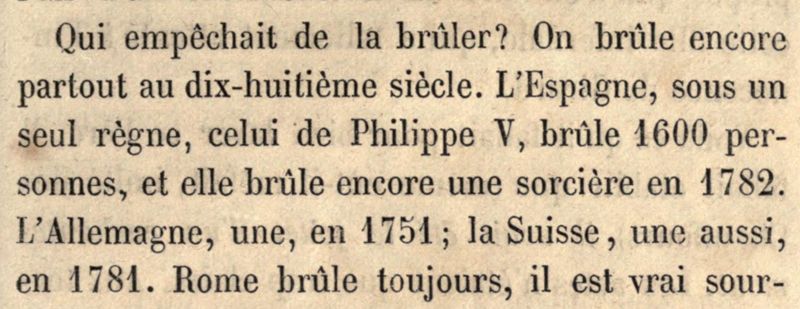
What prevented her from being burnt? They still burn everywhere in the eighteenth century. Spain, under a single reign, that of Philip V, burns 1600 persons, and she burns a witch again in 1782. Germany, one, in 1751; Switzerland, one also, in 1781. Rome burns still, it is true, covertly, in the ovens and cellars of the Inquisition¹.
¹ This detail is passed on to us by a consultor of the Holy Office who is still living.
Original French
Qui empêchait de la brûler ? On brûle encore partout au dix-huitième siècle. L’Espagne, sous un seul règne, celui de Philippe V, brûle 1600 personnes, et elle brûle encore une sorcière en 1782. L’Allemagne, une, en 1751 ; la Suisse, une aussi, en 1781. Rome brûle toujours, il est vrai sournoisement, dans les fours et les caves de l’Inquisition¹.
¹ Ce détail nous est transmis par un consulteur du Saint-Office encore vivant.
Lecky’s note: “The last judicial execution in Europe was, I believe, in Switzerland, in 1782 (Michelet’s Sorcière, p. 415), the last law on the subject, the Irish Statute, which was not repealed till 1821.” The Irish statute is not on this page. The figure “1600” under Philip V is Michelet’s; I have not checked it. For the Swiss case, historians’ usual date of the last European execution for witchcraft by a court is Anna Göldi in Glarus in 1782, which I give from memory and have not checked on a source here; Michelet’s “1781” for Switzerland is then his own date.
Editor’s notes on this page
Lecky says: “The last judicial execution in Europe was, I believe, in Switzerland, in 1782 (Michelet’s Sorcière, p. 415).” Michelet’s sentence is in the book, but it does not say that: it says that Spain “still burns a witch in 1782”, Germany one in 1751 and Switzerland one “also” in 1781. So Lecky’s “Switzerland, 1782” combines Michelet’s Swiss place with the Spanish year; in Michelet it is Spain, not Switzerland, that has the latest date. (Lecky hedges with “I believe”.) Michelet, in the same sentence, also says that Rome burned secretly in the cellars of the Inquisition, on the word of a consultor of the Holy Office, which is not an execution of record.
Further down the rabbit hole
Sources that Lecky cites in the notes next to the ones that cite this page.
- Madden, PhantasmataAn Irish doctor’s history of delusions, and the witch-burnings in an Alpine valley
- Garinet, Histoire de la Magie en FranceA history of magic in France, from the Frankish kings to the author’s own day
- Thiers, Traité des SuperstitionsThree papal bulls but no rebellion
- Maury, La magie et l’astrologieRoman laws against diviners, the first medieval doubters, and the praying heretics
- Bodin, Démonomanie des SorciersThe great lawyer who wrote the witch-hunters’ handbook
- Grillandus, De SortilegiisA judge on why sorcerers stay poor
Backlinks
Every place in Rationalism in Europe that links to this page (generated automatically when the site is built).