Orpheus as pagan type and Christian symbol (p. 138)
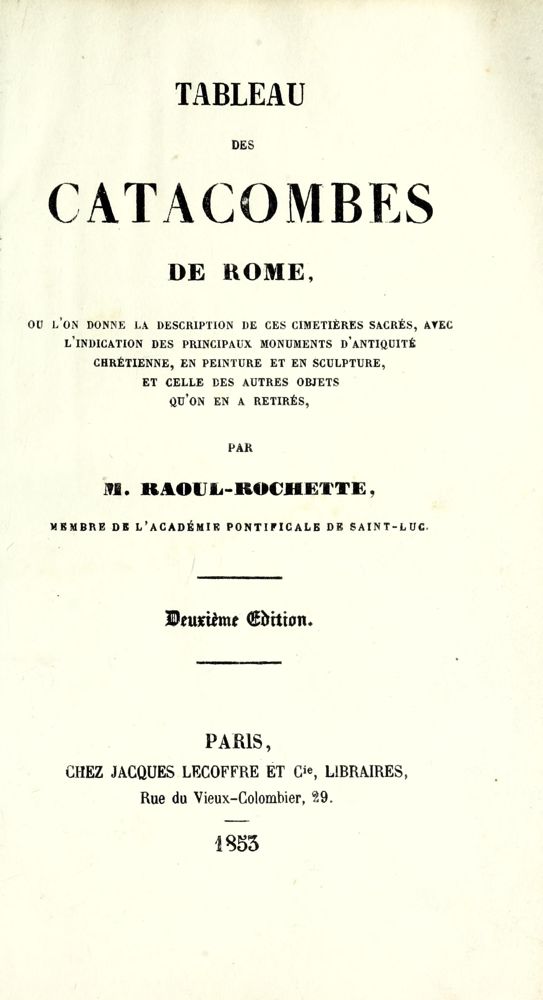
French: p. 138, scan.
… On both sides it is the same figure, seated, in the first flower of youth, the head covered with a tiara enriched with gold, with embroidered trousers; … his lyre, which he holds against his left side, still resounds under his fingers; but his eye, which seems fixed on some distant object, and his brow, which appears marked with deep meditation, show him wholly absorbed in the contemplation of divine things. Such is the Orpheus of the paintings described by Philostratus and Lucian, as he appears in our paintings of the catacombs; this Christian reminiscence of a profane type serves to teach us, by a decisive example, in what manner a crowd of pagan motifs and symbols could enter Christianity, by means of the models and traditions of ancient art, while receiving there a new application with a Christian sense.
Original French
… C’est, de part et d’autre, le même personnage, assis, dans la première fleur de la jeunesse, la tête couverte d’une tiare enrichie d’or, avec des anaxyrides brodées ; … sa lyre, qu’il soutient contre son flanc gauche, résonne encore sous ses doigts ; mais son œil, qui semble fixé sur quelque objet éloigné, et son front, qui paraît empreint d’une méditation profonde, le montrent entièrement absorbé dans la contemplation des choses divines. Tel l’Orphée des peintures décrites par Philostrate et par Lucien, se produit dans nos peintures des catacombes ; cette réminiscence chrétienne d’un type profane sert à nous apprendre, par un exemple décisif, de quelle manière une foule de motifs et de symboles païens avaient pu s’introduire, à l’aide des modèles et des traditions de l’art antique, au sein du christianisme, en même temps qu’ils y recevaient une application nouvelle avec un sens chrétien.
Editor’s notes on this page
Page 138 describes the Orpheus of the Christian paintings of the cemetery of St Callixtus as the same figure as the Orpheus of the profane paintings described by Philostratus the younger and by Lucian, and draws the lesson that pagan motifs entered Christian art through ancient models while receiving a new Christian meaning. It supports Lecky’s note that Orpheus appears as a Christian symbol; the claim that Eusebius made him a type of Christ is not on this page (see the Marangoni page).
Further down the rabbit hole
Sources that Lecky cites in the notes next to the ones that cite this page.
- Marangoni, Delle cose gentilesche e profaneOrpheus as Christ on p. 45; two other notes not there
- Augustine, De civitate DeiSeventy reports, not miracles, and a town, not a province
- Ciampini, Vetera monimentaThe saint’s halo: a sign of eternity, or a shield against pigeons?
- Didron, Iconographie chrétienneHow medieval art pictured Christ the Judge
- Agobard, Liber de imaginibusLecky’s five Agobard quotes checked against Baluze
- Aquinas, Summa theologiae, Supplement, q. 94Lecky’s quotation that is really a paraphrase
Backlinks
Every place in Rationalism in Europe that links to this page (generated automatically when the site is built).
- Chapter III: note 10