The Exorcists (pp. 85–87)
English: 1749 Dublin printing, pp. 85–87. Spelling and punctuation as printed, except that the long s is printed as s. The first extract is a note running along the foot of pp. 85–86. Highlighted: what Lecky’s note 3 summarises.
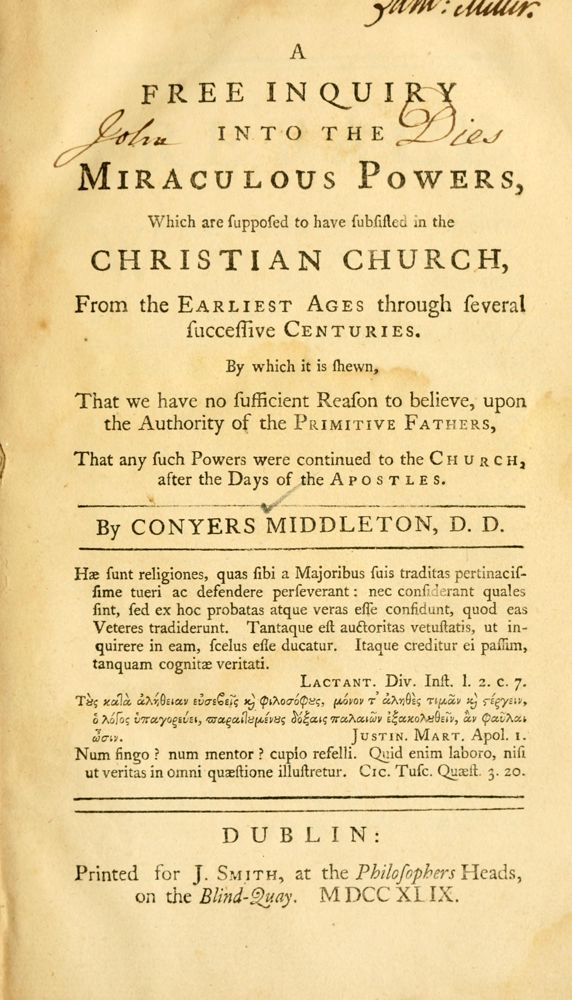
N. B. From what is here said by Origen, and the other Fathers, it appears; that the power of casting out Devils, was considered as a peculiar gift, or art rather, grounded on certain rules, which were taught and delivered in books; and was common both to the Jews and the Heathens, as well as to the Christians; and, among them all, was administered by a particular set of men, called Exorcists: who about the time of Origen’s death, or the middle of the third Century, began to be reckoned among the inferior orders of the Church: [Vid. Euseb. l. 6. c. 43.] The form of whose ordination is given us by the learned Bingham. [Antiq. lib. 3. c. 4. § 5.]
Now it will be granted, I suppose, by all men of sense, that these Jewish and Gentile Exorcists were mere Knaves and Impostors; who, by their tricks and false miracles, contrived to delude the credulous multitude, in order to acquire gain or power to themselves, and to keep their people firm to the Jewish or Heathenish rites, in opposition to the Christian. Ulpian the lawyer speaks of Exorcism in general, as a term of art used by Impostors: by whom he is supposed by some, to mean the Jewish, by others, Christian Exorcists. But Tertullian, and all the Fathers in general declare, that these Magicians and wandering Jugglers performed many wonderful things, above the force of human power, which they wholly ascribe to the assistance of Dæmons.
What leads up to it (pp. 84–85), and the Josephus story (p. 86)
The note stands at the end of a run of testimony that the Fathers allowed the same power over devils to Jews and Gentiles: Justin Martyr says that Jewish exorcists, like the Gentiles, use “this art in exorcising, together with certain fumes and ligatures”; Irenaeus says the Jews “even now, by this same invocation of the name of God, drive away devils”; and Origen, against Celsus, says that the names of Abraham, Isaac and Jacob are used by all “Inchantors and Magicians”, and appear in magical books “as peculiar to the art, and effectual against Devils” (pp. 84–85). On p. 86 Middleton quotes Josephus’s story of the Jewish exorcist Eleazar, who drew a devil out through a man’s nostrils with a ring in the presence of Vespasian. The passage on p. 87 draws the conclusion quoted above.
The Succession of Miracles (Preface, p. xv)
English: Preface, p. xv (scan). Spelling as printed. Highlighted: the sentence Lecky quotes in note 10. Middleton is answering a defender of the Fathers who had said the question of how long the miracles lasted was neither clear from history nor of any concern to us.
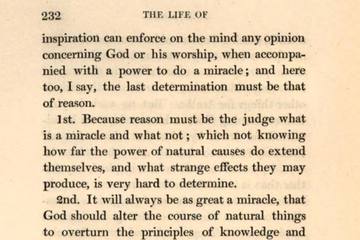
As to his first reason, I am at a loss to conceive, what farther light a professed Advocate of the primitive ages and Fathers can possibly require in this case. For as far as the Church-Historians can illustrate or throw light upon any thing, there is not a single point in all history, so constantly, explicitely and unanimously affirmed by them all, as the continual succession of these powers through all ages, from the earliest Father, who first mentions them, down to the time of the Reformation. Which same succession is still farther deduced, by persons of the most eminent character, for their probity, learning, and dignity in the Romish Church, to this very day. So that the onely doubt, which can remain with us, is; whether the Church-Historians are to be trusted or not.
“That Surprizing Confidence” (Introductory Discourse, p. lxxxiv)
English: Introductory Discourse, p. lxxxiv (scan). Spelling as printed. Highlighted: the sentence Lecky quotes in note 11, where he calls it the “Introductory Chapter”. The page number comes from the scan’s text layer; the heading is partly cropped in my view of the image, so treat “lxxxiv” as read from the OCR.
And first, when we reflect on that surprizing confidence and security, with which the principal Fathers of this fourth age have affirmed as true, what they themselves had either forged, or what they knew at least to be forged; it is natural to suspect, that so bold a defiance of sacred truth could not be acquired, or become general at once, but must have been carried gradually to that height, by custom and the example of former times, and a long experience of what the credulity and superstition of the multitude would bear.
“About Ninety Heresies” (Introductory Discourse, p. lxxxvi)
English: Introductory Discourse, p. lxxxvi, footnote [t] (scan). Spelling as printed, with the long s printed as s. Highlighted: the sentence behind Lecky’s Chapter IV, note 25. Middleton is arguing that the first centuries were no purer than later ones; the note hangs on the words “so many rank Heresies were publicly professed” in the text above it.
For there never was any period of time in all Ecclesiastical History, in which so many rank Heresies were publicly professed [t] nor in which so many spurious books were forged …
[t] The learned, I think, have reckoned about ninety Heresies, which all sprang up within the three first centuries.
Middleton gives no authority for the figure, and he hedges it himself (“The learned, I think, have reckoned”). The book’s index has an entry “Heresies: ninety different ones sprung up within the three first centuries” pointing to the same page. A small mark after “Heresies,” on the scan could be a stray reference mark; I have not been able to read it, and I did not find an authority anywhere on the page.
Lecky’s Quotations Compared
Lecky’s two quotations (Chapter II, pp. 167 and 169) agree with Middleton in sense and almost in wording. The differences are small, but one of them is not just spelling:
| Lecky, 1865 | Middleton, 1749 | |
|---|---|---|
| Preface, p. xv | “…there is not a single point in all history so constantly, explicitly, and unanimously affirmed by them all, as the continual succession of those powers…” | “…there is not a single point in all history, so constantly, explicitely and unanimously affirmed by them all, as the continual succession of these powers…” |
| Preface, p. xv: opening | “As far as the Church historians can illustrate or throw light upon anything…” | “…For as far as the Church-Historians can illustrate or throw light upon any thing…” (Lecky drops “For”, joins “any thing”, and removes the hyphen.) |
| Introductory Discourse, p. lxxxiv | “When we reflect,” he says, “on that surprising confidence and security with which the principal Fathers of this fourth century have affirmed as true…” | “And first, when we reflect on that surprizing confidence and security, with which the principal Fathers of this fourth age have affirmed as true…” |
| Introductory Discourse: rest | “…by custom and the example of former times, and a long experience of what the credulity and superstition of the multitude would bear.” | Same words (Lecky omits the commas after “height” and “confidence”). |
| Ch. IV, note 25 (Introd. p. lxxxvi) | Text, ch. IV: “It is computed that there were about ninety heresies in three centuries.” Note 25: “Middleton’s Free Enquiry, Introd. p. 86.” | “The learned, I think, have reckoned about ninety Heresies, which all sprang up within the three first centuries.” |
Lecky’s sentence in ch. IV is a paraphrase: “computed” for “reckoned”, “three centuries” for “the three first centuries”, and the figure is stated flatly where Middleton writes “I think”. The page reference is right (p. lxxxvi).
The only change that touches meaning is “those powers” for “these powers”, which turns Middleton’s “these” (the miraculous powers he has been discussing) into a distant “those”. “Fourth century” for “fourth age” is a fair gloss, since Middleton means the century of Athanasius and Jerome. His note-11 reference to the “Introductory Chapter” is a loose name: the book calls it the Introductory Discourse.
Note 3
Lecky’s note 3 says there were exorcists among Christians, pagans and Jews, that “they were not regularly formed into an order till the middle of the third century”, and that they “seem to have practised from almost the beginning”, and refers to Middleton, pp. 85–87. The first two statements are Middleton’s own words in the note above. “From almost the beginning” is Lecky’s inference, and is consistent with the second-century testimony of Justin Martyr and Irenaeus that precedes it on pp. 84–85; Middleton does not put it in those terms in the pages I read. Lecky’s “Bingham, Antiquities of the Christian Church, book iii. c. 4” is the same reference Middleton gives (“Antiq. lib. 3. c. 4. § 5”), so Lecky has taken it from him.
Editor’s notes on this page
Middleton’s 1749 book argued that the miracles the Fathers describe cannot be trusted. Lecky draws on it in Chapter II in three places. The Preface supplies the sentence he quotes about the unanimous testimony of Church historians; the Introductory Discourse supplies the sentence about the Fathers’ “surprizing confidence”; and the discussion of demoniacs supplies, in a note, the evidence that Jewish, pagan and Christian exorcists were all at work.
Lecky’s two quotations are accurate in substance but not word for word. He modernises the spelling, changes “these powers” to “those powers”, and changes “this fourth age” to “this fourth century”. See the comparison below.
Further down the rabbit hole
Sources that Lecky cites in the notes next to the ones that cite this page.
- Palmer, A Treatise on the Church of Christ“Whosoever is separated from the Catholic Church … will not have life”
- Maury, Essai sur les légendes pieuses du moyen âgeThe stag that sucks serpents out of their holes, and the angel who carried the star of Bethlehem
- Locke, A Third Letter for TolerationLecky quotes Locke correctly on miracles after Constantine
- Locke’s Commonplace Book on Inspiration and MiraclesHume’s argument against miracles, seventy years before Hume
- Muzzarelli, Dell’InquisizioneWhen God stopped striking heretics dead, the Inquisition had to do it
- Brewster, Memoirs of the Life, Writings, and Discoveries of Sir Isaac NewtonLecky’s Newton quote and the missing last sentence
Backlinks
Every place in Rationalism in Europe that links to this page (generated automatically when the site is built).